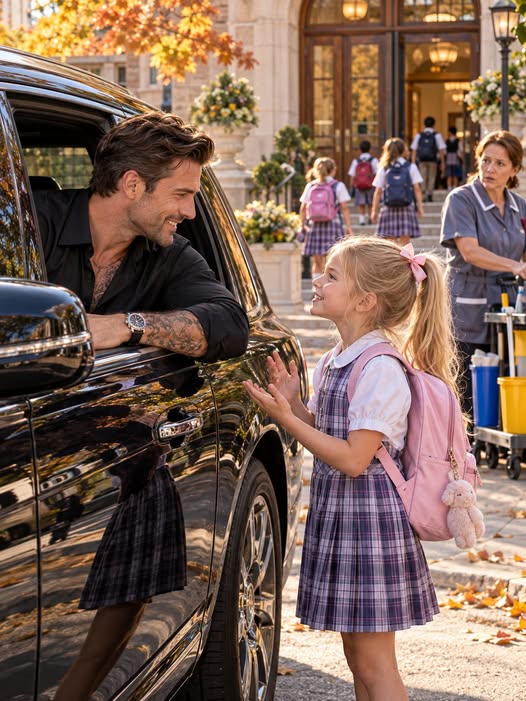
I knew that laugh.
That was the problem.
My name is Sofia Moretti, and I was seven years old that October.
Three years earlier, my mother had died.
Before that, our house had sounded different.
My father still had men outside the gates. He still took calls in rooms I was not allowed to enter. Adults still went quiet when he walked into restaurants.
But when my mother was alive, the silence never followed him all the way home.
She would stand in the kitchen barefoot, steal olives from whatever the cook was making, and say things specifically designed to irritate him.
He would pretend not to be amused.
Then he would laugh.
That laugh.
The one Zoe had just pulled out of him with a joke about a math book.
I had not heard it since my mother’s funeral.
Not once.
So when it happened on the sidewalk outside St. Catherine’s, I did not laugh with him.
I started crying.
Nobody noticed at first.
Everyone was staring at Dominic Moretti.
The feared man.
The dangerous man.
The man who apparently could be defeated by elementary-school humor.
Zoe grinned so proudly that I thought her face might split.
“I know another one.”
My father wiped at the corner of one eye.
“That seems dangerous.”
“Why did the bicycle fall over?”
He shook his head.
“Why?”
“Because it was two-tired!”
He laughed again.
Not as hard.
Enough.
The sound broke something open inside me.
I turned away.
My pink backpack hit the ground.
Then I ran.
“Sofia.”
My father’s voice changed instantly.
I heard the car door open behind me.
I got maybe twelve steps.
His cane hit the pavement faster than usual.
“Sofia.”
I stopped because even grief had rules.
He caught up.
For one second, neither of us spoke.
Then he crouched.
My father hated crouching in public.
His left knee had never healed correctly after an injury nobody explained to me.
That day he did it anyway.
“What happened?”
I stared at him.
“You laughed.”
Confusion crossed his face.
“Yes.”
“You don’t laugh.”
His eyes changed.
Children are cruel without meaning to be.
Adults build entire systems to avoid saying things directly.
Children simply hand you the sentence.
“You used to,” I said.
My voice broke.
“When Mommy was here.”
The sidewalk disappeared from his face.
Not literally.
But the world around us stopped mattering.
He looked past me toward the car.
Toward Zoe.
Toward nothing.
Then back.
“Sofia.”
“I forgot what it sounded like.”
That was when my father stopped pretending.
His mouth tightened.
He looked down.
For three years, everyone had protected me from his grief.
Or maybe they protected him from mine.
I had been told Daddy was tired.
Daddy had business.
Daddy needed quiet.
Daddy was working.
Nobody said:
Your father loved your mother so much that losing her made him afraid of joy.
I understood that later.
At seven, I only knew he had laughed for Zoe.
And not for me.
That hurt.
I hated myself for it almost immediately.
Zoe had done nothing wrong.
She was standing beside the sedan now with both hands gripping the straps of her broken backpack.
The guard who had grabbed her shoulder looked deeply uncomfortable.
My father noticed.
He stood.
Then his eyes went to the guard.
“What did you do?”
The man stiffened.
“Sir?”
“You put your hand on her.”
“She approached the vehicle.”
“She is five.”
“She could have been carrying—”
My father raised one hand.
The guard stopped talking.
Dominic looked at Zoe.
“Did he hurt you?”
She rubbed her shoulder.
“No.”
The guard exhaled.
“But he squeezed hard.”
The exhale disappeared.
My father’s voice went quiet.
“Children are not security threats because they are poor.”
The guard lowered his head.
“Yes, sir.”
“You move between the child and the car. You call her parent. You do not put adult force on a five-year-old unless somebody is in immediate danger.”
“Yes, sir.”
My father looked at the backpack.
Gray tape.
Split seams.
Then at me.
“Is she in your class?”
I nodded.
Zoe answered for herself.
“I sit behind Sofia because she has nice handwriting.”
My father looked at me.
“You have terrible handwriting.”
“I know.”
Zoe shrugged.
“It’s nicer than mine.”
That nearly made him smile again.
Then a woman came running down the school steps.
“Zoe!”
Zoe’s face changed completely.
“Mom.”
The woman looked about thirty.
Maybe younger.
Exhaustion makes age difficult to guess.
She wore navy scrubs beneath an old coat and had one shoe half untied.
She grabbed Zoe and pulled her close.
“What were you thinking?”
“I told him a joke.”
“I see that.”
“You said sad people need people.”
The woman closed her eyes.
Something in that sentence made my father look away.
“I’m Rachel Turner.”





