Outside the hospital elevator, my brother laughed as I stumbled against the wall. “Relax, it was just a prank.” Mom told the nurse I was exaggerating. Two days later, security played the elevator footage for my parents. Dad watched my brother reach into his pocket—and asked them to pause.
“She’s being dramatic about a simple prank,” my brother laughed while I lay on the hospital floor, struggling to breathe.
My mother stood beside him, telling a nurse that I had always been overly sensitive.
What neither of them understood was that my throat was closing.
My name is Emily Parker. I was thirty-one that night, and we’d just finished visiting my grandfather at a hospital in Columbus, Ohio.
My brother, Jason, had brought homemade chocolate brownies for everyone. He handed me one outside the third-floor elevators.
“Relax,” he said when I hesitated. “They’re peanut-free. I checked.”
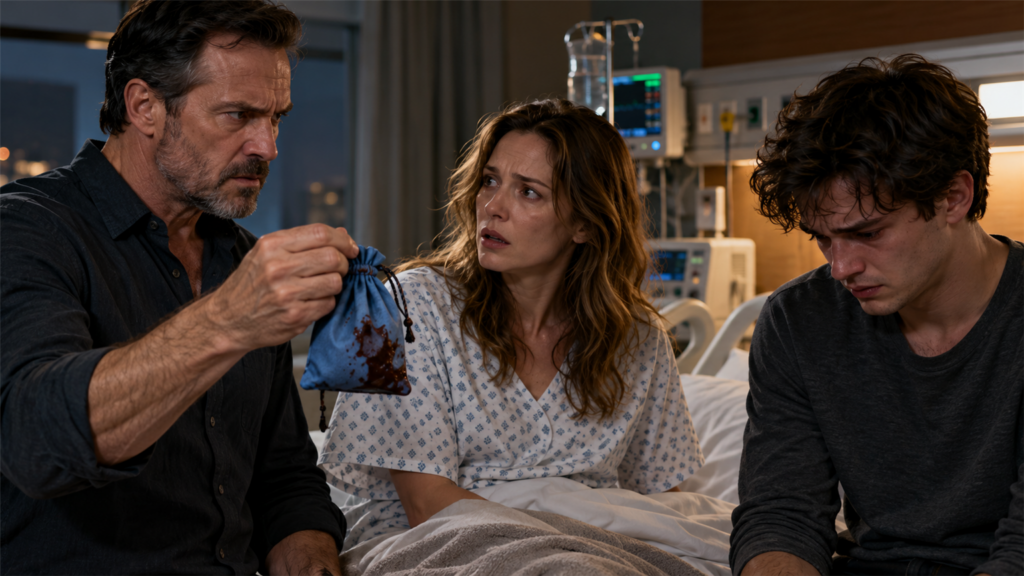
I’ve had a severe peanut allergy since childhood. At eight, I spent four days in the hospital after an accidental exposure. Grandma Ruth subsequently sewed me a small blue pouch for my prescribed epinephrine auto-injectors, with my initials stitched crookedly in white thread.
I still carried that pouch everywhere.
Jason knew why.
I’d barely finished the brownie when my lips began tingling. Then came the tightness in my throat and a frightening pressure across my chest.
“Jason,” I whispered. “What’s in this?”
He grinned.
“You should see your face.”
I reached for my purse.
The blue pouch wasn’t there.
I checked again, pushing aside my wallet and keys while my fingers began trembling.
“Where’s my medication?”
Jason laughed harder.
“Seriously, Em? Can’t you take one joke?”
My knees buckled.
I remember the elevator doors opening, someone shouting for help, and the cold floor against my cheek.
A nurse from the nearby unit rushed toward us.
“Possible anaphylaxis!” she shouted.
My mother grabbed her arm.
“She does this whenever she’s upset. Please don’t make a scene.”
The nurse ignored her and called for the emergency response team.
I was treated immediately and transferred to the emergency department for further care. Later, a physician told me that delaying treatment could have cost me my life.
When I woke, my father sat beside my bed, holding my hand.
His thumb kept moving across my knuckles the way it had when I was little.
“Jason said you had some kind of panic attack,” he whispered.
I swallowed against the soreness in my throat.
“He took my medication.”
Dad’s expression changed.
“What?”
Before I could answer, Mom stepped through the doorway carrying my blue pouch.
“Look what we found in Jason’s jacket,” she said brightly. “See? Nothing happened.”
I looked at the pouch.
The little white stitching was stained with something dark.
And suddenly, I remembered Jason reaching into my purse before he’d given me the brownie.
The next morning, my mother brought me a clean sweatshirt and asked whether I’d be home in time for Sunday dinner.
I was still connected to an IV.
“Emily, your brother feels terrible,” she said, folding the sweatshirt across the visitor’s chair. “He didn’t think you’d actually get sick.”
I looked at her.
“He knew I could die.”
“Don’t exaggerate.”
My father was standing near the window. He hadn’t spoken since learning about the missing medication.
“Linda,” he said quietly, “the doctor called it anaphylaxis.”
Mom turned toward him.
“And she’s recovering. Must we make this a tragedy?”
I noticed Dad’s hands closing into fists at his sides.
That afternoon, hospital security contacted me. They were reviewing an incident report because medication had been deliberately removed from a patient’s belongings shortly before a medical emergency.
A hospital administrator explained that relevant footage would be preserved for investigators.
I’d already told the responding officer what Jason had said. I agreed to cooperate fully.
Mom found out when the officer called me.
She came back to my room with Jason.
My brother looked freshly showered. He wore the same expensive watch Dad had given him for his birthday.
“Emily,” he began, “can we please talk like adults?”
I waited.
“It was supposed to scare you for a second. I didn’t think you’d react like that.”
“Why would you want to scare me?”
He looked toward Mom.
She answered instead.
“You embarrassed him at Grandpa’s birthday last month. You told everyone he shouldn’t borrow money he couldn’t repay.”
Jason crossed his arms.
“You made me look pathetic.”
I stared at him.
I’d lent him $4,000 the previous winter after he lost his job. When he asked for another $2,000, I told him privately that I couldn’t keep paying his bills. He’d shouted about it at Grandpa’s party, and I’d refused to argue.
Now he was calling a life-threatening allergic reaction revenge for a financial disagreement.
“Did you know what was in the brownie?” I asked.





