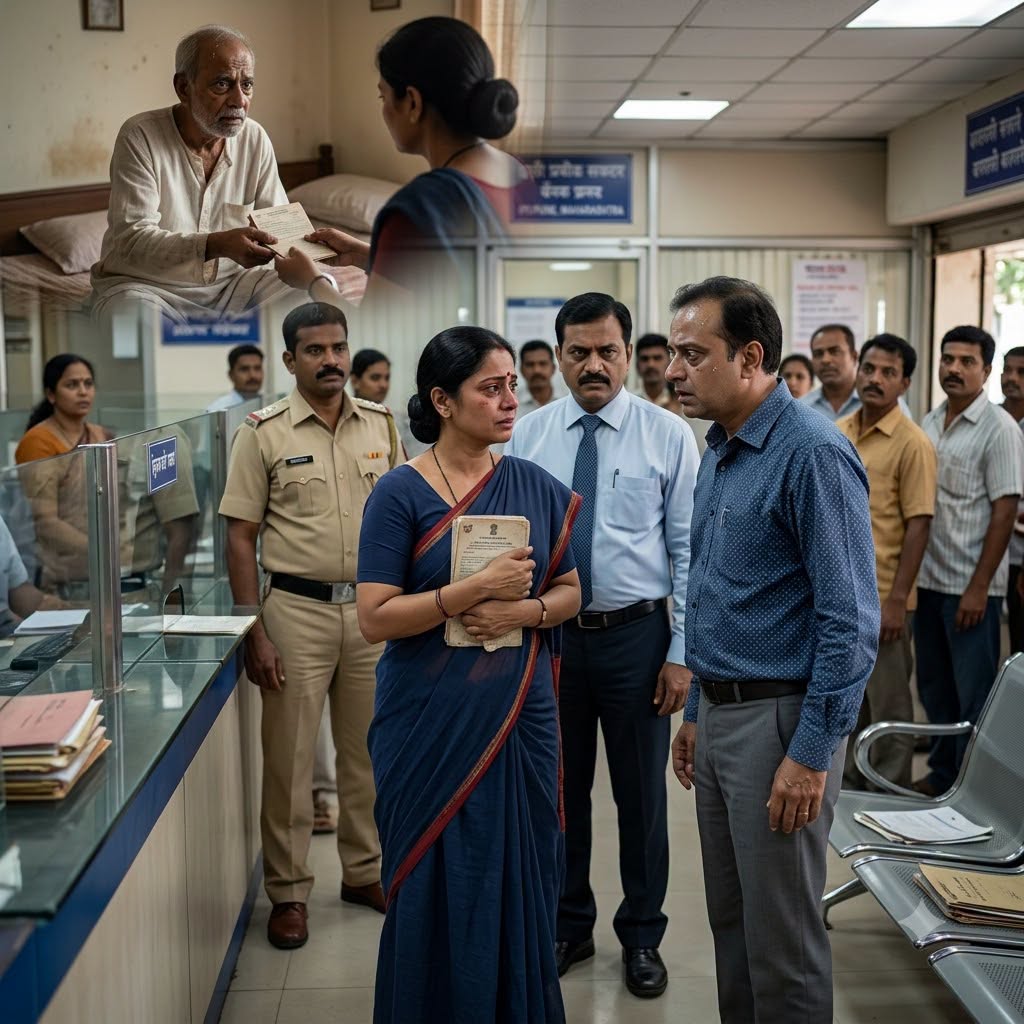
“…the house.”
I stared at Amma’s sentence until the words blurred.
**If Harivansh ever remembers who actually owns the house, then Nandkumar will lose not only the pension money, but also the house.**
I looked at Pitaji.
Then at my brother.
“What does that mean?”
Nandkumar moved toward the door.
The police officer blocked him.
“I need air.”
“You can have air after we finish,” the officer said.
I unfolded the declaration.
The address was ours.
The house where I had grown up.
The courtyard where Amma dried chillies every summer.
The bedroom where Pitaji now slept with a bell beside him because dementia sometimes made him forget where the bathroom was.
But under **Beneficial Owner**, Pitaji’s name did not appear.
Mine did.
I read it twice.
Then a third time.
“I own the house?”
Pitaji began crying.
Nandkumar shouted, “No!”
Everyone turned.
“That document means nothing.”
Bhaskar saab examined the declaration.
“It is notarised.”
“It’s old.”
“So?”
“My mother was sick.”
I looked at him.
“Amma was not sick when this was signed.”
He went silent.
I remembered the date.
Seven years earlier.
Long before cancer entered our house.
Bhaskar saab continued reading.
“The property was purchased using funds inherited by your mother.”
I stopped breathing.
“Amma bought the house?”
Pitaji nodded.
Memory flickered behind his eyes.
“Her father’s money.”
My mother had inherited money from my grandfather.
I knew that.
What I didn’t know was that she had used it to buy the family home.
“But why was Pitaji’s name on everything?”
“Convenience,” Bhaskar saab said. “Possibly because your mother did not want family conflict.”
Pitaji whispered, “Her brothers were angry.”
Then another memory came.
“People said house should be in husband’s name.”
Of course.
My mother had paid for the house.
My father had become the registered owner.
Everyone called it his property.
Then years later, when Amma discovered Nandkumar stealing from him, she created the declaration establishing that the beneficial ownership belonged to me.
“Why me?”
Pitaji looked at me.
“Your mother trusted you.”
My throat tightened.
Nandkumar laughed bitterly.
“There. That’s the whole story. She always trusted Ishwari more.”
I turned toward him.
“This is about jealousy?”
“You left!”
“What?”
“You got married and left. I stayed.”
His voice grew louder.
“I took Pitaji to appointments. I handled the bills. I dealt with everything.”
“And stole from him.”
“I used money that would eventually come to me anyway!”
Pitaji flinched.
I stared at my brother.
There it was.
The truth beneath every forged signature.
He had not thought of it as stealing.
He had thought of it as collecting his inheritance early.
“The ₹18 lakh?”
“I had debts.”
“What debts?”
He said nothing.
The officer asked again.
“What debts?”
Finally, Nandkumar whispered, “Property.”
I remembered the unfamiliar address in Amma’s letter.
“What property?”
He closed his eyes.
“A development outside Nashik.”
“You invested Pitaji’s money?”
“It was supposed to triple.”
“Did it?”
“No.”
The project had collapsed.
The developer disappeared.
Nandkumar borrowed more money trying to recover the first loss.
Then borrowed again.
Private lenders.
Interest.
Threats.
By the time Amma discovered what he had done, he owed nearly forty lakh rupees.
My stomach turned.
“So the pension wasn’t for you.”
“No.”
“It was for your lenders.”
He nodded.
“And now they want this house.”
His face collapsed.
“Yes.”
That explained everything.
The forged valuation.
The photocopied Aadhaar card.
My signature.
The bank papers.
Nandkumar had been preparing to mortgage a house he did not legally own to repay debts he had hidden for years.
I felt furious.
Then I looked at him properly.
My brother looked old.
Not innocent.
Not misunderstood.
Just destroyed by years of choices he had refused to stop making.
“Why didn’t you tell me?”
He laughed.
“What would you have done?”
“Helped.”
“You?”
“Yes!”
“With what money?”
“With whatever I could.”
“And then you would know I failed.”
The sentence surprised me.
Not because it excused anything.
Because suddenly I understood the first lie.
It had not begun with greed.
It had begun with shame.
But shame had become deception.
Deception became theft.
Theft became forgery.
And eventually my brother had become willing to put our confused father’s home at risk just to keep everyone from seeing the man he had become.
The police took the documents.
They took statements.
They questioned Nandkumar for hours.
That night, I brought Pitaji home with me.
He kept asking where Amma was.
Each time, I told him gently that she had died.
Each time, he grieved as though hearing it for the first time.
Around three in the morning, I stopped telling him.
When he asked, “Where is your mother?”
I said, “She’s not here, Pitaji.”
That was enough.
He fell asleep holding my hand.
I sat beside him until sunrise.





