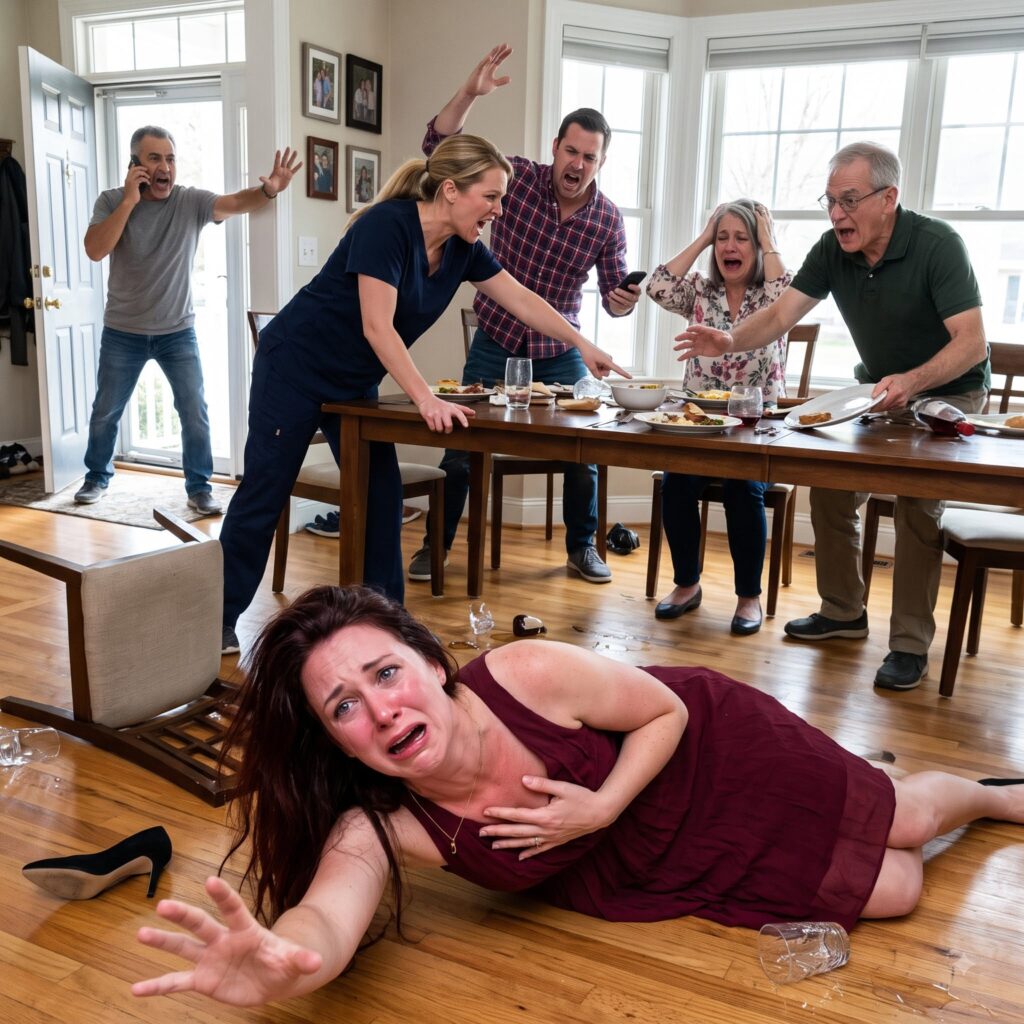
“You’re fine, stop being dramatic,” my brother said as I clutched my chest and tried to breathe.
We were at Sunday dinner at my parents’ house in Columbus, Ohio. I reached for my water—and my right arm dropped like it belonged to someone else.
“Something’s wrong,” I said. At least, I tried to. The words came out thick and broken.
My mother glanced at my sister-in-law, Jessica.
Jessica was a registered nurse.
She looked at my face, looked at my useless arm, and went back to cutting her chicken.
“She did this at Ryan’s birthday too,” she said. “It’s a panic attack. Don’t feed into it.”
“I can’t… feel…”
Ryan laughed, nervous at first. “Megan, come on. You’re scaring Mom.”
My fork hit the plate. My mouth pulled to one side—half my face was sliding down.
“Call 911,” I whispered.
“No,” Jessica said sharply. “She was in my ER this morning with the same performance. Anxiety. If we call every time she wants attention, she’ll never stop.”
Dad kept eating. Mom folded her napkin. Nobody reached for a phone.
I slid out of my chair.
The room tilted. My knee cracked against the hardwood, and my cheek followed. From the floor, I could see shoes, chair legs, and my mother’s hand—still holding her fork.
“Get up,” Ryan said. “You’re embarrassing yourself.”
I tried to scream. Only air came out.
Then someone pounded on the front door.
Our neighbor, Mr. Delgado, heard the crash through the open window. He took one look through the screen, pulled out his phone, and shouted:
“I don’t care what they told you—I’m calling 911 right now!”
Sirens. Hands. A paramedic’s face above mine: “Megan, stay with me.”
At the hospital, a doctor used one word that silenced the room.
“Stroke.”
But when the administrator walked in holding a tablet, Jessica’s face changed—because the security footage from that morning was about to prove this wasn’t the first time she had seen my emergency and walked away.
The administrator, Ms. Grant, turned the tablet so my parents could see it.
On the screen was me—nine hours earlier, in the emergency room where Jessica worked.
I walked in clutching my right arm. My mouth was already pulling to one side.
Jessica looked up from triage. She was family, so I had gone straight to her window, relieved.
The footage had no sound, but none of us needed it.
She pointed me back to the waiting room. No blood pressure cuff. No doctor. No stroke scale. Just Jessica typing for less than a minute and waving me away like I was wasting her shift.
Ms. Grant paused the video.
“The chart says, ‘Patient denies weakness. Speech clear. Likely anxiety,’” she said. “That is not what this footage shows. A registered nurse ignored a clear medical emergency.”
Mom covered her mouth. “Jessica… you saw her like that this morning?”
“She exaggerates when she’s stressed! You all know that!”
“She was trying not to be wrong,” Dad said quietly.
In surgery, doctors pulled a massive clot from my brain. The surgeon said Mr. Delgado’s call had saved my life—but barely. The delay at dinner cost twenty-seven minutes. The delay that morning cost hours. I might never speak clearly, walk without help, or use my right hand again.
Mom sobbed. “We kept eating while she was on the floor.”
Jessica backed toward the door. “I didn’t cause her stroke.”
“No,” Ms. Grant said. “But there is something else.”
She opened my electronic chart, with an audit trail only administrators could see.
At 11:42 that night—while I was in surgery—someone using Jessica’s login added three words to her morning note:
“Patient refused testing.”
I had never refused anything. I had begged for help.
Ryan stared at his wife. “Jess, where were you at 11:42?”
“I was getting coffee,” she whispered.
Ms. Grant’s phone buzzed. “Security checked the hallway cameras. She was at an empty nurses’ computer on this floor. And Ryan—your home security app just sent a motion alert.”
On Ryan’s phone, they watched Jessica at dinner: kneeling beside me for four seconds, checking my drooping face, touching my weak arm, looking at her watch.
Then standing up and telling everyone, “She’s faking it.”
She hadn’t missed the stroke. She had recognized it—and chosen to let the clock run.
Two hours later, I woke in the ICU to a dark room, a tube in my throat, and my right side completely dead.
The door eased open.
Jessica stepped inside in clean scrubs, wearing her hospital badge—after security had already taken it.
She looked at my monitor. Then at my call button.
And reached for the cord.
I couldn’t scream.
I couldn’t move my right hand. I couldn’t even turn my head far enough to see the door clearly.
But my heart monitor could scream for me.





