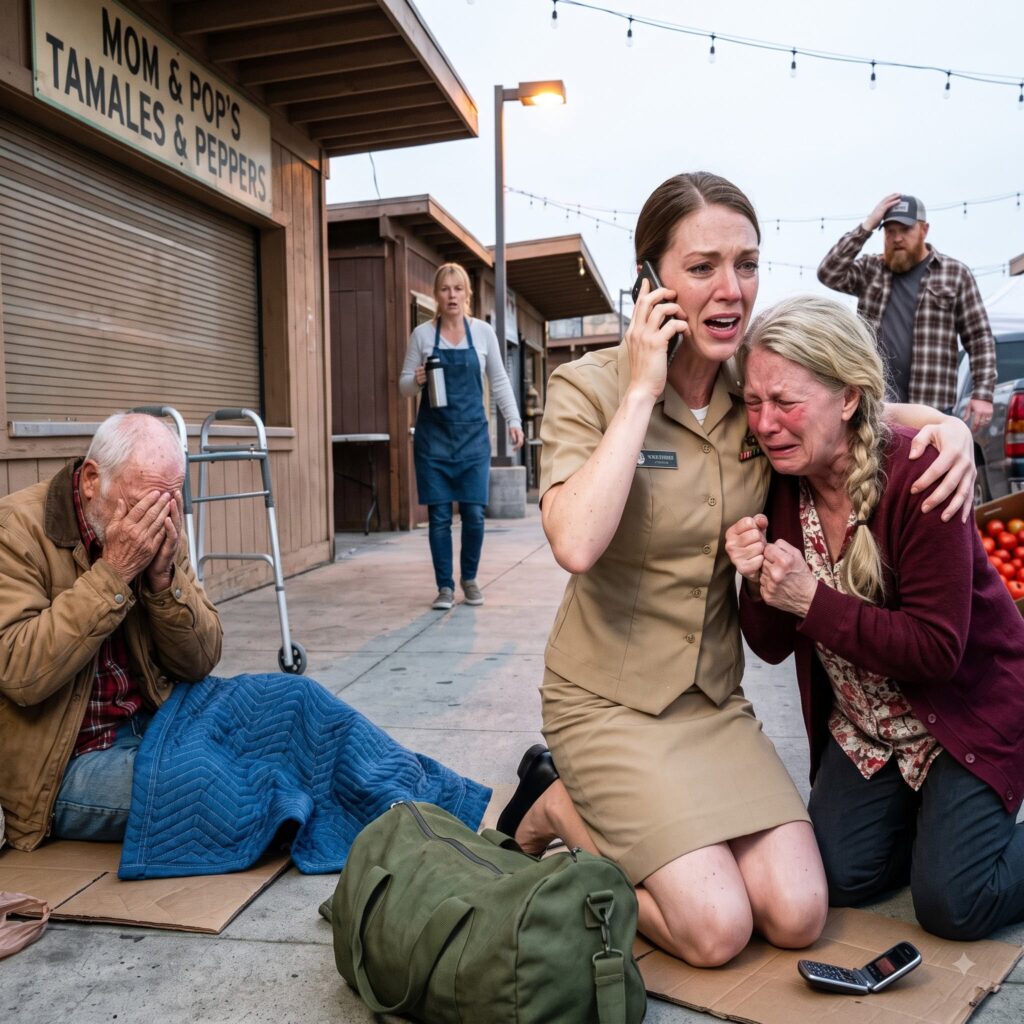
It was 5:40 in the morning when I found my parents sleeping on a piece of cardboard.
They were curled up in front of their old stall at the Tower District Farmers Market in Fresno, the same stall where my mother sold tamales and my father sold peppers for thirty years. The stall was empty now. The awning was gone, and a padlock hung on the metal gate.
My mother’s head rested on a rolled-up sweater. My father, seventy-one years old and still weak from last year’s stroke, lay shivering under a moving blanket.
I dropped my duffel bag on the pavement.
I’d just come home from eight months at sea as a nurse on a Navy hospital ship. I was back a week early, and I’d driven straight from San Diego to surprise them.
“Mamá?”
My mother opened her eyes. For a second, she didn’t recognize me in my uniform. Then she covered her mouth and started to cry.
“Elena. Mija. You’re home.”
I knelt on the concrete and grabbed her cold hands. “What are you doing here? Where is the house I bought for you?”
Two years ago, I’d emptied my savings to buy them a small blue house on Maple Avenue, with a lemon tree and a ramp for Dad’s walker. It was the proudest day of my life.
My mother’s voice broke. “Your husband and his family kicked us out. Six weeks ago. They changed the locks.”
The world went silent.
“Derek?” I whispered. “Mamá, why didn’t you call me? Why didn’t you tell anyone?”
My father slowly sat up and looked at me with an expression I’ll never forget. It wasn’t anger. It was hurt.
“We did call, mija,” he said quietly. “And you told us to go.”
My mother reached into her coat with shaking hands and pulled out her old flip phone. She opened it and turned the screen toward me.
It was a text message from my number, sent while I was on a ship in the middle of the Pacific Ocean.
I read the first line, and my blood turned to ice.
I thought the worst thing I would see that morning was my parents sleeping on the street. I was wrong. That text was only the beginning of what my husband had done while I was gone. Within twenty-four hours, I would be fighting for my father’s life and my family’s home at the same time.
Mamá, I’m so sorry. Derek’s mom lost her apartment and they need the house. Please move out by Friday. Don’t call me. I can’t talk about this. I’m too ashamed.
It was signed Love, Elena.
I never wrote it.
Then I remembered. Navy ships at sea don’t allow personal cell phones on the network. I’d left my iPhone at home in San Diego with Derek, the man who knew my passcode, while I used ship email for eight months.
“I didn’t send this,” I said, my voice shaking. “Mamá, I swear to God, I didn’t send this.”
My mother began sobbing harder, not from sadness this time, but from relief. “I knew it. I knew my daughter would never…”
My father turned his face away, but I saw the tears.
They had believed I’d abandoned them. They were too proud to beg, too afraid to call the police on their own son-in-law, and they had nowhere else to go. So for six weeks, they slept in front of the only place that still felt like theirs.
I put them in my car, cranked up the heat, and asked one question.
“Papá, where are your blood thinners?”
He hesitated. “In the house. In the kitchen cabinet.”
My nurse brain went cold. A stroke survivor without his blood thinner for six weeks was a time bomb.
I got them a room at a Best Western, bought them breakfast, and drove straight to Maple Avenue.
The lemon tree was still there. So were my mother’s wind chimes. But Derek’s mother, Gloria, opened the front door wearing my mother’s bathrobe.
Behind her, Derek’s brother Travis was sprawled on my parents’ couch watching TV. My mother’s picture of the Virgin of Guadalupe had been taken down. Their family photos were in a trash bag by the door.
“Elena!” Gloria smiled thinly. “You’re early.”
“Get out of my parents’ house.”
“Your parents’ house?” She laughed. “Derek said you agreed. He said it was decided.”
A black Silverado pulled into the driveway. Derek climbed out. Gloria had obviously called him the moment she saw me.
“Babe,” he said, raising his hands. “Let’s not do this on the lawn.”
“You used my phone. You pretended to be me. You put my seventy-one-year-old father on the STREET.”
His face hardened. “My mother got evicted. Your parents had a free house. I made a decision as your husband.” Then he smirked. “And good luck proving I sent anything.”





