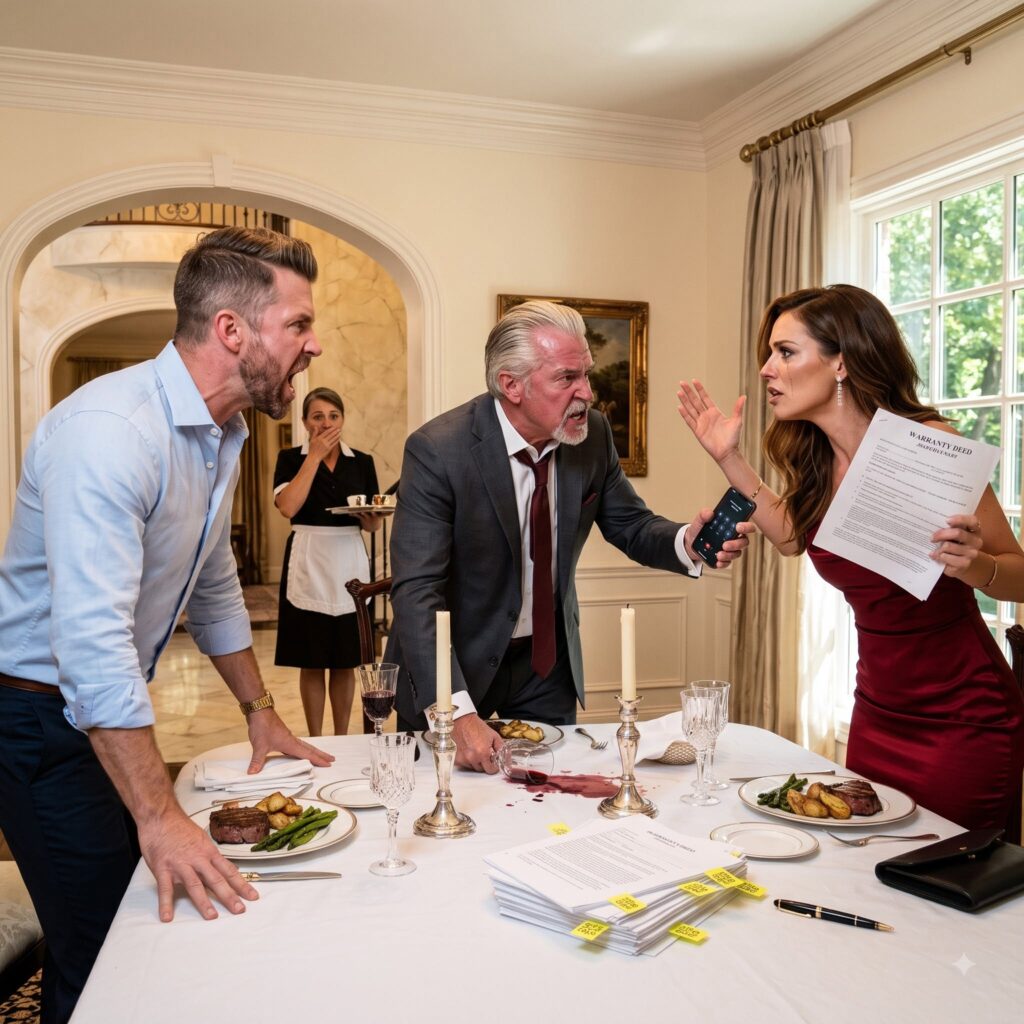
My husband cut into his ribeye, chewed slowly, and said it like he was reading a grocery list.
“I filed for divorce. You have forty-eight hours to get out of my house.”
The dining room went still, and the candles flickered. Across the table, his father, Richard Whitmore, took a long sip of his cabernet.
“Don’t fight it, Hannah,” Richard said. “You’ve gotten enough from this family.”
Enough. That was nine years of marriage and nine years of Sunday dinners in this River Oaks dining room, where Richard called me “the counselor” like it was a punchline. Nine years of hosting his clients, smiling at his jokes, and being told I’d “married up.”
Grant slid a thick stack of papers across the tablecloth, already tabbed with little yellow sign-here flags. “My lawyer drew it up. It’s a waiver of service. Saves us both the hassle. Sign it and be out by Sunday night.”
He held out a pen. It was a Montblanc, his father’s.
I didn’t cry, and I didn’t argue.
I took the pen, flipped to each yellow flag, and signed my name. Hannah Price Whitmore. Three times.
Richard smiled into his glass. Grant actually looked relieved and picked his fork back up.
I set the pen down, folded my hands, and looked at both of them.
“Did your lawyer forget to tell you?”
Grant frowned. “Tell me what?”
“That this house isn’t yours, Grant,” I said softly. “It’s mine. It has been for almost seven years.”
Grant laughed. “Nice try.”
But his father wasn’t laughing.
Richard’s wine glass had stopped halfway to the table. The color drained out of his face like a man watching a car slide toward him on ice.
I reached into my purse, took out a single folded page, and laid it beside Grant’s plate. It was a deed, recorded in Harris County in 2019.
Grantor: Richard A. Whitmore.
Grantee: Hannah Price Whitmore.
Grant read it twice. Then he turned slowly toward his father.
“Dad,” he said. “What the hell is this?”
Neither of them touched their dinner again.
They thought I was the quiet wife who would pack her bags and disappear without a fight. They never imagined I’d spent three months preparing for this exact dinner, or that the deed on the table was only the first secret I was about to drag into the light. One of them had lied under oath, and someone had been listening the whole time.
Richard set his glass down very carefully.
“It was paperwork,” he said. “A formality. She signed it without reading it, same as she just did.”
“I read it,” I said. “You told me it was estate planning, to save the family on taxes. You even filed a gift tax return with the IRS. My attorney pulled a copy.”
Grant stared at his father. “You gave her the house? You told me this place was in the family trust!”
“Because I couldn’t have it in my name!” Richard snapped. Then he caught himself.
Silence.
“Why not, Richard?” I asked quietly. “Go ahead. Tell your son why.”
He didn’t, so I did.
In the spring of 2019, forty families in a Whitmore Homes subdivision called Cypress Creek sued the company. Their foundations were cracking, and doors wouldn’t close. One little girl’s bedroom floor split open down the middle. Experts said Whitmore had cut corners on the slabs.
During the lawsuit, Richard gave a sworn deposition. He testified that, apart from the company’s insurance, he had no significant personal assets and no real estate. The families believed him and settled for a fraction of what their repairs would cost.
Two weeks before that deposition, Richard had deeded his two-and-a-half-million-dollar River Oaks house to his daughter-in-law as a gift.
“And here’s what your lawyer definitely didn’t tell you,” I said to Grant. “In Texas, a gift to one spouse is that spouse’s separate property. It isn’t split in a divorce. This house was never yours to kick me out of.”
Grant went white.
Then the rest clicked for me too: the sudden divorce, the forty-eight hours, the rush.
“Why now, Richard? Why after seven years?”
“Because the company is finished,” Richard said flatly. “The bank called my personal guarantee. Eleven million dollars. This house is the last thing left.” He leaned toward me. “Grant divorces you. You take a nice little settlement and sign a quitclaim deed back to me. That was the plan, and it’s still the plan.”
“And Kayleigh?” I asked.
Grant’s fork clattered onto his plate.
“Your father’s assistant,” I said. “The one you’ve been texting since March. Was the plan going to buy her the pool house too?”
He couldn’t look at me.





