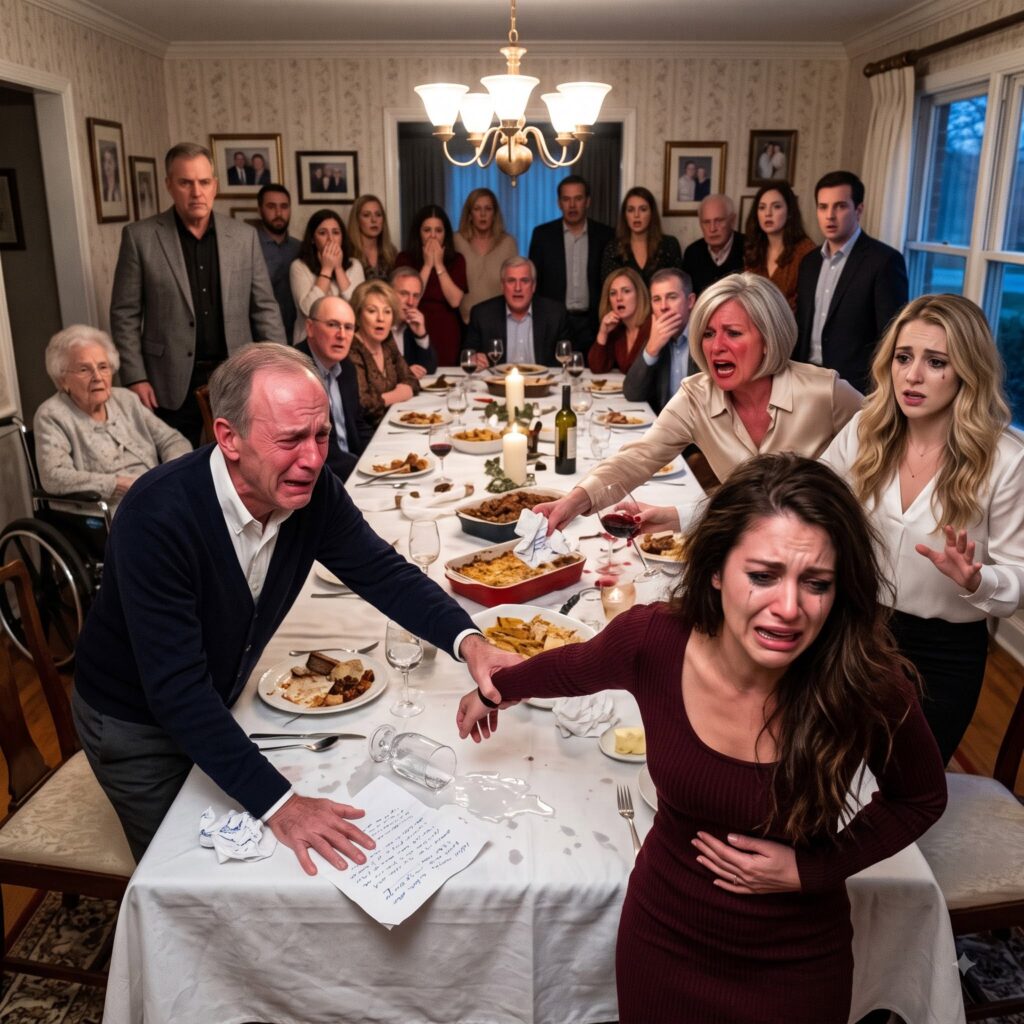
Nine weeks after they removed my left kidney, I sat at my parents’ dining table in Cleveland, still wincing whenever I reached for the bread basket.
Twenty-two relatives crowded the room. At the head of the table sat my father, Gary, thinner than I’d ever seen him, but alive. Alive because a piece of me was working inside his body.
My mother, Denise, tapped her glass with a fork.
“I’d like to make a toast,” she said, her voice trembling. “To my daughter Courtney, who organized the fundraiser and saved your father’s life.”
Glasses rose. Twenty-two people said, “To Courtney!” My little sister, glowing in a white silk blouse, pressed a hand to her heart like she’d just won an Oscar.
I waited for someone to say my name.
Nobody did. Nobody even looked at me.
Not for the testing. Not for the surgery. Not for the nine weeks I couldn’t work, three of them unpaid, while I quietly drained my savings and told no one.
I set down my fork and stood up.
“Hannah, sit down,” Mom whispered through her smile. “Don’t you dare ruin this.”
I didn’t sit.
Something clamped around my wrist.
Dad. His grip was weak, but his eyes were wet, and they weren’t the eyes of a man enjoying a toast. They were the eyes of a man begging.
He slid a paper napkin across the tablecloth. Written in his shaky blue pen:
We received a report from—
The sentence just stopped, as if he’d been afraid to finish it.
Across the table, Courtney’s smile slipped. Her eyes dropped to the napkin, then to me.
She pushed back her chair.
“What’s that, Dad?” she asked, far too sweetly, already walking toward us.
And my mother, who had spent my entire life telling me to keep the peace, lunged forward and snatched the napkin first.
Teaser: Twenty-two people had just toasted the wrong daughter, and the only person who knew it was a man too weak to stand without help. Hannah had given up an organ, nine weeks of her life, and her place in the family. But the napkin her mother crushed in her fist held something far worse than being forgotten. Someone at that table had been lying for months, and the proof was about to land in a lawyer’s folder.
Mom’s fist closed around the napkin.
“It’s nothing,” she told the room, bright and brittle. “Gary’s exhausted. He’s been through so much.”
“Denise.” Dad’s voice was thin, but the whole table went silent. “Give it to her.”
“Gary, please—”
“Give it to Hannah.”
Twenty-two forks hung in midair. Slowly, Mom’s fingers opened, and the napkin dropped onto my plate, creased and damp.
We received a report from—
“From who?” I whispered.
“From GiveHope.” My uncle Tom, Dad’s younger brother, a tax attorney from Akron, set down his wine glass. “The fundraising site. Gary asked me here tonight, Hannah. He didn’t want to say this without a lawyer in the room.”
Courtney laughed, high and thin. “Uncle Tom, it’s a family dinner.”
“Then let’s talk about family.” He opened a leather folder. “The campaign ‘Save Gary Brooks,’ created by Courtney, raised $112,400 from three thousand donors. Eighteen days ago, GiveHope’s fraud team froze the remaining balance and notified the campaign beneficiary.” He glanced at Dad. “That’s your father.”
“I only found out because a nurse showed me my own email,” Dad said. “Your mother had been handling my inbox since the surgery.”
Across the table, Mom flinched.
“Withdrawn where?” asked a cousin.
“A personal checking account,” Tom said. “Courtney’s. Ninety-eight thousand dollars in eleven transfers. Not one cent to Cleveland Clinic. Not one cent to Hannah, whom the campaign page promised would be ‘compensated for her lost wages.’”
Courtney’s face blotched red. “I was going to pay it back!” She turned. “Mom. Tell them.”
My mother stared at the tablecloth.
“Mom? You said you’d handle this.”
The room tilted. “You knew,” I said.
Mom finally looked at me, and the answer was already there.
“There’s more,” Dad said, finding my hand. Tom slid one sheet from the folder. A lab report from Cleveland Clinic’s transplant center, two names, two columns.
Courtney Brooks, compatibility: 98%. Hannah Brooks: 87%.
“Your sister was the better match,” Tom said quietly. “She was tested first. Then she told you she wasn’t compatible.”
Courtney looked down at her hands. For the first time in my life, she couldn’t look at me.
I had lost a kidney in a surgery my sister was cleared for and ran from.
“Dad,” I said, my voice shaking, “did you know about this, too?”
His eyes filled again. “Only since Tuesday. And there’s one more thing I haven’t told anyone, Hannah. It’s about what your mother did the night Courtney’s results came back.”





