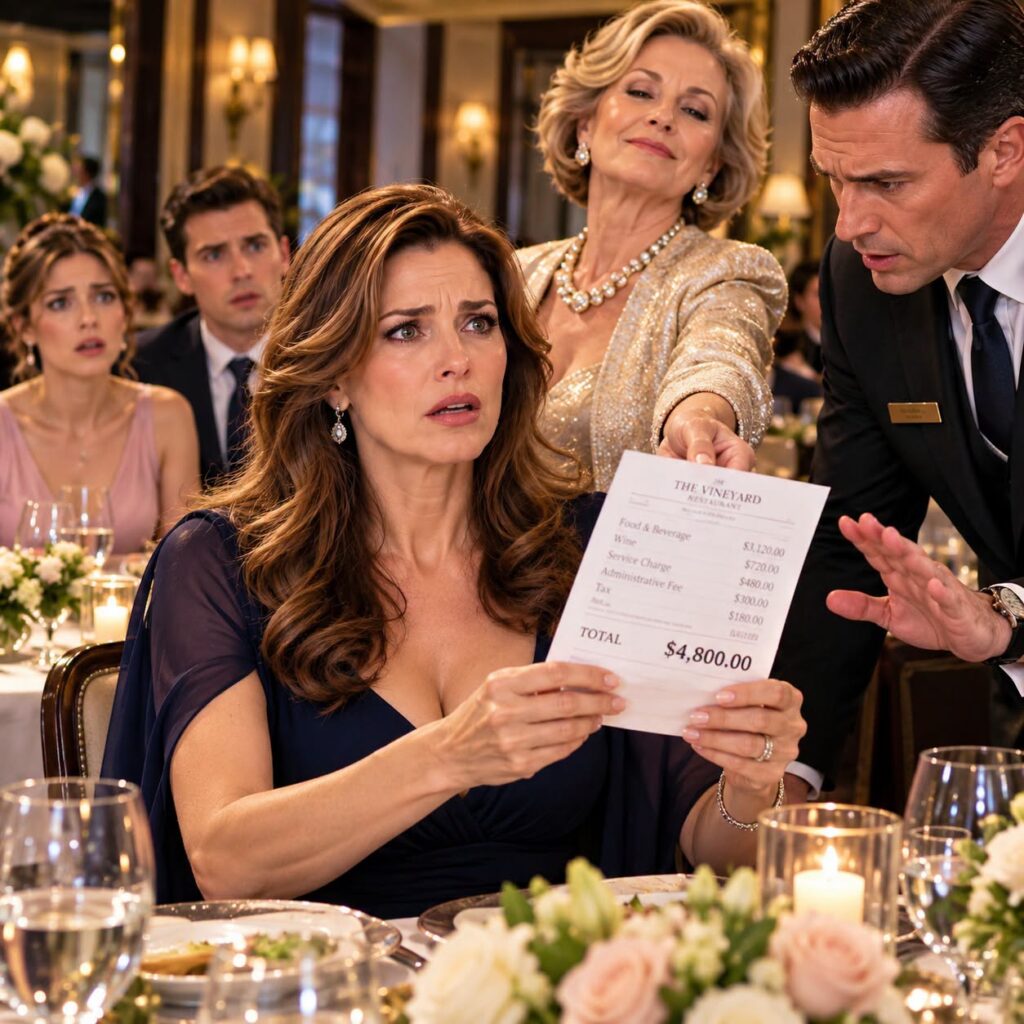
My daughter’s future mother-in-law slid a $4,800 restaurant bill across the table and smiled as if she were handing me a death sentence. “Consider it your contribution to the wedding—unless you can’t afford it.”
Eleven people heard her. Nobody moved.
I was sitting at a candlelit table in a private dining room in Columbus, Ohio, wearing the navy dress I had bought for my daughter Hannah’s nursing-school graduation. Across from me, Celeste Whitmore adjusted a diamond bracelet worth more than my car.
“Mom,” Hannah whispered, “Celeste said her family was hosting.”
Celeste lifted her wineglass. “We are hosting, sweetheart. Your mother is simply helping with the cost.”
Her son, Tyler, studied his plate. My daughter looked at him, waiting for the man she planned to marry to say something.
He didn’t.
I glanced at the invoice. Private dining. Imported champagne. Premium seafood. A total of $4,800, neatly printed above a red line.
“Did you ask me before ordering all this?” I said.
Celeste’s smile tightened. “I assumed you’d want to contribute something meaningful. Tyler’s family is covering so much already.”
I ran a small bookkeeping practice from my kitchen. Celeste had spent six months calling it my “little hobby,” never asking what kind of books I kept. I had spent twenty-six years tracing missing money for attorneys and business owners. Fancy paper had never impressed me.
“Mom, please don’t,” Hannah said. Her eyes were wet.
Celeste leaned toward her. “Darling, a marriage joins families. We should know now whether everyone can meet their obligations.”
I felt a dozen eyes settle on my hands.
My husband had died when Hannah was twelve. I had worked nights, packed lunches at dawn, and kept every promise I could afford to make. I had also tucked an $8,000 wedding gift into my purse that evening, sealed in an envelope with Hannah’s name on it.
Celeste didn’t know that. She only knew I drove a nine-year-old Honda.
I reached for my purse—not because she had won, but because I wanted to take out my phone and photograph the bill before anyone touched it again.
A man in a charcoal suit stepped beside my chair.
“Ma’am, don’t pay that.”
Celeste’s glass stopped halfway to her mouth.
“I’m Daniel Price, the restaurant manager,” he said. “I’m sorry to interrupt. But there’s something you need to know.”
Celeste spoke sharply. “This is a private family conversation.”
Daniel set a receipt beside the invoice. His hand was steady.
“This dinner was paid in full at 4:12 this afternoon. We haven’t asked anyone at this table for a penny.”
I looked from the receipt to the invoice. Same $4,800. Same dining room. Two different stories.
“And,” Daniel continued, looking directly at Celeste, “the card used for payment was presented in Hannah Bennett’s name.”
Hannah pushed her chair back so hard it scraped the floor.
“That’s impossible,” she whispered. “I don’t have that card.”
Celeste’s expression changed before anyone spoke. She wasn’t surprised by the payment. She was terrified by the receipt. And as Hannah stared at the unfamiliar card number, I realized the dinner bill might be the smallest part of what had been stolen.
Tyler shot to his feet. “Daniel, you’re mistaken.”
“I personally processed the payment,” Daniel replied. “You and your mother came in before the other guests. I can preserve the transaction record and the security footage.”
Celeste reached for the receipt. I covered it with my palm.
“Don’t,” I said.
Hannah was staring at the last four digits. “My only credit card ends in 1176. This says 9042.”
“It’s for the wedding,” Celeste snapped. “Must we make everything so ugly?”
I moved beside my daughter. “Open your credit-monitoring app.”
Hannah’s fingers shook. A moment later, her face drained of color. A new credit-card account had appeared on her report six weeks earlier. The reported balance was $21,680. She had never applied for it.
“That could be an error,” Tyler said.
“Then tell us who made it,” I answered.
He looked at his mother.
There it was. A glance so small nobody else might have noticed. I had spent my career finding truths hidden in details people thought were harmless.
Six weeks earlier, Hannah had asked me to review a wedding-vendor quote from Caldwell Event Services. Celeste had insisted the company could handle the entire reception. I had checked Ohio business filings and found Tyler listed as the company’s organizer and statutory agent.
At the time, I’d assumed they were just avoiding an awkward discussion about keeping profits in the family.
Now I took the saved filing from my phone.
“You told Hannah Caldwell Event Services was an independent planner,” I said. “Why is Tyler’s name on its formation paperwork?”
Hannah turned toward him. “You said your family was paying that company a deposit.”





