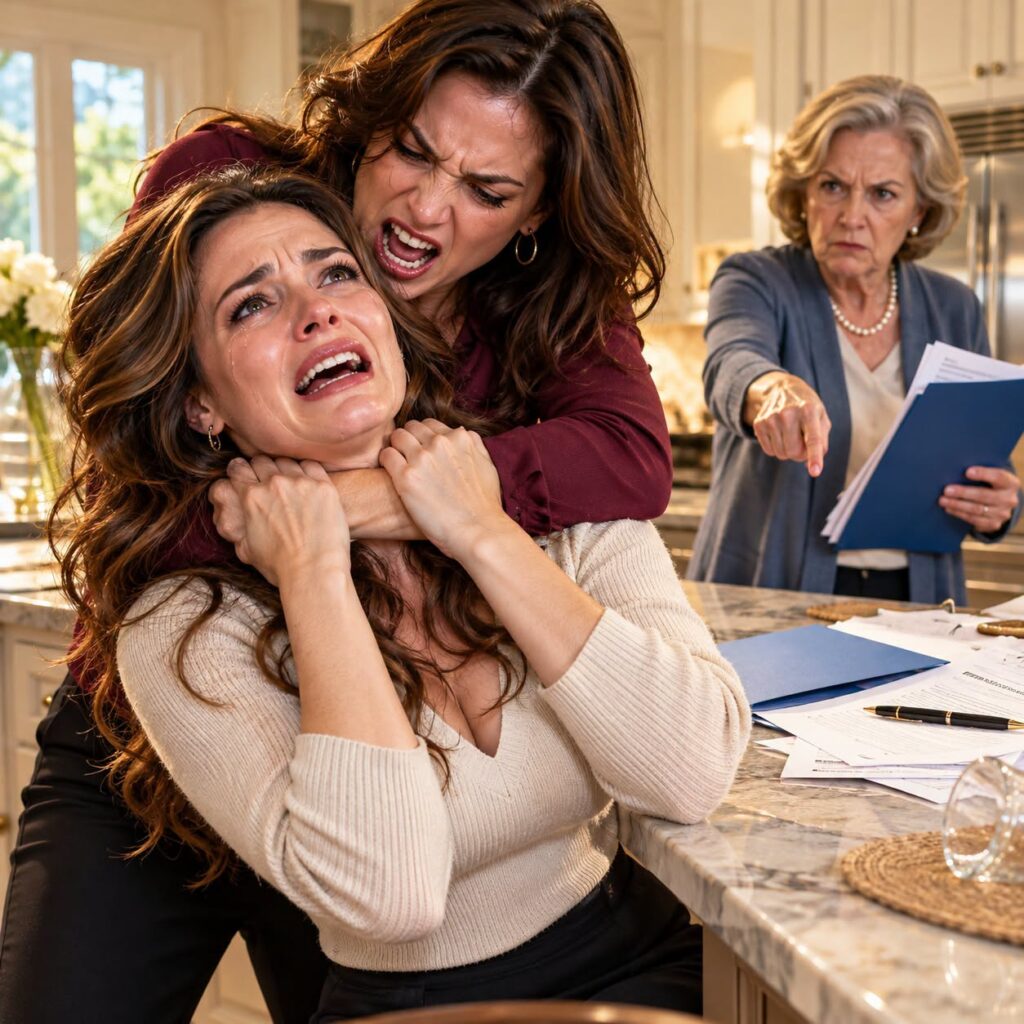
My sister’s forearm crushed my windpipe while my ten-year-old daughter screamed for her to stop. I clawed at Vanessa’s sleeve, my knees buckling against the kitchen cabinets. Across the room, my mother watched without moving.
“Mommy!” Sophie grabbed my phone from the counter. “I’m calling 911!”
My mother, Elaine, stepped between Sophie and the back door. “Dial 911 and you’re next,” she hissed.
I had heard my mother say cruel things before. Never to my child. Never while her other daughter was trying to strangle me.
Ten minutes earlier, they’d arrived carrying a blue folder and pretending this was a family meeting. Vanessa wanted me to sign a document releasing my mother from responsibility for managing my late grandmother’s accounts. I said my attorney needed to read it first.
Vanessa slammed the folder down. “You think you’re better than us because Grandma left you this house?”
“Grandma put the deed in my name six years ago,” I said. “That doesn’t mean I owe you my signature.”
My mother pointed to the last page. “Just sign it, Rachel. Stop making everything difficult.”
I pushed the papers back. Vanessa came around the table so fast I barely saw her move.
Now the room was narrowing to a bright spot above the stove. Sophie’s sobs sounded distant. I tried to speak, but nothing came out.
Then glass shattered.
Sophie had thrown the heavy sugar jar against the patio door. Our neighbor, Mrs. Alvarez, was watering her plants on the other side of the fence. She turned toward the noise.
Vanessa loosened her grip just enough for me to slide to the floor. Sophie ran through the unlocked patio door and screamed over the fence, “Please call the police!”
My mother lunged after her. I caught the hem of Mom’s cardigan and held on until Mrs. Alvarez shouted that officers were coming.
At the hospital, a doctor examined the bruising on my neck and ordered imaging because strangulation injuries can become dangerous even after breathing returns to normal. Sophie sat beside my bed, refusing to release my fingers.
“Did I do something wrong?” she whispered.
“No, sweetheart. You saved me.”
A detective viewed the kitchen camera footage I’d saved automatically to a cloud account. Vanessa was arrested that evening. My mother told the officer it had all been a misunderstanding. The video disagreed.
After Vanessa was released pending court proceedings, I obtained temporary protective orders against both women. I had a locksmith replace every exterior lock. Then I took Sophie to a counselor and stopped answering my family’s calls.
For twenty-one days, our house was quiet.
On the twenty-second morning, my doorbell camera showed Vanessa twisting her old key in the front lock. My mother stood behind her with a real estate agent and a moving truck.
I spoke through the intercom. “You’re violating the orders. Leave.”
Mom lifted a sheet bearing the county recorder’s stamp.
“Check the deed, Rachel,” she said. “This house belongs to your sister now.”
And beneath the recorded transfer was a signature that looked exactly like mine.
I knew I hadn’t signed away my home. What I didn’t know was how far my mother had gone to make a lie look legal—or why she’d risked coming back with a witness. Then I noticed the date beside that signature.
The date on the deed was the day I lay in the emergency room with bruises around my throat.
I photographed the page through the window without unlocking the door. Then I called Detective Harris, the officer handling the assault case.
“They’re here,” I said. “Both of them. They have a deed with my forged signature.”
Vanessa rattled the handle again. “Open up! Our agent needs to measure the rooms.”
The agent, a man named Paul Bennett, stepped backward when he heard me mention protective orders. He clearly hadn’t been told about those.
“Ma’am,” he said through the glass, “I’ve only been hired to prepare a listing.”
“Then don’t enter,” I answered. “And photograph everything they’ve given you.”
When a patrol car turned onto our street, Vanessa sprinted toward the truck. Officers stopped her before she could leave. My mother stayed on the sidewalk, insisting the deed made her visit legitimate. The officers took statements and documented the possible order violations; they did not decide ownership on my porch.
That afternoon, my attorney, Dana Ellis, obtained the recorded document. It was a quitclaim deed transferring my house to Vanessa for ten dollars. Someone had forged my name and arranged a notarization.
Dana found something else: a listing agreement promising a quick cash sale once the transfer was recorded. Mom expected an offer within days.
“She’s trying to turn stolen title into money,” Dana said. “We’re going to stop the sale before a buyer gets hurt.”





