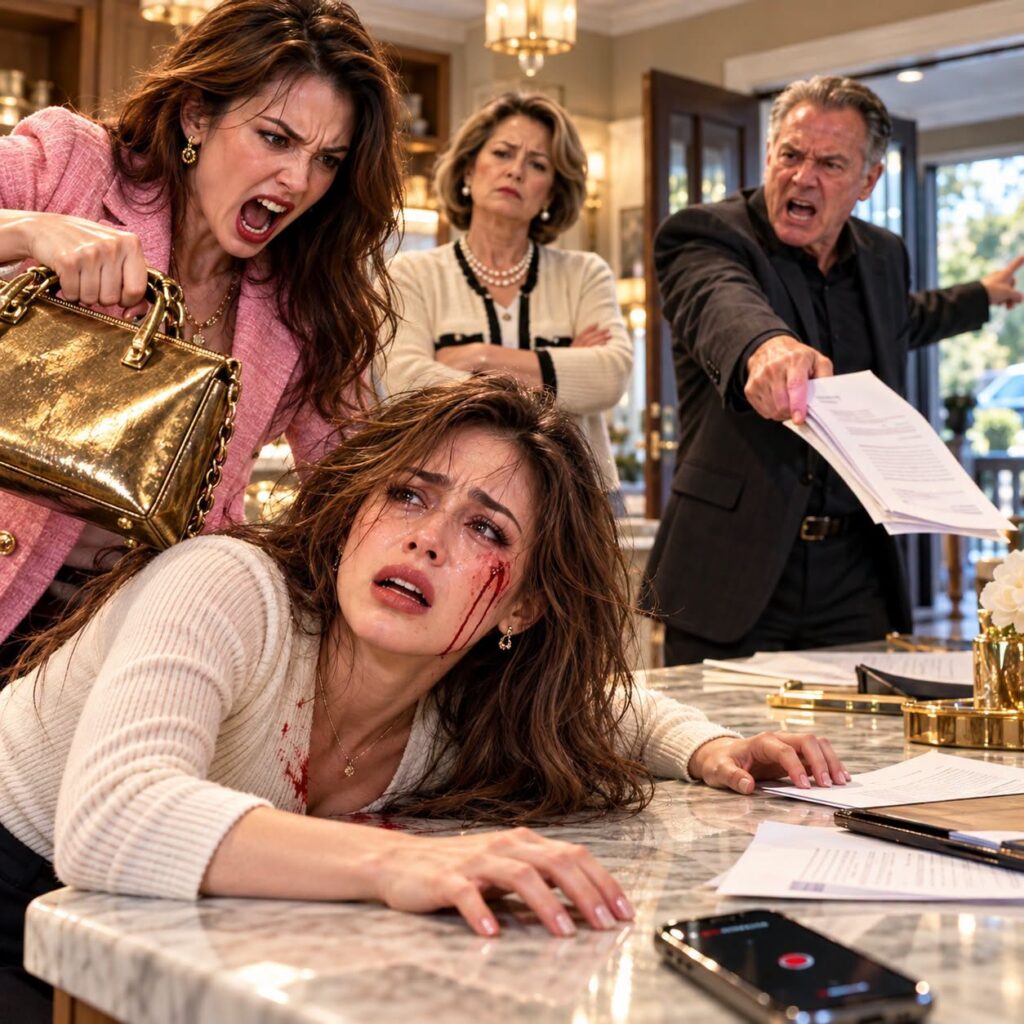
The brass corner of my sister’s handbag struck my cheekbone so hard I heard something crack. I hit the kitchen table, choking on blood, while Lauren raised the bag again.
“Nobody wants a useless parasite!” she screamed.
I caught her wrist before the second blow. My fingers slipped against the polished metal.
“Lauren, stop!”
My mother stood beside the stove, watching blood drip onto her expensive tile. She didn’t move.
“She brought this on herself,” Mom sighed.
My father shoved a stack of papers into my chest. “Sign the warehouse over, Rachel. Then get out.”
I was thirty-four, married to a U.S. Army staff sergeant deployed in Poland, and standing in the house where I’d grown up. Somehow, that made me the family disgrace.
Three months earlier, I’d moved into their guest room after Mom’s knee surgery. I cooked, drove her to appointments, and transferred $2,400 every month toward expenses. Lauren called me unemployed because my bookkeeping clients paid me remotely.
What she really hated was the warehouse.
My grandfather had left me a brick shipping building outside Dayton. Dad’s freight business used it rent-free under an agreement I’d signed before Grandpa died. Lately, Lauren had demanded permanent control.
That afternoon she’d shoved a new agreement across the table.
“You don’t even deserve that property,” she said. “Dad built this family.”
“Grandpa bought it,” I answered. “And I’m not signing something I haven’t read.”
That was when the handbag came down.
Now Dad grabbed my arm and dragged me toward the front door. The papers fluttered across the kitchen floor. I saw a company name on one page I didn’t recognize, beside a signature that looked disturbingly like mine.
“What is Halcyon Transit?” I asked.
Lauren went pale.
Dad squeezed harder. “Drag your garbage out of here. Never come back!”
He threw my overnight bag onto the porch. Mom closed the door behind me without looking at my bleeding face.
I staggered to my neighbor Mrs. Ellis’s porch. She called 911 while I pressed a towel against my cheek. An ambulance took me to Miami Valley Hospital, where a doctor closed the cut with six stitches and ordered scans. Nothing was broken.
The police photographed my injuries. I gave them Lauren’s name. I didn’t tell them everything.
Because two nights earlier, I’d seen a delivery at my warehouse that no legitimate freight company should have received.
And I’d recorded it.
From the hospital bed, I opened an end-to-end encrypted message to my husband, Ben. I attached the clip from our family kitchen, the warehouse footage, and a photograph of the strange paperwork.
Ben replied from Poland minutes later.
“Rachel, don’t go back. I’m calling the investigator who contacted us last month.”
I stared at those words. He’d promised that investigator would call only if the case became serious.
Three days later, armored tactical vehicles rolled down my parents’ street. Federal agents poured out beneath the flashing lights.
Mom stepped onto the porch, pointing straight at me.
“She owns the warehouse!” she shouted. “Arrest her!”
An agent turned toward me with a folder in his hand.
“Rachel Davis,” he said, “we need to talk about your signature.”
I thought the worst thing my family could do was beat me and throw me out. I was wrong. The agent’s next question would expose why they needed my signature—and what they’d prepared to destroy before anyone found out.
I could barely hear the agent over the engines.
“That’s not my signature,” I said.
Special Agent Melissa Grant led me behind an unmarked SUV, away from my mother’s shouting. Across the street, officers escorted Lauren outside in handcuffs. Her pink sweater was the same one she’d worn when she attacked me.
Grant showed me a photocopy of a shipping authorization.
Halcyon Transit LLC. Rachel Davis, managing member.
Seven shipments. All approved with my electronic signature.
“I’ve never heard of this company,” I told her.
“We believed that,” she said. “Until we found a new insurance policy on your warehouse.”
My throat tightened.
Grant explained that agents from the FBI and Army Criminal Investigation Division had been tracing stolen military night-vision equipment through private freight companies for months. Several serial numbers had appeared on crates delivered to my property.
Ben hadn’t sent soldiers to rescue me. He’d forwarded my video to the investigators already working the case. What I’d filmed gave them fresh evidence to present to a judge. The warrants were theirs, not his.
“The video from your kitchen matters,” Grant said. “But there’s another reason I’m asking for your help.”
She showed me an image captured at my warehouse after midnight.
My mother stood beside a pallet of sealed cases, holding a clipboard. Lauren checked labels. Dad loaded boxes into a delivery van.
I stared at Mom’s face.
She hadn’t been a helpless bystander.





