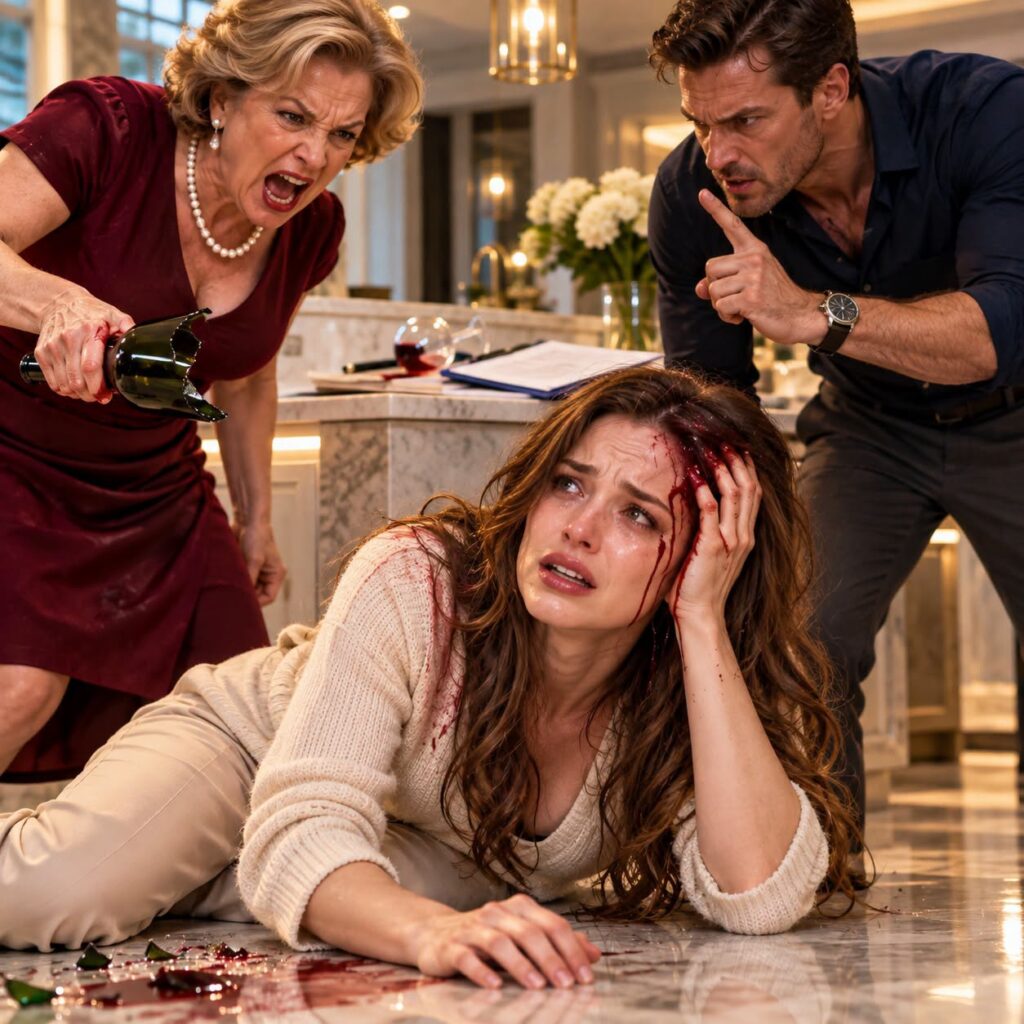
The wine bottle struck my head before I saw my mother-in-law lift it.
I heard a dull crack. My knees hit the kitchen tile, and my ten-year-old daughter screamed, “Mom!”
Red wine spilled down my face. Then I felt something warmer.
Blood.
Evelyn Holloway stood over me in her pearl necklace, gripping the broken neck of the bottle like she couldn’t believe what she’d done. My husband, Grant, didn’t move to help.
Instead, he looked at the folder I’d pushed across the table.
“You should’ve signed,” he said.
Twenty minutes earlier, I’d asked why his mother had brought papers giving Grant an ownership interest in my house. Not our house. Mine. My grandmother had left it to me five years before I married him.
Evelyn had smiled tightly. “Families don’t keep score.”
I told her a family shouldn’t need my signature to prove itself.
That was when she reached for the bottle.
Now my daughter, Lily, was fumbling with her phone. “I’m calling 911!”
Grant crouched beside her. For one second, I thought he’d finally remembered he was her father.
He leaned close enough for her to smell the whiskey on his breath.
“Cry and you’re next,” he hissed.
Lily went silent. Her hands shook so badly she dropped the phone.
Something inside me changed.
I could survive what Evelyn had done to my head. I would not let my daughter learn that love meant staying quiet when someone threatened her.
“Lily,” I said, forcing my voice steady, “go to Mrs. Carter’s. Right now.”
Grant reached for her arm.
I grabbed his wrist.
“Touch her,” I whispered, “and the neighbors will hear exactly what kind of man you are.”
He stared at me, surprised I’d spoken at all.
Lily bolted through the back door. I followed, one hand pressed against my scalp, leaving bloody fingerprints on the white doorframe.
Our neighbor called 911 before we’d made it across her patio.
Before the argument turned ugly, I’d photographed the folder’s first pages. At the hospital, I emailed those pictures to an account Grant didn’t know existed. Whatever those papers meant, I wasn’t letting him erase the evidence.
At the emergency room, I needed nine stitches. A police officer photographed my injuries while Lily sat beneath a hospital blanket, refusing to let go of my hand.
Evelyn claimed I’d fallen. Grant called it “a misunderstanding.”
But Lily had heard every word.
The next morning, I hired an attorney. We requested a protection order covering both Lily and me. A judge granted temporary exclusive possession of the house and ordered Grant to stay away while the case proceeded. Evelyn was barred from contacting us.
Only after the orders were served did I have a locksmith change every lock.
For three weeks, our home was quiet. Lily began sleeping without the hallway light.
Then, on a rainy Thursday, my doorbell camera sent an alert.
Grant stood on the porch, jamming his old key into the new deadbolt.
When it failed, he smiled straight into the camera and held up a document.
Across the bottom was a signature that looked exactly like mine.
I had never signed it.
I stood behind the locked door, staring at the screen, while Lily asked why Daddy was back. The stitches had healed. The fear hadn’t. And whatever he was holding, he seemed certain one piece of paper could undo everything I’d done to keep us safe.
I did not unlock the door.
I called my attorney, then the police, and told Lily to stay in her room. Through the camera speaker, I said, “You know there’s a protection order, Grant.”
He slapped the page against the glass.
“I’m an owner now. You can’t keep me outside my own house.”
A patrol officer arrived seven minutes later. Grant waved the document at him, too. But a recorded deed did not cancel a judge’s order. The officer arrested him for violating it.
My attorney pulled the county recorder’s copy while I sat at the kitchen table, staring at a dark stain still trapped between two floor tiles.
It was a quitclaim deed.
According to the filing, I’d transferred half my house to Grant for ten dollars. The signature was a careful imitation of mine.
And the notary who supposedly watched me sign?
Evelyn Holloway.
My attorney asked where I’d been on the date and time listed.
“At work,” I said. “In the hospital.”
I’m a respiratory therapist. At the exact minute Evelyn claimed I’d stood in front of her, I was treating a patient in the intensive care unit. My badge records, shift assignment, and a coworker’s statement could prove it.
My attorney went quiet.
Then she said, “This wasn’t an argument over marital property. Someone falsified a public record.”





