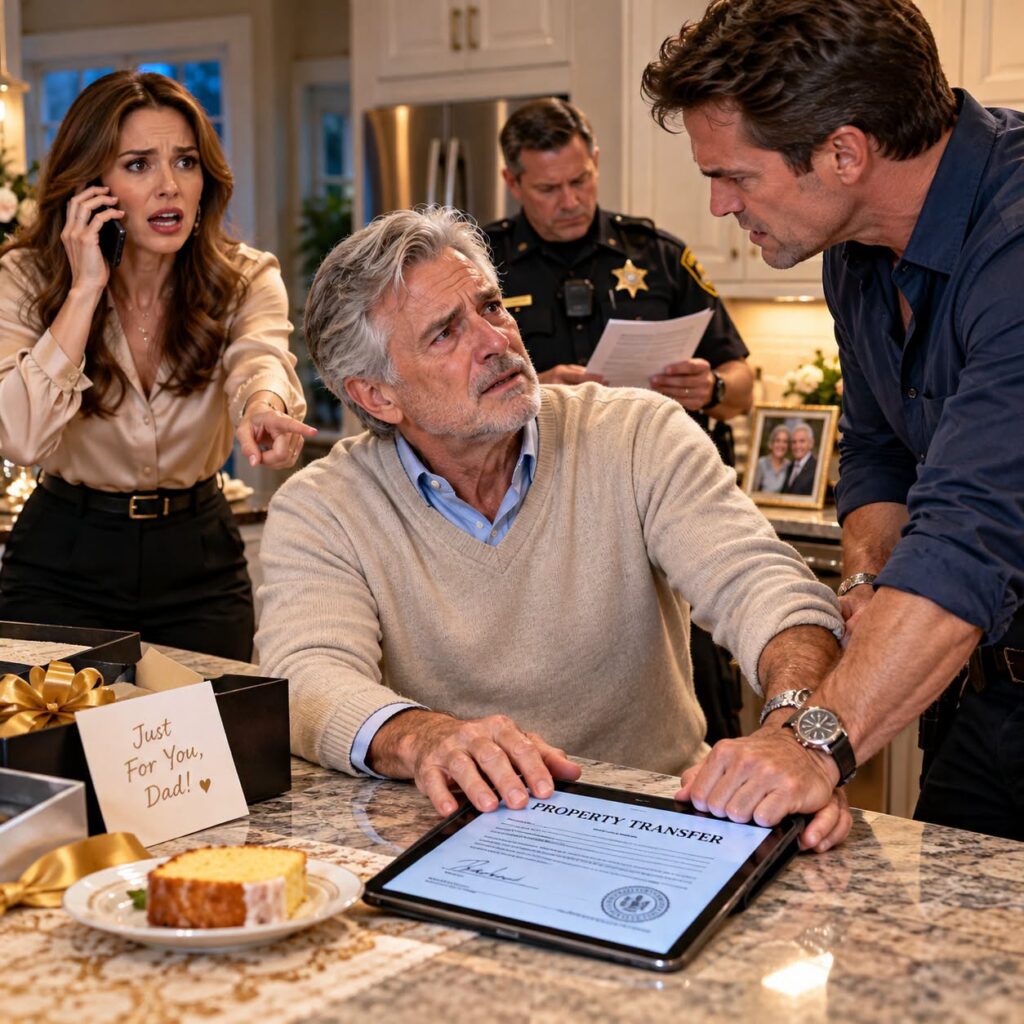
My son bent my wrist against my kitchen counter while his wife told a 911 dispatcher I was dangerous and confused.
All because I refused to hand over the birthday present they’d sent me.
I turned sixty-eight on Monday. My wife had been gone three years, and my son, Mason, hadn’t visited in six weeks. But his wife, Brooke, sent a tablet that probably cost twelve hundred dollars.
“Just for you, Dad!” her card said.
There was even a little bow around the stylus.
I live outside Columbus, Ohio, in the house my wife and I spent thirty years paying off. After a minor eye procedure Monday morning, my doctor had ordered me to limit screen time for forty-eight hours. So I left the tablet on my kitchen table.
The next afternoon, at 12:40, Brooke’s mother, Judith, showed up with lemon pound cake.
Judith and I had never been close. She was a retired notary, the sort of woman who checked a restaurant receipt before leaving a tip. But she had loved my wife, and she still brought cake on my birthday.
“Mind if I borrow that?” she asked, pointing to the tablet. “I need to look something up.”
“Knock yourself out.”
For hours, she sat at the table, tapping and scrolling. Once, I heard her whisper, “That can’t be right.”
When I asked what was wrong, she turned the screen away.
“Walter, did you give Mason permission to handle your house?”
“No.”
She pressed her lips together. “Then don’t let anybody take this tablet.”
She left at 4:43. I knew because my driveway camera chimed when her car pulled out.
At 5:06, Brooke called.
“Dad! Did you set it up?”
“Doctor limited my screens. Your mom stopped by, so she used it all afternoon.”
Silence.
“All afternoon?” Brooke’s voice cracked. “What time did she leave?”
“Four forty-three.”
The line went dead.
I picked up the tablet despite my doctor’s orders. It was already signed into a shared family folder Brooke had loaded with photographs.
But the open file wasn’t a photograph.
It was a deed transferring my house to an LLC I’d never heard of. My signature sat at the bottom, under a notary seal bearing Judith’s name.
The document said it had been notarized at 2:50 that afternoon.
Judith had been sitting across from me at 2:50, eating cake.
I photographed every page with my phone and called my attorney’s after-hours number.
Before I could finish the message, headlights swept across my curtains.
Mason came through the back door without knocking. Brooke followed, her face white.
“The tablet,” she said. “Now.”
“Why is your mother’s seal on a deed for my house?”
Mason reached for it. I stepped back.
“Dad, you’re not thinking clearly,” he hissed. “That’s why we need to help you.”
Then he grabbed my wrist and slammed it against the counter.
Brooke called 911 and began describing a violent, delusional elderly man.
When the deputy arrived, Mason smiled and produced a folded paper.
“See?” he said. “We have medical documentation.”
I looked at the signature at the bottom.
It belonged to a doctor who had never treated me.
I had spent my whole career investigating insurance fraud. I knew the difference between a mistake and a staged scene. But standing in my own kitchen, I finally understood that my son wasn’t trying to take my tablet. He was trying to take my credibility.
“May I see that?” I asked the deputy.
Mason held the page higher. “Dad, please. Don’t embarrass yourself.”
The deputy took it anyway. It claimed I suffered from advanced cognitive impairment and required supervision. The physician’s name was printed beneath a crooked signature.
“My eye doctor is Dr. Patel,” I said. “This man isn’t my physician. Call his office.”
Brooke interrupted. “He’s confused about his appointments.”
I showed the deputy the deed on my phone. My name, my address, Judith’s seal. The time stamp.
“Judith was here until 4:43,” I said. “My driveway camera shows her leaving. She was in my kitchen when this was supposedly notarized.”
The deputy separated us and called a supervisor. He didn’t pretend he could settle a property dispute at my counter. But he photographed the bruise spreading across my wrist and took down everyone’s statements.
Then the tablet buzzed.
A new comment appeared beneath the deed, posted from Judith’s email.
DO NOT TRUST MASON. CALL ME.
My phone immediately rang from an unfamiliar number.
“Walter,” Judith whispered, “I’m at my attorney’s office. They used my stolen notary stamp.”
Three weeks earlier, Brooke had brought her a stack of papers and begged her to notarize them without meeting the signer. Judith refused. Two days later, her stamp disappeared from a locked desk at Brooke’s house, where she’d been staying while her apartment was renovated.





