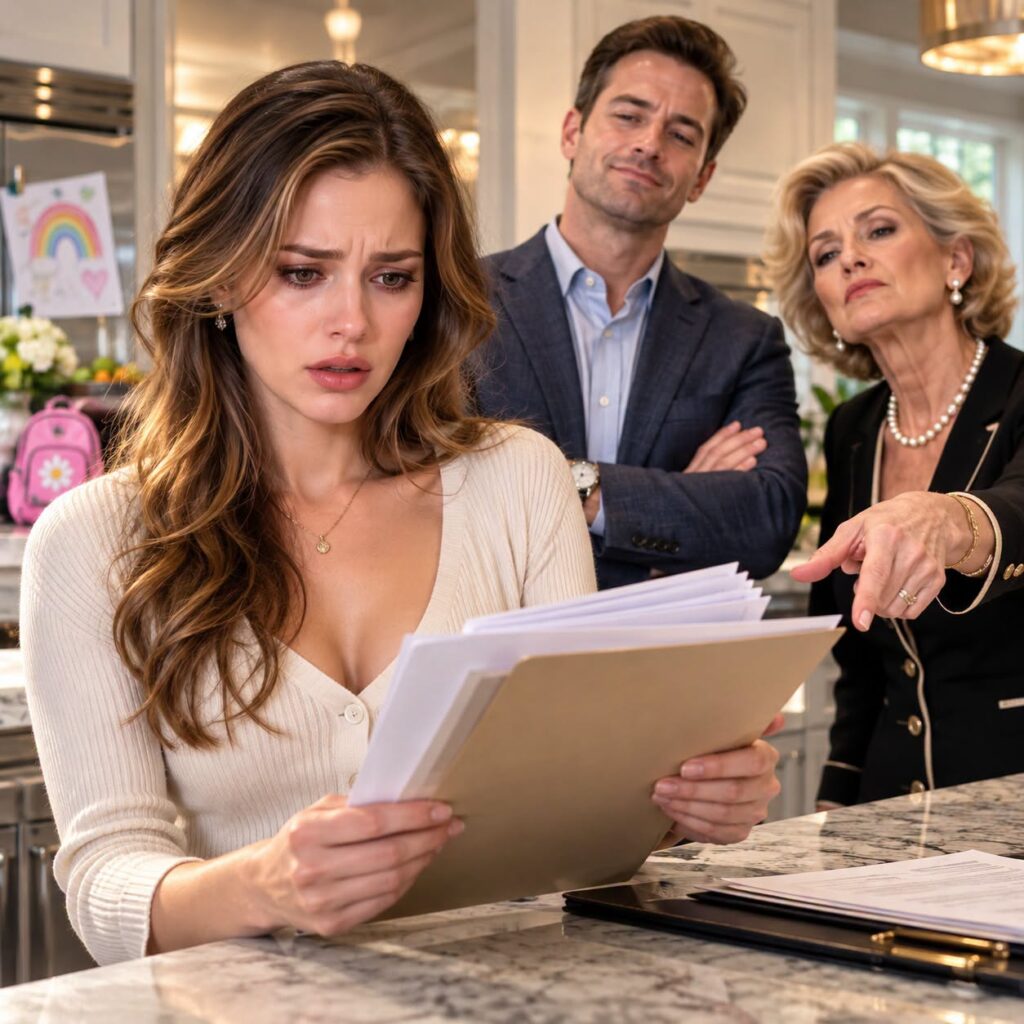
The moment my mother-in-law said she didn’t care what happened to my nine-year-old daughter, I was standing outside the kitchen with Ellie’s lunchbox in my hand.
Diane didn’t lower her voice.
“I don’t care about the child. I care about the money.”
My husband, Scott, laughed. “Rachel isn’t that smart, Mom. She’ll sign whatever we put in front of her.”
Behind me, Ellie stopped halfway down the stairs.
She had heard every word.
Three years earlier, Ellie’s father had died in a highway collision outside Columbus. A court-approved settlement had placed $286,000 in a restricted account for her future. I couldn’t withdraw a dollar without a judge’s permission. That protection had helped me sleep through the worst months of our lives.
Then I’d married Scott.
For eighteen months, he had called Ellie “our girl.” He’d attended school concerts, packed her lunches, and promised we’d always be a family. Now his mother was discussing my daughter’s money as if she were an inconvenience attached to a bank account.
I turned to Ellie and pressed a finger to my lips.
Upstairs, I tucked her beneath the quilt her father had given her.
“Is Grandma mad at me?” she asked.
“No, sweetheart. The adults have made a mess. You didn’t.”
I stayed until she fell asleep. Then I opened the laptop.
Scott owned a small remodeling company. Recently, subcontractors had been calling our house, asking why their checks bounced. He’d blamed slow-paying customers. Diane blamed the economy.
Neither had mentioned the pink notices stuffed behind the microwave.
The following morning, Diane arrived with a leather folder and a smile sharp enough to cut glass.
“Just a few signatures,” she said. “We’re moving Ellie’s settlement into a better investment.”
“Which investment?”
“A family-managed account. Your husband will explain.”
Scott slid the pages toward me. On top was a form labeled WAIVER OF NOTICE. Beneath it, half-hidden, was a petition naming Diane as proposed guardian of Ellie’s estate.
I felt my pulse hammer against my collar.
“Why would Ellie need a new guardian?” I asked.
Scott reached for my hand. “It’s paperwork, Rach. Don’t make it complicated.”
I smiled the way I did when Ellie insisted a broken vase had fallen by itself.
“I’ll read it tonight.”
Diane’s face tightened. “The lawyer needs it Monday.”
After they left, I photographed every page. I searched the county probate docket. My daughter’s name appeared beside an emergency petition filed the previous afternoon.
The petition claimed Ellie needed expensive neurological treatment. She didn’t. It claimed I had consented to releasing $192,000. I hadn’t.
And attached to it was a notarized statement bearing my signature.
A signature I had never written.
Six days later, after consulting my own attorney, I signed a sworn objection at the courthouse.
On the seventh day, Scott’s lawyer called me, breathing hard.
“Mrs. Harris, the judge has seen your filing,” he said. “But there’s something else in that petition. Something about your daughter.”
Then he told me what they had submitted in Ellie’s name.
By the time the call ended, my hands were shaking. Someone had put words into my daughter’s mouth, and my husband had helped. I hadn’t signed their waiver. I’d signed the one document they never expected me to file.
“A handwritten statement,” attorney Martin Bell said. “It says Ellie is frightened of you and wants to live with her grandmother.”
I sat down so fast the kitchen chair scraped the floor.
“She’s nine,” I said. “And she hasn’t spent a night at Diane’s house in a year.”
Bell went quiet. Then he asked whether he could send me a copy.
The letter was written on lined notebook paper. The words were stiff and adult: My mother is financially irresponsible and cannot be trusted with my inheritance. At the bottom, in uneven letters, was ELLIE.
I knew that handwriting.
Not because it was my daughter’s.
Because Diane had written Ellie’s birthday cards in the same exaggerated, rounded script for eighteen months.
Bell admitted he’d never met Ellie. Scott had brought the letter to his office and claimed a school counselor had recommended it. The emergency filing had gone further than I understood: Diane wanted temporary control of both Ellie’s property and her day-to-day care.
My stomach turned cold.
“What happens to a child while you sort out the money?” I asked.
“The court hasn’t granted anything,” Bell said quickly. “The account remains blocked. I’ve asked to withdraw the emergency request. I also have an obligation to correct the record.”
That was when I told him about the supposed medical emergency.
Ellie’s pediatrician had never diagnosed a neurological condition. The doctor’s office confirmed that the treatment letter attached to the petition didn’t come from them. My attorney had preserved the email and contacted the court.
By noon, Scott had sent fourteen texts.





