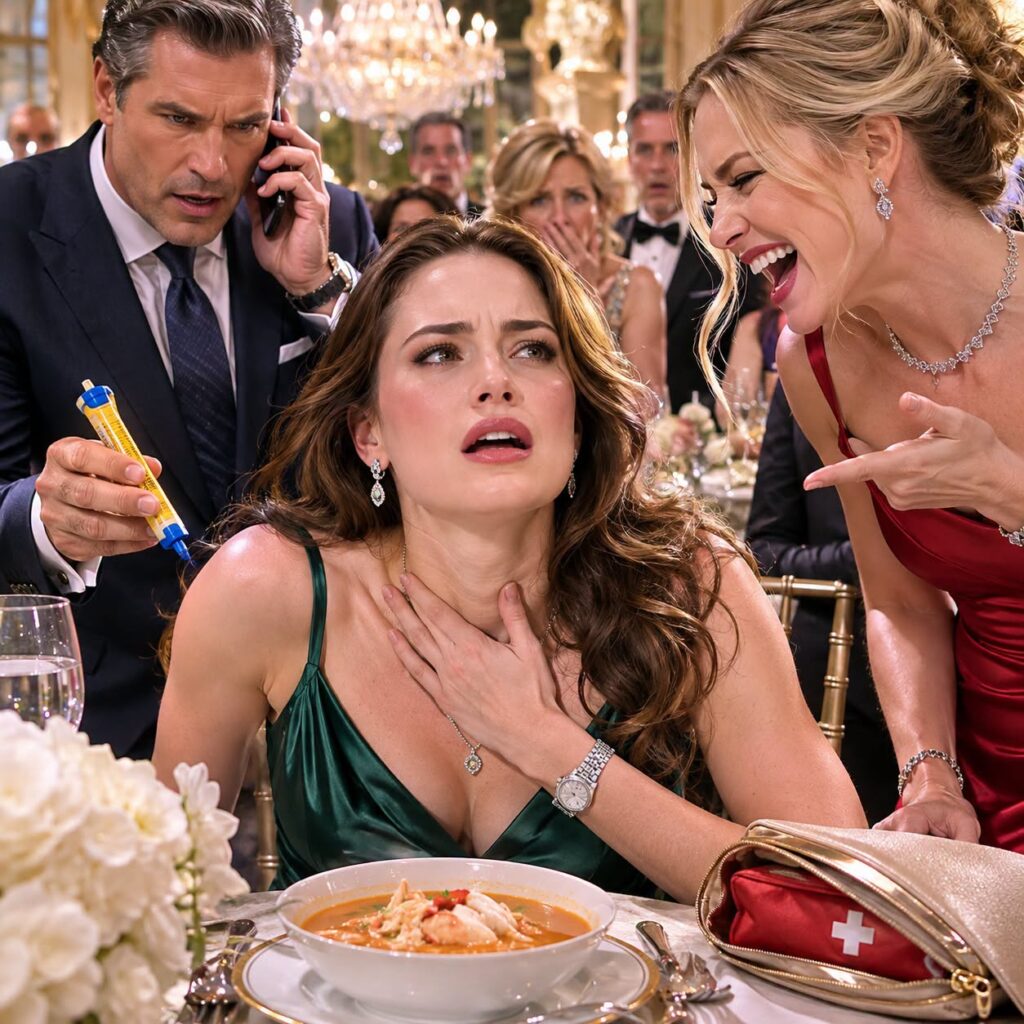
The first thing I heard after swallowing my sister’s “crab-free” soup was her laughing. The second was the ugly, whistling sound coming from my own throat.
“See?” Paige announced to seventy dinner guests. “Natalie can turn a spoonful of soup into a medical emergency.”
I gripped the edge of the table. My tongue tingled. Heat crawled up my neck.
“There’s crab in this,” I whispered.
My sister’s smile never moved. “It’s roasted squash bisque. Stop embarrassing me.”
We were in the ballroom of a Chicago hotel, celebrating the launch of my company’s school-meal program. I had spent six years building SafeTable Kitchens after a shellfish reaction nearly killed me in college. That night, billionaire grocery-chain CEO Michael Vale was considering a multimillion-dollar distribution agreement.
Paige had organized the dinner. She wanted everyone to believe she had built the business, too.
An hour earlier, she’d pulled me aside near the elevators.
“When Michael asks who runs operations, tell him I make the important decisions.”
“You coordinate events,” I said. “I make the decisions.”
She stepped closer. “You always have to be the special one.”
Now she had a microphone in one hand and my life in the other.
Before the first course, I had asked the banquet captain twice whether my meal was shellfish-free. He showed me the printed ticket: NATALIE REED — NO SHELLFISH. Paige intercepted the server anyway, insisting she wanted to deliver my bowl personally.
“You can’t even enjoy dinner without a dramatic announcement,” she’d joked. A few guests chuckled. Our mother sighed like I was twelve again.
I took two small spoonfuls because the kitchen had confirmed my meal. Because I trusted the ticket. Not because I trusted Paige.
Then my lips began to swell.
I pushed back my chair. “Call 911.”
Paige rolled her eyes. “She does this every holiday.”
I reached for my purse, where I always carried two epinephrine auto-injectors. It wasn’t beside my chair.
“Your bag’s in the coatroom,” Paige said. “I moved it. It looked messy.”
My vision narrowed. I couldn’t get enough air to argue.
Michael Vale had spent the evening watching my sister with a guarded expression I couldn’t explain.
A chair scraped across the marble floor.
Michael was already standing, his phone against his ear, an EpiPen in his other hand.
“Severe allergic reaction,” he told the dispatcher. “Adult woman. Trouble breathing. Epinephrine going in now.”
He looked straight at me. “Natalie, I’m trained. My daughter has the same allergy.”
I nodded once. He pressed the injector against my outer thigh and held it as directed. Someone shouted for the hotel’s AED. Someone else started crying.
Paige reached for my soup bowl.
“Leave that,” Michael said sharply. “Nobody clears this table.”
A banquet server blocked Paige’s path. Our mother stood frozen beside the flowers.
As the paramedics rolled me toward the exit, the server hurried up with a silver evening bag he’d found behind the service station.
It belonged to Paige.
The zipper hung open. Inside was my red emergency pouch—the one that should have been in my purse.
I had spent my whole life believing my sister was cruel with words. Now, struggling to breathe, I realized she’d found a way to make her cruelty deadly.
By the time the ambulance doors closed, I had one question that hurt worse than the needle in my thigh: Why had Paige taken the medication that could save my life? I thought the answer was jealousy. I was about to learn how much money my silence was worth.
I woke in the emergency department with an oxygen mask against my face and my mother crying beside the bed. Doctors had treated the anaphylaxis and wanted to monitor me in case my symptoms returned.
Paige wasn’t there.
“She went home,” Mom said. “She’s devastated. She says the kitchen made a mistake.”
“Then why was my emergency medicine in her purse?”
Mom stared at the blanket. “I don’t know.”
Michael appeared in the doorway with a woman carrying a laptop. He introduced her as his company’s general counsel, Rebecca Shaw. A police detective waited outside; the hotel had already reported the incident.
“I need to show you something,” Michael said. “But we can do it tomorrow.”
“No.” My voice scraped. “Show me.”
Rebecca opened security footage from the hotel’s service corridor. Paige stepped behind the serving station, lifted the lid from my specially labeled bowl, and poured in liquid from a small pitcher. The caterer’s supervisor had identified it as crab bisque from another course.
The video showed Paige taking my red medication pouch from my handbag minutes earlier. A second camera caught her slipping it into her clutch.
I watched twice. The screen never changed.
“Why would she do this?” I asked.





