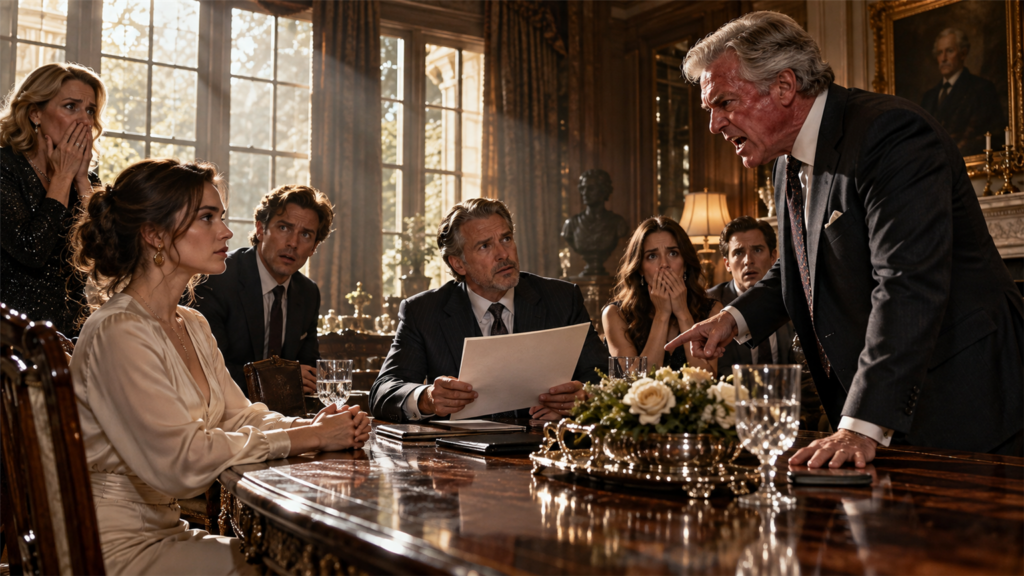
Dad laughed when I arrived at Grandma’s estate meeting. “You came for money? She left you nothing.” I almost believed him—until the lawyer placed a thick folder on the table and said my name. Inside were the deeds to every house my parents and relatives lived in. Then he read Grandma’s final letter, and suddenly nobody was laughing…
“You don’t deserve to be in this family,” Dad shouted in front of everyone.
I didn’t answer.
I just placed my coat over the back of the chair and sat down again.
Across Grandma Evelyn’s dining room, my aunt Melissa stared into her coffee. My younger brother Tyler looked at the floor. Even Grandma’s attorney, Martin Hale, stopped arranging the papers in front of him.
Dad’s face had gone red.
“You disappeared for years,” he continued. “Now she dies and suddenly you show up for the money?”
That was almost funny.
For the last four years, I had driven from Columbus to Grandma’s house every other Saturday. I took her grocery shopping, organized her prescriptions, replaced lightbulbs she could no longer reach, and sat beside her through chemotherapy appointments.
Dad had visited mostly on holidays.
But I didn’t correct him.
Grandma had taught me something important.
“Never argue with people who need an audience, Claire. Let documents do the talking.”
So I stayed quiet.
Martin opened a thick blue folder.
Dad leaned back as if the meeting already belonged to him.
Grandma had owned more property than most people realized: the lake house where Dad and my stepmother lived, a suburban home occupied by Melissa, and a smaller brick house where Tyler lived with his wife and son.
Grandma had bought each property years ago.
Nobody paid rent.
The family simply called them “our houses.”
Martin began reading distributions.
Some savings went to charities.
Her jewelry went to Melissa.
Tyler received Grandma’s truck and a small investment account.
Dad received her antique watch collection.
Then Martin stopped.
Dad frowned.
“And the properties?”
Martin removed three envelopes from the blue folder.
Each had an address written across the front.
I recognized all three.
Dad’s lake house.
Melissa’s house.
Tyler’s house.
Martin looked directly at me.
“Those properties are addressed separately.”
Dad laughed.
“Fine. Read it.”
Martin slid a document toward me instead.
“Claire, before Mrs. Bennett passed, she transferred all three properties into the Bennett Family Property Trust.”
My fingers touched the edge of the paper.
At the bottom was Grandma’s signature.
Dated eleven months earlier.
Dad leaned forward.
“And who controls the trust?”
Martin turned to the final page.
The room became so still I could hear the refrigerator humming behind us.
“Upon Evelyn Bennett’s death,” he read, “the trust becomes irrevocable. Claire Bennett is appointed sole trustee and sole beneficial owner of the residential properties listed in Schedule A.”
Melissa’s coffee cup stopped halfway to her mouth.
Tyler whispered, “What?”
Dad stared at me.
Martin continued.
“In plain English, Claire now owns the three homes.”
Dad’s chair scraped backward.
“That’s impossible.”
Martin calmly closed the document.
“No, Richard. It’s already recorded.”
Dad’s eyes snapped toward me.
And then Martin reached beneath the folder and removed one final sealed envelope.
Grandma had written my name across it in shaky blue ink.
Underneath were five words:
READ ONLY AFTER THEY KNOW.
Dad reached for the envelope.
Martin pulled it away.
“This belongs to Claire.”
“Oh, give me a break,” Dad snapped. “Mom was sick. She didn’t know what she was signing.”
Martin’s expression didn’t change.
“She underwent an independent capacity evaluation six days before executing the trust.”
Melissa finally spoke.
“You had her evaluated?”
“Evelyn requested it herself.”
Dad looked at me.
“You planned this.”
“No.”
It was the first word I had said in several minutes.
He laughed bitterly.
“You expect us to believe Grandma randomly handed you millions in real estate?”
“I didn’t know she had.”
That part was true.
Grandma had once asked whether I would “look after the houses” if she couldn’t.
I assumed she meant maintenance.
Taxes.
Maybe helping Tyler if something broke.
I never imagined ownership.
Then Tyler stood.
“So what happens to us?”
His voice wasn’t accusing.
Just frightened.
His five-year-old son had started kindergarten three blocks from that house.
“I don’t know yet,” I said.
Dad immediately pointed at me.
“There. Listen to her. She already thinks she can throw us out.”
Martin interrupted.
“Richard, nobody has said that.”
“You don’t understand her.”
I nearly smiled at the irony.
Dad had spent years telling people he understood me better than I understood myself.
Too stubborn.
Ungrateful.
Cold.
The daughter who “walked away.”
What he never mentioned was why I had moved out at twenty-three.
Or the night he told me I could either apologize to his new wife for questioning missing money from Grandma’s account, or leave his house.





