I didn’t sleep another minute.
At 12:07 a.m., I lay perfectly still in my son’s guest room outside Phoenix, listening to my daughter-in-law, Vanessa, unzip the carry-on I had packed for my 6:40 flight to Seattle. The room was dark, but a strip of hallway light cut across the floor. I watched through half-closed eyes as she slipped something small into the inner pocket of my suitcase.
Then she whispered into her phone, “It’s in her carry-on. Tip off airport security at six.”
My blood went cold.
Vanessa zipped the pocket, closed the suitcase, and padded out. I heard my door click shut.
For several minutes, I didn’t move. My first instinct was to jump up, tear open the bag, and confront her. Instead, I reached for my phone under the pillow and checked the time. Then I opened the voice-memo app.
By pure luck, I had started recording before bed because I’d been making notes for a memorial speech for my late husband, Frank. The recording was still running.
Her whisper was on it.
I called my attorney, Melissa Grant, even though it was after midnight. She answered on the fourth ring. When I told her what had happened, she became instantly alert.
“Do not touch whatever she put in there,” she said. “And do not let anyone take that suitcase out of your sight.”
Melissa called the non-emergency number for airport police while I photographed the suitcase exactly where Vanessa had left it. Then I sat on the edge of the bed until 4:45, fully dressed, staring at the door.
At 5:05, Vanessa knocked.
“Ready?” she asked brightly.
Too brightly.
My son, Daniel, was already in the kitchen. He wouldn’t look at me. That hurt more than I expected.
Vanessa insisted on driving me. During the forty-minute ride to Sky Harbor, she chatted about traffic, coffee, and whether I had remembered my medication. I answered calmly while my stomach twisted.
At the terminal, she hugged me.
“Safe flight, Carol.”
I looked straight into her eyes. “I’m sure it’ll be memorable.”
Her smile flickered.
I walked inside carrying the suitcase myself. Two airport police officers and a TSA supervisor were waiting near the screening entrance because Melissa had already given them my name and flight information.
I told them exactly what I had heard.
One officer asked me to step aside while the bag was examined.
Vanessa had planted a sealed prescription bottle containing dozens of oxycodone tablets in the inner pocket. The label had been peeled off.
I felt sick.
But the officer didn’t arrest me. Instead, he asked where I had spent the night and whether anyone else had access to my luggage.
Before I could answer, his radio crackled.
Another officer had stopped Vanessa in the parking garage.
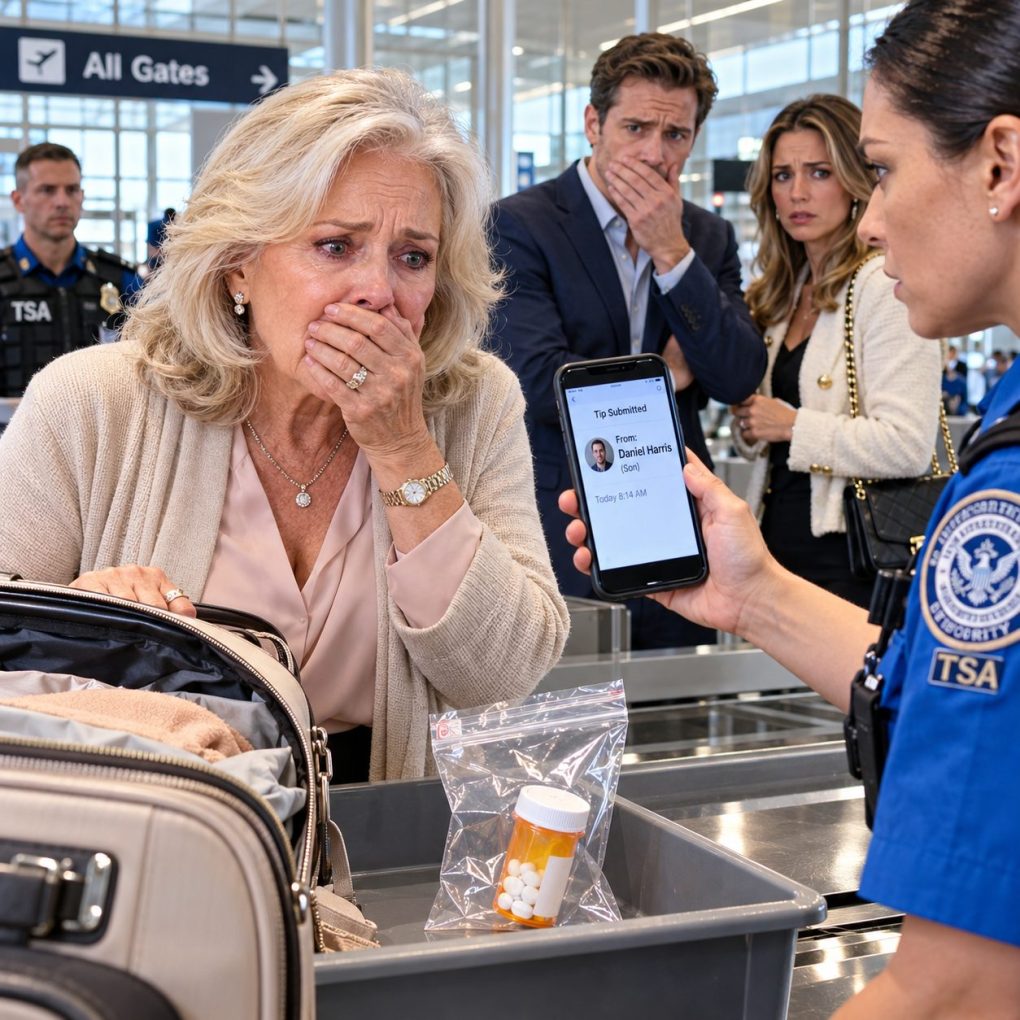
Then the TSA supervisor looked at me and said, “Mrs. Whitman, there’s something else you need to know.”
He held up his phone.
“We received the tip at 5:58 this morning.”
I stared at the screen.
The tip hadn’t come from Vanessa.
It had come from my son, Daniel.
For one awful second, the pills stopped mattering. Daniel hadn’t merely known what Vanessa was doing—he had helped set the trap. But when the officer showed me the rest of Daniel’s message, I realized the airport was only one piece of something much bigger.
I must have looked stunned, because the officer lowered his voice.
Daniel’s tip described me as “confused,” “dependent on pain medication,” and “likely to deny knowing the pills were there.” Those words weren’t random. They sounded rehearsed.
Melissa arrived at the terminal twenty minutes later with her laptop and a folder tucked under her arm. She had been digging while I was on the road.
“Carol,” she said, “Daniel and Vanessa filed an emergency petition for temporary conservatorship two days ago.”
For a second, I couldn’t understand the sentence.
A conservatorship.
Over me.
The petition claimed I had shown signs of cognitive decline since Frank died, that I had become reckless with money, and that I was abusing prescription painkillers. Daniel was asking a Maricopa County judge to give him temporary control over my financial accounts “for my protection.”
My hands started shaking.
Six weeks earlier, Daniel had asked me to lend his remodeling company $240,000 after two major projects collapsed. I had refused. Frank and I had spent thirty-eight years building our retirement, and after his death I wasn’t going to gamble it because my son was desperate.
Daniel had called me selfish.
Vanessa had called me paranoid.
Now I understood why.
The planted pills were supposed to make their court filing look true.
Police separated Daniel and Vanessa when Daniel returned to the airport after learning she had been stopped. Neither was allowed near me. I watched through the glass wall of an interview room as my son paced, his face red, while Vanessa sat with her arms folded tightly across her chest.





