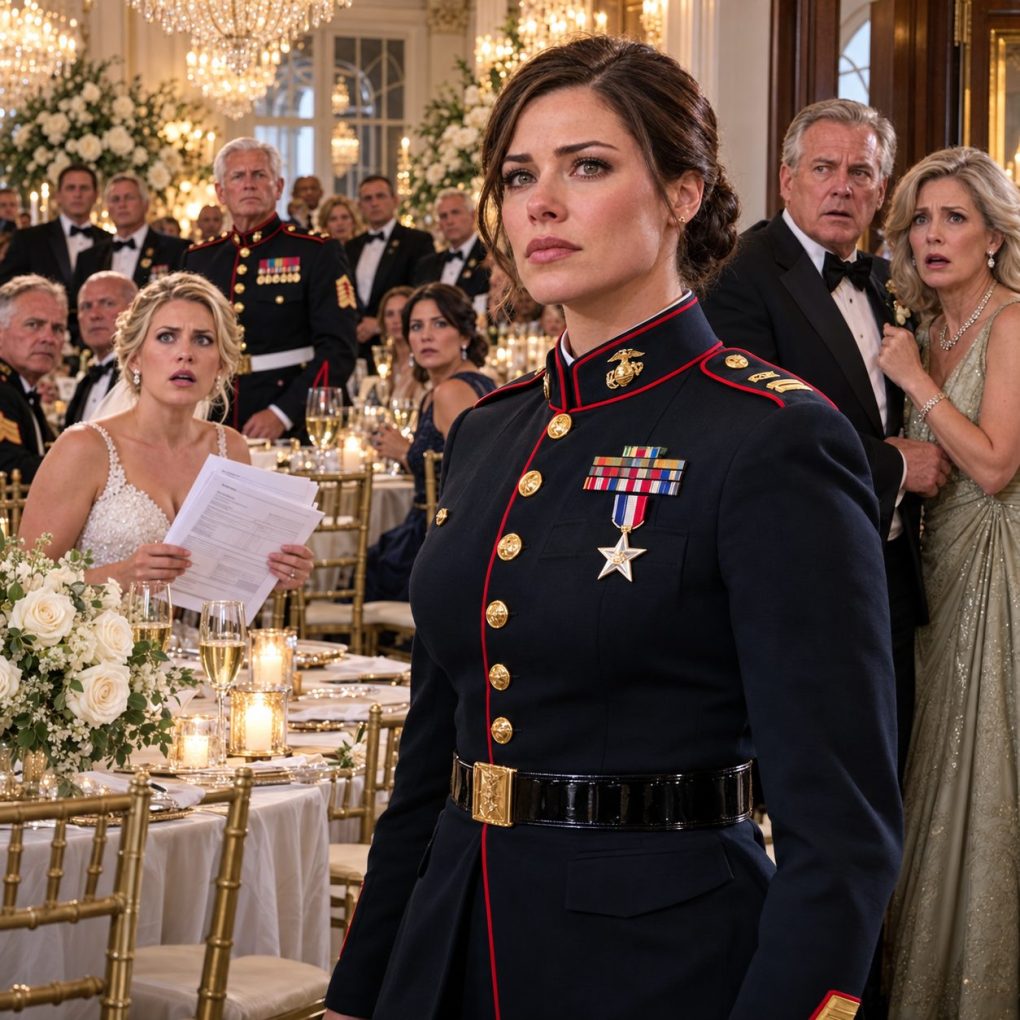
The first thing my mother said when I stepped out of my car was, “Claire, please tell me you brought a dress.”
I looked down at my Marine Corps dress blues, the polished buttons, ribbons, and Silver Star above my left breast.
“No,” I said. “I brought exactly what Ethan asked me to wear.”
Her face went white.
Behind her, the ballroom doors of the Harbor House in Charleston were opening for my younger brother’s wedding reception. Through the glass, I could see chandeliers, white roses, champagne towers, and a hundred and fifty people dressed like they belonged in a magazine.
My father came outside so fast he nearly collided with a server.
“You cannot walk in there like that,” he hissed.
A week earlier, both of them had called me separately. Mom said Caroline’s family was “traditional” and military uniforms would look aggressive in photographs. Dad was less careful.
“The military is embarrassing, Claire. This is Ethan’s day. Don’t turn it into one of your ceremonies.”
I had spent fourteen years in the Marines. I had buried friends. I had earned the Silver Star during a convoy attack in Afghanistan, and I had never asked my family to understand what it cost.
But I had never expected them to be ashamed of it.
“Ethan told me last spring to wear my blues,” I said.
Dad’s jaw tightened. “Things changed.”
“What things?”
He glanced toward the ballroom. “Go back to the hotel and change.”
That was when I understood this wasn’t about etiquette.
They were scared.
I walked past them.
My mother caught my sleeve. “Claire, don’t.”
I gently removed her hand.
The moment I entered the reception, conversations thinned out. Heads turned. A few people stared at the uniform. Others noticed the medal.
Then an older man near the center of the room stood so abruptly his chair scraped the floor.
He was broad-shouldered, silver-haired, and wearing a Marine Corps lapel pin.
His eyes went directly to my chest.
“Silver Star in the room,” he said.
Everything stopped.
Eleven more men and women rose from two nearby tables.
Some were my age. Some were old enough to be my parents. One used a cane. Another wore a Navy Cross pin on his tuxedo lapel.
Nobody clapped.
They simply stood.
That silence hit harder than applause ever could.
My mother froze beside the entrance. My father looked like someone had pulled the floor out from under him.
The silver-haired man crossed the ballroom and extended his hand.
“Sergeant Major Daniel Ruiz, retired,” he said. “Major Bennett, I know your name.”
Before I could answer, the bride appeared beside him.
Caroline was still wearing her wedding gown. She looked from me to my parents, then back to me, confusion turning into anger.
“Claire,” she whispered, “why did your mother tell us you were discharged under bad circumstances?”
I stared at her.
“What?”
Caroline swallowed.
“And why did she say we weren’t supposed to introduce you as Ethan’s sister?”
Behind me, my father said my name sharply.
But Caroline wasn’t finished.
She reached into the pocket hidden in her gown and pulled out a folded paper.
“There’s something else,” she said. “My dad thinks your signature is on it.”
For one second, the medal on my chest no longer mattered. Whatever my parents had been hiding was bigger than their shame, and judging by my father’s face, that folded page could destroy far more than a wedding.
Caroline handed me the paper before my father could reach us.
It was a federal contracting disclosure for Bennett Infrastructure, my family’s construction company. I had never worked there. I owned a small inherited share from my grandfather, but I had no management role.
According to the document, I owned fifty-one percent.
According to the signature at the bottom, I had certified it myself.
“This isn’t my signature,” I said.
My father stepped closer. “Claire, not here.”
Sergeant Major Ruiz heard him. “Then where?”
Caroline’s father, Thomas Avery, joined us. Until then, I knew him only as the quiet father of the bride. I also knew he had spent twenty-six years in the Marine Corps before becoming an attorney advising companies on federal procurement.
Now I understood why Dad looked terrified.
Thomas took the page from me.
“Your company has represented for three years that Claire is the majority owner and exercises control,” he said. “Her veteran status is part of the basis for several set-aside contracts.”
“I am not a fifty-one percent owner,” I said.
My mother whispered, “Richard.”
Then Ethan pushed through the crowd.
“What is happening?”
I looked at my brother. “Did you know Dad was using my name on company filings?”
His face went blank.
Dad answered for him. “Nobody used anybody. Claire has equity. The paperwork was structured for the business.”





