 The air in my kitchen still smelled of sugar glaze, cheap strawberry frosting, and the sharp, hot scent of wax after nine little candles had been blown out in a single, triumphant puff.
My daughter Ruby was sitting on the second step of the back patio, her knees drawn up into the oversized yellow sundress she had begged to wear. Her socks were stained with grass at the heels. On the kitchen island behind me, six opened juice boxes sat in a puddle of condensation next to a mountain of paper plates smeared with crushed cake. The house was loud—the kind of suburban Sunday afternoon loud that rattled in your dental work. Little girls’ sneakers squeaked across the hardwood; parents stood in loose clusters by the French doors, pretending they weren’t checking the time on their smartwatches every four minutes while balancing paper cups of pinot grigio.
Ruby was nine today. Nine is an earnest, fragile age. It is old enough to understand when an adult is being sarcastic, but still young enough to believe that fairy tales might be concealed in ordinary packages delivered by the United States Postal Service.
Then the doorbell chimed.
It wasn’t a guest. The guests were already here, sweating through their polo shirts and laughing too loudly at each other’s polite neighborhood jokes. I dried my hands on a flour-sack towel and stepped around the cluster of mothers from Ruby’s soccer team.
The postal carrier was already jogging back down the front walkway toward his white truck, leaving a medium-sized cardboard box propped against the storm door. The shipping label was standard priority mail, but the ink wasn’t printed from a computer. It had been written with an old-fashioned ballpoint pen—the strokes deliberate, trembling slightly with the unmistakable palsy of an artist who had lived nine decades.
*Miss Ruby Vance.*
*c/o Lauren Vance.*
My heart gave a quiet, familiar thump. Great-Grandma Clara.
Clara was ninety-one. She lived three towns over at Silver Creek Manor, in a quiet, sunlit corner apartment where she kept African violets in vintage teacups and listened to classical radio at top volume because her hearing aids whistled if she turned them up too high. She didn’t drive anymore, and her arthritis made long social gatherings an agonizing trial, but she never missed a milestone.
“Ruby!” I called over the noise of the living room, picking up the box. “Look what just arrived.”
Ruby perked up immediately, abandoning her juice box on the porch step and bounding inside. Her dark curls bounced against her collarbone. “Is it from Great-Grandma?”
“Her handwriting,” I said, smiling as I handed her a dull butter knife from the counter. “Careful with the tape.”
The kitchen seemed to drift toward us. Other kids gathered round, attracted by the crinkling sound of brown paper. My sister, Rebecca, stood leaning against the kitchen pantry, her blonde highlights immaculately blown out, her silver bangles jingling softly as she crossed her arms. Her daughter, Isabella—ten years old, dressed in a pristine designer polo dress that looked like it had been dry-cleaned twice—hovered near her elbow, watching Ruby with cool, bored eyes.
Ruby sliced through the paper tape. She pulled back the cardboard flaps. Inside, buried beneath layers of tissue paper printed with tiny silver stars, was a box.
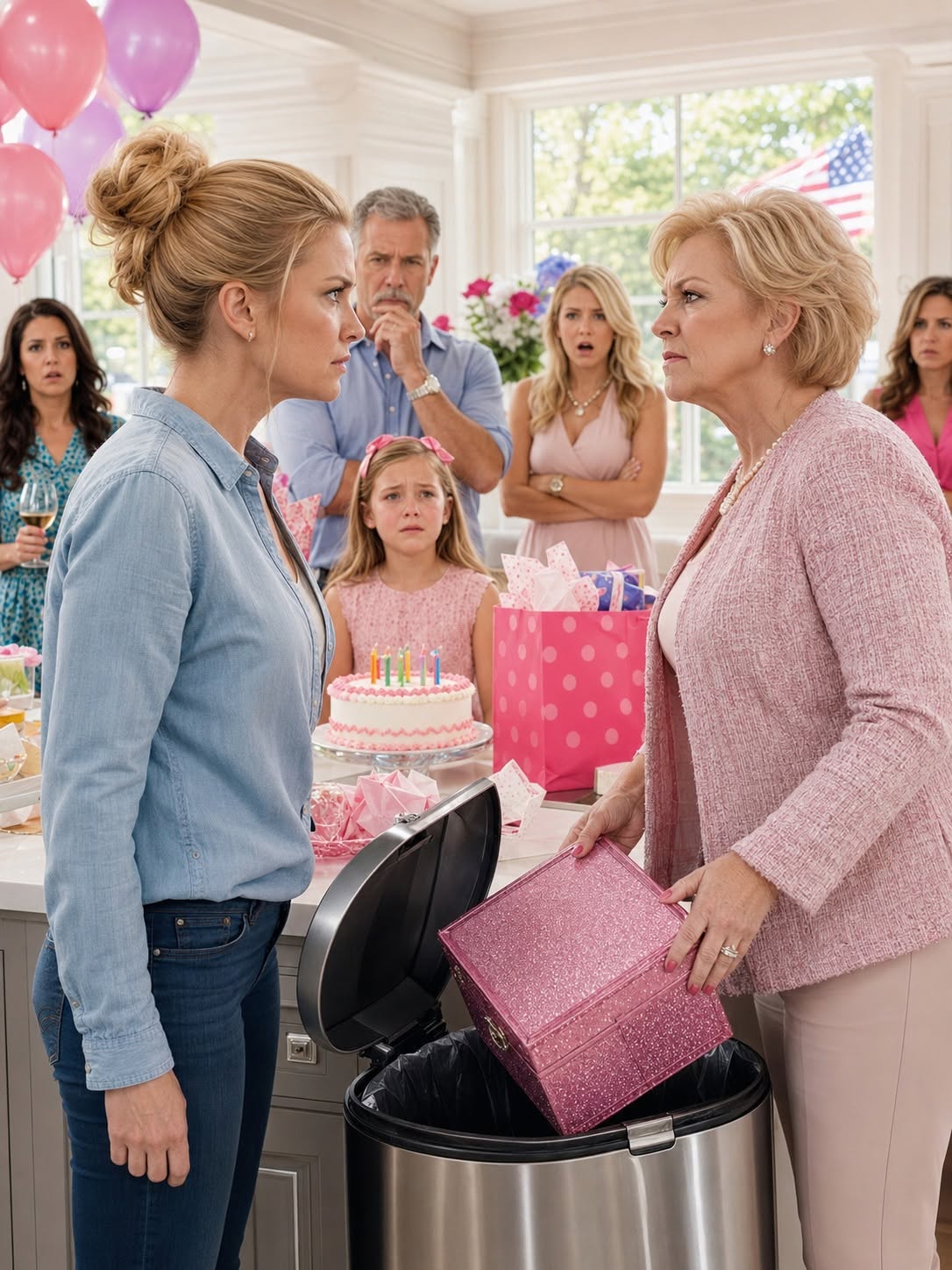
It wasn’t a standard store-bought container. It was a wooden keepsake chest, about the size of a hardback dictionary, painted in a shimmering, pearlescent pink lacquer with a small brass latch. Around the edges, hand-painted sprigs of lavender and wild roses framed a brass nameplate. It was beautiful, tactile, and completely unique.
Ruby’s eyes widened. She touched the smooth, cool wood. “Mine,” she whispered. It wasn’t greedy; it was reverent.
And that was the precise moment the air in the room died.
“No, no. Absolutely not.”
My mother’s voice didn’t rise to a shout. She had never needed to shout. Evelyn Vance had spent forty years commanding school board meetings, junior league committees, and dinner tables with a calm, clipped, mid-Atlantic drawl that sounded like silver spoons clinking against bone china.
She crossed the kitchen from where she had been standing by my father. Her movements were not rushed, yet she covered the distance in two strides.
“Step back, Ruby,” my mother said. Her manicure was a pale, bloodless beige.
Ruby blinked, freezing with her hands still resting on the pink lid. “Grandma? It’s from Great-Grandma Clara—”





