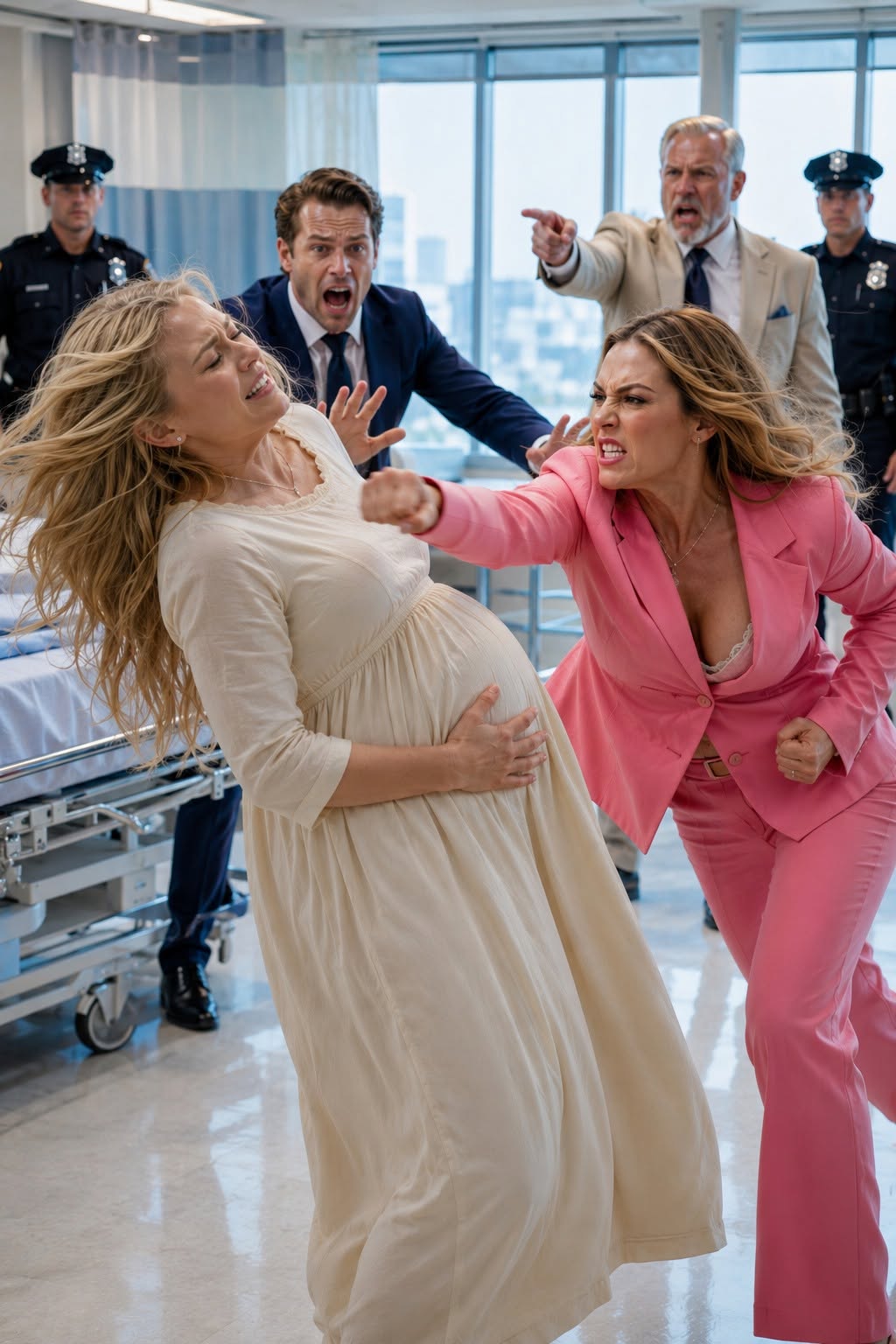
 A woman remembers the exact moment her marriage stops being a covenant and becomes a crime scene.
For Avery Whitmore, it was not the afternoon she found three different hotel receipts from the Olympic Club tucked into the pocket of Grant’s cashmere overcoat. It was not the silent dinners in their Medina mansion, where the clinking of heavy sterling silver against bone china sounded like small, rhythmic hammers striking iron. It was not even the evening she sat on the cedar floor of the nursery, six months pregnant, listening to her mother-in-law, Eleanor Whitmore, discuss the legal advantages of an early emergency cesarean with a private pediatric firm.
It was the smell of industrial floor cleaner, winter rain through an exhaust vent, and the sound of Grant’s laughter echoing through the third-floor corridor of Mercy General Hospital.
The corridor was fifty yards long, paneled in imitation maple, and illuminated by recessed fluorescent panels that hummed at sixty cycles per second. Avery stood five paces from the triage desk, her bare feet flat against the linoleum. She was thirty-two years old, eight months pregnant, and wearing a pale blue linen maternity shift that had grown tight across her ribs. On her left wrist was a clear plastic hospital bracelet stamped with her medical record number, her name, and the blood type she shared with her father: O-negative.
Two feet in front of her stood Brooke Keating.
Brooke was twenty-six, small-boned, and dressed in a tailored double-breasted blush wool coat that smelled of bergamot and dry cedar. Her fingernails were short, neat, and painted a pale, lacquered almond. Her right fist was still closed, suspended in the cold air between them, her knuckles reddened where they had just connected with the soft tissue of Avery’s upper lip.
Avery did not fall.
She had spent three years as a collegiate rower on Lake Washington before she ever met Grant Whitmore; she understood how to drop her center of gravity, how to plant her heels, and how to absorb kinetic force through the pelvis rather than the spine. She took one deliberate step backward, her shoulder blades brushing the vinyl bumper rail along the wall. Her hands moved instinctively down, cupping the lower swell of her belly, fingers spreading wide over the thin blue linen.
Beneath her palms, the child had gone rigid.
For three seconds—the longest interval of Avery’s life—there was no flutter, no kick, no familiar rhythmic shifting of small heels against her right ribs. Just a dead, frozen stillness that felt like ice water poured directly into her thoracic cavity.
Then, at the corner of her vision, Grant chuckled.
Grant Whitmore was thirty-five, six feet two inches of clean-shaven, East Coast breeding, with dark hair parted with mathematical precision and a jawline that appeared on quarterly healthcare reports distributed across three continents. He stood three paces behind Brooke, his hands buried deep in the pockets of his charcoal bespoke trousers. His camel-hair coat was unbuttoned, draped with casual elegance over his shoulders. His smile was not tight, not nervous, not panicked.
It was light. Amused. The casual expression of a man watching an expensive retriever snap at an unfamiliar hound in a private paddock.
“Careful, Brooke,” Grant murmured, his voice rich, textured, and carrying easily down the linoleum corridor. “She’ll make herself the victim again. You know how she gets when she doesn’t control the room.”
Avery tasted the copper. It was thin at first, pooling in the small groove above her incisor, then running hot and thick down the left corner of her chin. A single, dark drop fell from her lower lip, striking the toe of her bare right foot, bright scarlet against the pale skin.
Down the hallway, the world had frozen in amber.
A charge nurse, her identification badge clipped to a pale green scrub top with a yellow smiley face, stopped with her hand hovering four inches above a computerized medication dispenser. Two orderlies with a fresh linen cart stood motionless, their rubber-soled shoes glued to the floor. Across from the elevators, an armed security guard with a grey mustache looked from Avery’s bleeding mouth to Grant’s tailored suit, his eyes flicking involuntarily to the heavy bronze plaque mounted beside the glass doors: The Grant & Eleanor Whitmore Pavilion for Maternal and Infant Health.
The guard did not move. He did not unclip his radio. He simply lowered his chin, staring at the floor between his polished boots, choosing his mortgage over his conscience.





