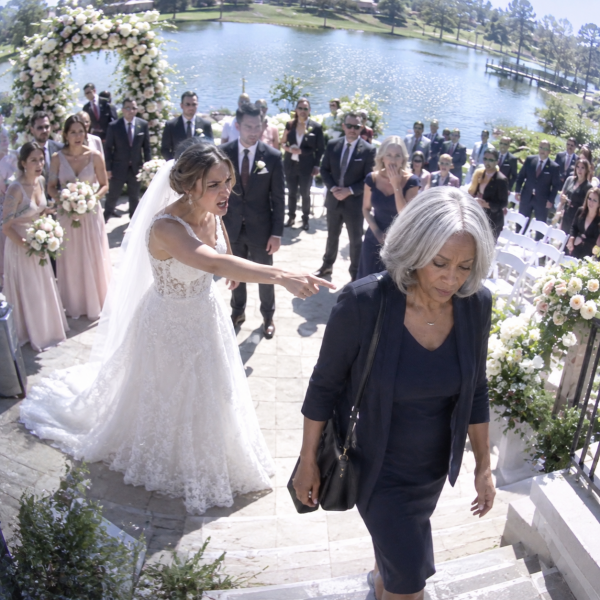
My daughter asked me to leave her wedding before the first dance because, in her words, I was “making them look bad.”
She said it quietly at first, beside the white rose arch overlooking Lake Travis, but not quietly enough. Her new husband, Ryan, heard her. So did his mother, who stood three feet away in pearls and a pale blue dress, pretending to study the seating chart.
“Mom, please,” Emily said, jaw tight. “You should go.”
I looked down at my navy dress. It was simple, knee-length, the same one I had worn to church the previous Easter. I had driven three hours from our ranch outside Fredericksburg, Texas, after spending the morning helping the caterer unload boxes because Emily’s coordinator had called in a panic.
“What exactly am I doing?” I asked.
Her eyes flicked toward Ryan’s family.
“You keep talking about the ranch. About cattle. About fixing fences. They’re… different people.”
Different.
Ryan’s father owned a commercial real estate company in Dallas. His mother had spent the cocktail hour telling everyone about their second home in Aspen.
I had spent thirty-two years raising Emily on 640 acres my late husband and I built from nothing.
Then Emily whispered the sentence that cut deeper than the first.
“They think you’re embarrassing.”
A bridesmaid stopped mid-step.
Ryan stared at the ground.
Nobody defended me.
I could have reminded Emily who had paid the final $18,000 when the venue deposit came due. I could have mentioned the $42,000 I had quietly transferred for her college loans. I could have asked why she had spent the previous six months calling the ranch “our future” whenever she needed something.
Instead, I picked up my handbag.
“Enjoy your wedding,” I said.
She seemed relieved.
That was the part I remembered most.
I walked past the string quartet, past two waiters holding champagne trays, and across the sunlit lawn while people pretended not to watch.
My hands shook only once, when I reached my truck.
The next morning, at 8:17, my phone rang.
Emily.
No apology.
“Mom,” she said quickly, “I need you to email me the ranch papers today. Ryan’s lender needs them by noon.”
I sat at my kitchen table and stared at the framed photograph of her father beside the coffee pot.
“What lender?”
Silence.
Then she exhaled.
“For the business loan. We already discussed this.”
No.
We hadn’t.
And suddenly, the wedding, the whispers, and months of strange questions about acreage values clicked into place.
I closed my eyes.
Then I gave my daughter four words.
“The ranch isn’t yours.”
Emily did not speak for several seconds.
Then her voice changed.
“What do you mean, it isn’t mine?”
I leaned back in the chair. Through the kitchen window, morning light stretched across the pasture, catching the fence posts her father had set by hand years earlier.
“I mean exactly that.”
“But Dad always said the ranch would stay in the family.”
“He did.”
“And I’m your only child.”
“That doesn’t make you the owner.”
Her breathing sharpened.
“Mom, Ryan already submitted paperwork. His father helped arrange everything. The bank just needs the deed and your signature.”
There it was.
Not a request.
A plan.
I asked her to send me whatever Ryan had submitted.
Ten minutes later, an email arrived with a PDF attached.
The application described the ranch as an asset “to be transferred to borrower’s spouse as an immediate family conveyance.”
Estimated value: $3.8 million.
My name appeared only in a note saying the transfer was “pending final execution.”
I called Daniel Mercer, the attorney who had handled my husband’s estate.
“Linda,” he said after reading it, “did you promise them this property in writing?”
“No.”
“Did you sign anything?”
“No.”
“Then don’t.”
By noon, Emily and Ryan were standing on my porch.
Emily still had yesterday’s wedding manicure. Ryan wore khakis and a white polo, but the confidence was unchanged.
“This is getting blown out of proportion,” he said.
I handed him the loan application.
“You represented property you don’t own as collateral.”
He glanced at Emily.
“We were told it was eventually hers.”
“Eventually isn’t legally.”
Emily stepped forward.
“Mom, you said you wanted me secure.”
“I did.”
“So why are you doing this to me?”
I stared at her.
“You threw me out of your wedding because I embarrassed you.”
Her face tightened.
“That was different.”
“No.”
I folded the document once.
“It clarified things.”
Ryan’s phone buzzed twice.
Then a black SUV turned onto the gravel drive.
His father, Charles, got out holding his phone.
“What did you tell the bank?” he demanded.
I said nothing.
Charles looked at Ryan instead.
“The lender froze the application. They want proof of ownership, and compliance is asking questions.”
Emily went pale.





