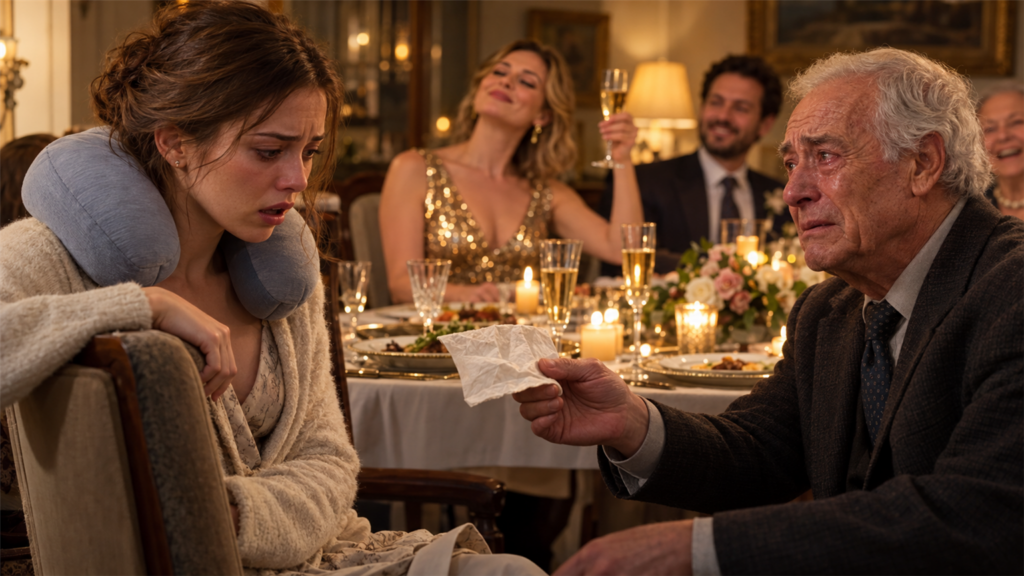
“To Vanessa,” Mom announced, raising her glass above the hospital-discharge cake. “Without her fundraiser, your father might not be here.”
Twenty-two relatives applauded. My sister stood beside the balloons, accepting hugs. I sat at the end of the table with a cushion pressed against my side, nine weeks after giving Dad my left kidney.
Nobody mentioned the operation.
My name is Claire Whitmore. I’m thirty-one, a public-school librarian in Dayton, Ohio. Dad had actually come home weeks earlier, but Mom had postponed the celebration until he was strong enough to enjoy a family dinner.
Before Dad’s transplant, I had spent four months going through evaluations, blood tests, and conversations with a transplant psychologist. I knew I could change my mind at any point.
I didn’t.
When I woke after surgery, Dad had sent a text from his own recovery room: We did it, sweetheart. Rest now.
I kept that message.
At home, I learned to sleep on my back. I needed help carrying groceries, missed weeks of work, and watched my emergency savings shrink. Vanessa visited once with a bouquet she left in its plastic supermarket sleeve.
“You’re the quiet one,” she said. “I’ll handle the family updates.”
She handled those updates beautifully. There were online photographs, matching T-shirts, and a fundraiser for “Dad’s transplant expenses and family recovery.”
I assumed the donations helped Mom cover the household costs. Whenever I asked, Vanessa said she was sorting out the bills.
Now she smiled beneath a banner that read OUR FAMILY HERO.
Mom continued, “Vanessa worked day and night to save him.”
I looked at Dad. He wasn’t clapping. His fork remained beside an untouched slice of cake, and he kept smoothing the edge of a folded paper napkin.
I stood carefully, one hand braced against the chair. My side still pulled painfully whenever I moved too quickly.
“Leaving already?” Vanessa asked. “Some of us actually worked to make today happen.”
A few relatives chuckled.
“I need to rest,” I said.
Dad caught my wrist—not hard, just enough to stop me. His eyes were wet. With his other hand, he slid the napkin into my palm.
On it, in his shaky handwriting, were seven words:
The transplant center called. Ask about the invoice.
I bent toward him. “What invoice?”
He whispered, “Your sister doesn’t know they contacted me.”
Across the room, Vanessa lifted her glass for another photograph. Dad looked past me at the banner, then back at my face.
“She told everyone the hospital needed forty-six thousand dollars,” he said. “Claire, the hospital says that bill doesn’t exist.”
I read the napkin in my car three times before driving home. Dad had given me a number for the transplant center’s patient financial office. I called the next morning, and a coordinator explained what concerned my care: the transplant-related donor surgery had been billed through Dad’s insurance, not to me. Other living expenses were separate. She couldn’t discuss Vanessa’s conversations without permission.
Dad called an hour later.
“A family friend sent the center a photograph of an invoice Vanessa posted,” he said. “It had their letterhead. They told me it wasn’t theirs.”
“Why didn’t you say anything at dinner?”
His breath caught. “Your mother said we should sort it out privately.”
I stared at the red indentation my waistband still left against my healing incision.
Vanessa’s fundraising page was still online. The caption promised help with transplant bills, medication, and “Claire’s recovery expenses.” It showed $46,380 raised. I had received nothing, although my unpaid leave, travel, and temporary assistance at home had cost nearly $9,000.
I took screenshots and asked Vanessa for an accounting in the family group chat.
Her reply came within minutes.
Stop making Dad’s celebration about yourself.
Mom called. “Your sister has done a lot. Don’t humiliate her over bookkeeping.”
“Did you know the invoice wasn’t real?”
Silence.
By Wednesday, three donors had messaged me. They had given because Vanessa said I might lose my apartment during recovery. One was Mrs. Patterson, Dad’s former neighbor, who’d enclosed fifty dollars with a note: Please make sure Claire has groceries.
I remembered eating crackers over my sink because lifting a pot had hurt too much.
At Dad’s follow-up appointment Friday, he asked me to come. We sat together outside the clinic while a transport shuttle hissed at the curb. He admitted he had seen the false invoice days before the party, but he’d been afraid Vanessa would cut him off from his grandchildren.
“I let your mother toast her anyway,” he said.
“Yes.”
“I’m sorry.”
“I needed you to say something before I got up.”
He reached for the napkin I’d carried in my coat pocket, then stopped.
“I know.”
That afternoon, Vanessa demanded a second family gathering to “clear the rumors.” She threatened to tell everyone I was trying to take money meant for Dad.





