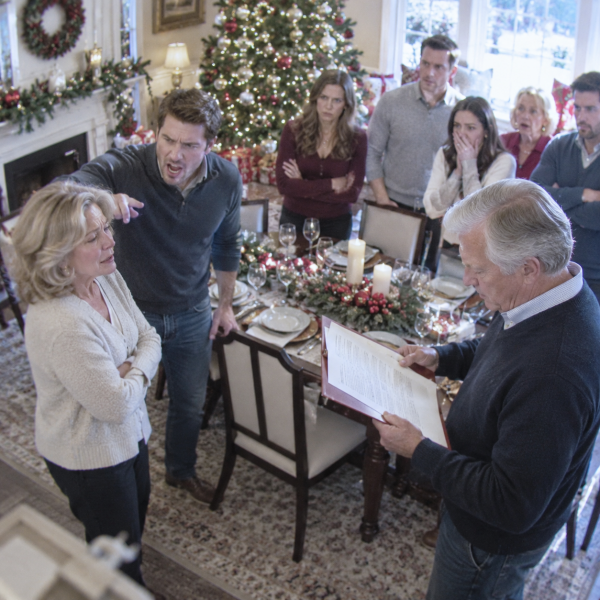
At Christmas dinner, my son called a family vote to decide whether I was still “appropriate” enough to attend our family gatherings.
He actually used that word.
Appropriate.
Twenty-three people were sitting around the long dining table in our house outside Columbus, Ohio. Candles burned between pine branches and red berries. Snow clung to the windowsills. My granddaughter’s handmade ornaments hung crookedly from the tree behind me.
And my forty-one-year-old son, Ryan, stood at the head of the table holding a wineglass like he was chairing a corporate meeting.
“Everyone gets one vote,” he announced.
At first, I thought it was some ugly joke.
My husband, Thomas, slowly lowered his fork.
“What exactly are we voting on?”
Ryan’s wife, Vanessa, answered before he could.
“Whether Diane should keep attending family events.”
My name.
Not Mom. Not Grandma.
Diane.
A few people stared at their plates.
My younger sister shifted in her chair. My nephew suddenly became fascinated with his napkin.
Ryan smiled.
“You make people uncomfortable, Mom.”
I looked at him. “By doing what?”
He laughed softly.
“That. That attitude.”
Vanessa folded her arms. “You criticize how we raise the kids. You ask uncomfortable questions about money. You refuse to dress appropriately for certain events.”
I looked down at my cream sweater and black slacks.
The sweater had cost forty dollars.
Apparently that mattered now.
Ryan had become successful over the past six years. He owned part of a construction company. Vanessa had discovered charity galas, private clubs, designer handbags, and people who introduced themselves by mentioning what neighborhood they lived in.
Somewhere along the way, my son started looking at me like I was an embarrassing photograph from his childhood.
Then he began the vote.
One hand after another went up.
Some reluctantly.
Some immediately.
A few people refused to participate.
Ryan counted only the raised hands that suited him.
Then he smiled.
“Unanimous.”
Thomas pushed his chair backward.
“It was not unanimous.”
Ryan ignored him.
Instead, he looked directly at me.
“You’re beneath us, Mom.”
The room went completely still.
Even Vanessa looked surprised he had said it aloud.
I felt my fingers tighten beneath the table.
But I didn’t cry.
I didn’t shout.
I simply looked at the little boy I had once worked double shifts to put through college.
Thomas stood.
His face had changed.
Not anger exactly.
Something colder.
He walked toward the antique cabinet beside the fireplace, opened the bottom drawer, and removed a brown legal folder.
Ryan frowned.
“What are you doing?”
Thomas returned to the table and placed the folder beside Ryan’s wineglass.
“You wanted a family vote?”
He opened it.
“Then perhaps everyone should know exactly where they’re sitting.”
Vanessa’s smile disappeared.
Thomas removed a document.
A property deed.
Ryan laughed nervously.
“Dad, what does the house have to do with this?”
Thomas adjusted his glasses.
Then he read the owner’s name aloud.
Mine.
Diane Elizabeth Carter.
And suddenly, nobody at that table seemed interested in voting anymore.
Ryan stared at the deed as if the letters might rearrange themselves if he waited long enough.
“That’s impossible.”
Thomas placed the document flat on the table.
“No. It’s recorded with Franklin County.”
Vanessa leaned forward.
“I thought this was your house.”
“It was,” Thomas said. “Until fifteen years ago.”
Then he looked at me.
I knew what he was asking.
So I finally spoke.
Thomas had nearly lost his engineering business during the 2009 recession. We had refinanced everything we could, but the house became vulnerable when one of his business partners defaulted on a loan.
My father had left me an inheritance.
I used most of it to clear the mortgage and protect our home.
Later, on advice from our attorney, the property was transferred solely into my name because the money used to save it had come from my separate inheritance.
Ryan knew none of this.
He had been twenty-four then.
Busy building his own life.
I never told him because I never believed my son needed to know whose name was printed on a deed to understand that this was his mother’s home.
Apparently, I had been wrong.
Ryan’s face reddened.
“So what? You’re going to throw your own family out on Christmas?”
I stared at him.
Interesting.
Five minutes earlier, throwing family away had seemed perfectly reasonable to him.
“No,” I said quietly. “I’m not throwing anyone out.”
His shoulders relaxed.
Then I continued.
“But the Christmas party is over.”
Silence.
Vanessa stood abruptly.
“You’re seriously embarrassing us over one comment?”
“One comment?” Thomas said.
His voice was low enough that everyone stopped moving.
“You organized a vote to exclude your mother from her own family while sitting inside the house she saved.”
Ryan turned toward him.
“You’re taking her side?”
Thomas stared at our son for several seconds.





