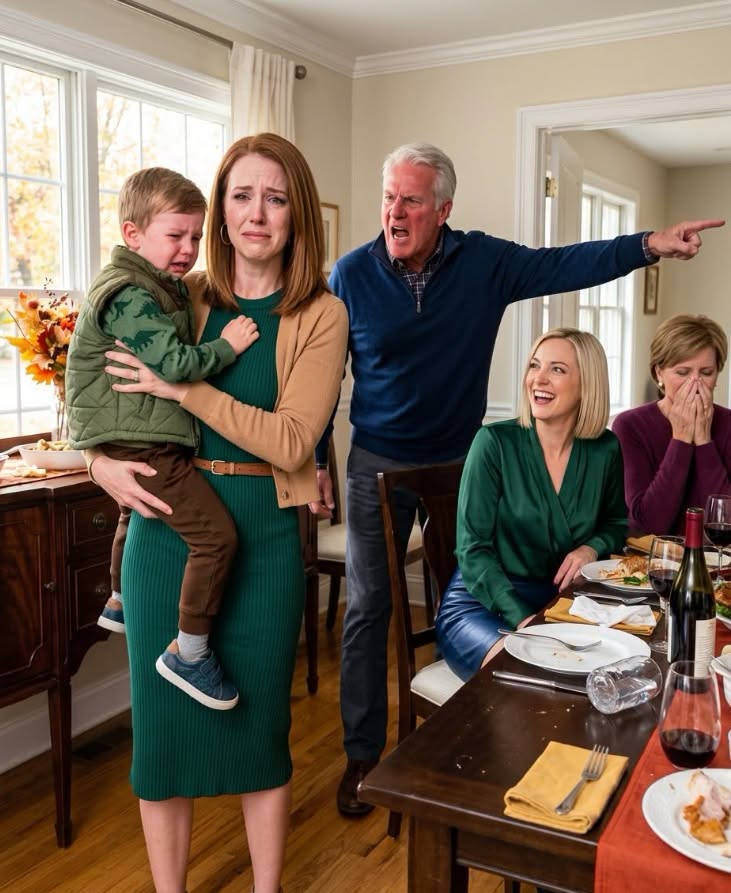
Der Regen über Delaware County roch nach nassem Asphalt und verrottenden Ahornblättern. Es war der dritte Sonntag im Oktober, ein typischer Herbstabend, an dem die Dämmerung nicht wirklich hereinbrach, sondern eher in die grauen Vororte nördlich von Columbus hineinreichte.
Emily Vance saß am langen Mahagoni-Esstisch des Coleman-Anwesens, die Hände flach auf der gestärkten Damasttischdecke. Der Tisch war für acht Personen gedeckt, doch nur fünf waren anwesend: ihr Vater Richard, ihre Mutter Susan, ihre ältere Schwester Vanessa, Emily selbst und ihr fünfjähriger Sohn Noah.
Daniels Stuhl blieb leer.
Auf der anderen Seite des Raumes schlug die Standuhr – eine hoch aufragende deutsche Reproduktion, die Richard vor zwanzig Jahren auf einer Nachlassauktion in Bexley erworben hatte – mit einem gebieterischen, blechernen Klang sechs Uhr. Richard Coleman mochte es nicht, wenn um sechs Uhr eins Essen serviert wurde. Er mochte es nicht, wenn die Brotteller rechts standen. Am allermeisten mochte er keine leeren Stühle an seinem Tisch, denn ein leerer Stuhl bedeutete, dass jemand woanders war und etwas tat, das außerhalb seiner Aufsicht lag.
„Er steckt wohl noch unter dem Chassis?“, sagte Richard.
Er blickte nicht von seinem Prime Rib auf. Mit klinischen, sägenden Bewegungen schnitt er es ab, das gezackte Silbermesser glitt durch das Fleisch, das Susan genau vier Minuten über medium-rare hinaus gegart hatte, um seine leisen, schneidenden Seufzer zu vermeiden.
„Ein Generator an einem Krankentransportwagen“, sagte Emily ruhig. Ihre Stimme klang gelassen und beherrscht, wie sie es sich fünf Jahre lang angeeignet hatte. „Der Fuhrparkleiter des Landkreises hat um drei Uhr bei Miller & Vance angerufen. Wenn Daniel das heute Abend nicht regelt, fährt der Dialysewagen morgen früh nicht aus der Garage.“
„Edel“, murmelte Vanessa.
Vanessa war vierunddreißig, achtzehn Monate älter als Emily, und hatte die blasse, zierliche Gesichtsfarbe ihrer Mutter geerbt, gepaart mit dem kalten, prüfenden Blick ihres Vaters. Sie trug einen cremefarbenen Kaschmirpullover, der aussah, als hätte er noch nie eine rauere Oberfläche als einen Ladentisch berührt. Sie drehte ihr Weinglas am Kristallstiel und fing so das sanfte Licht des Kronleuchters ein.
“Very civic-minded,” Vanessa continued, her mouth curving into that familiar, half-sympathetic tilt she used whenever she was about to drop an anvil. “Greg looked into the fleet contract for the county last year, you know. He said the margins are almost humorous. Four percent after municipal retainage. He told the county commissioner that his logistics consultants don’t step out of their air-conditioned offices for four percent.”
“Greg manages logistics for a regional tier-one auto parts supplier,” Emily said, keeping her hands steady under the table, where Noah’s small sneakers were gently swinging back and forth. “Daniel keeps the engines running. Different trades.”
“Very different,” Vanessa sighed happily. She leaned across the table toward their father. “Dad, did I tell you Greg finally took delivery on the Denali? Dark charcoal. He had them fly the trim package in from Detroit because the local allocation didn’t have the aniline leather.”
Richard’s fork paused halfway to his mouth. For the first time in an hour, a sliver of genuine warmth smoothed the hard vertical creases between his eyebrows.
“Seventy-two thousand,” Vanessa added. She didn’t state it as an expense; she stated it as an accreditation, a diploma hung on a wall.
Richard gave a single, satisfied nod and raised his cabernet. “A solid vehicle. Commanding presence. In commercial real estate and industrial transport, clients watch what you pull up in before they look at your contract. Greg knows how to project solvency. That’s what happens when a woman marries a man with ambition.”
He set his glass down. The heavy crystal base made a sharp *thock* against the wood.
Then, slowly, deliberately, his pale gray eyes traveled the length of the table and settled on Emily.
“You married a poor man.”
The dining room went entirely still.
Even the kitchen—where the exhaust fan had been humming a low, rattling monotone—seemed to drop an octave. Outside, a gust of October wind hurled a handful of wet pine needles against the double-paned bay window.
Noah’s fork slipped. A small mound of buttered mashed potatoes tumbled off the tines, leaving a yellow smear on the damask.
Under the table, Noah’s small knee pressed instantly into Emily’s thigh. It was a tight, rigid little press. Children do not understand the terminology of tax brackets, depreciation schedules, or portfolio management, but they understand tone with the precision of an oscilloscope.
Vanessa let out a short, high laugh.
It was not a nervous laugh. It was not the uneasy chuckle of a sister trying to smooth over a father’s drunken indiscretion. Richard Coleman did not drink to excess; he drank precisely two glasses of Beringer Private Reserve per Sunday meal, remaining cold, lucid, and entirely sovereign over his domestic court.
Vanessa’s laugh was real. It had teeth in it.





