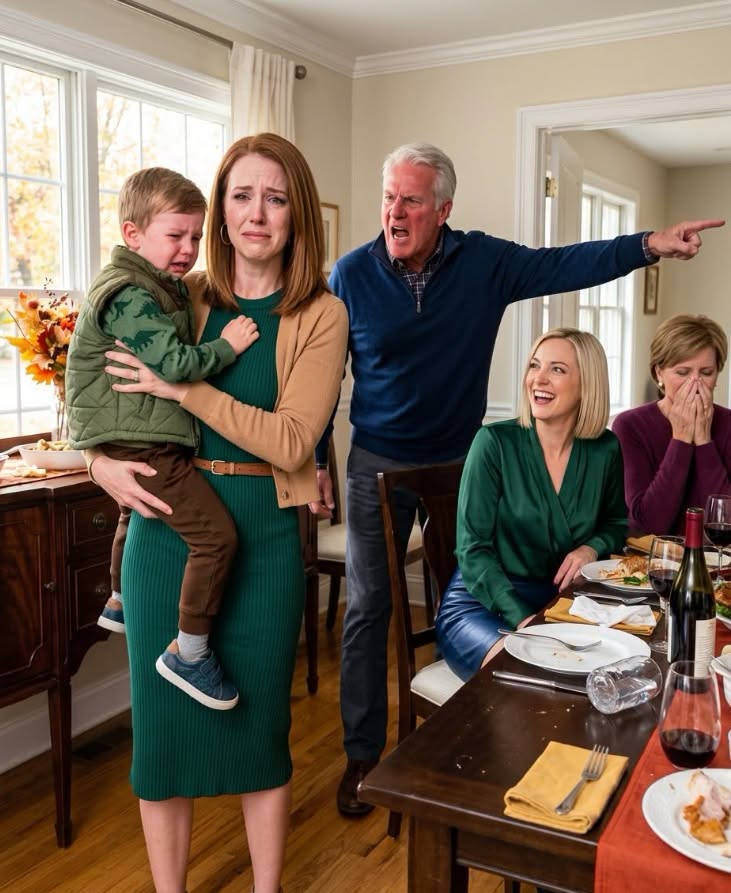
The rain over Delaware County smelled of wet asphalt and decomposing maple leaves. It was the third Sunday in October, the kind of autumn evening where the dusk did not fall so much as bleed into the gray suburbs north of Columbus.
Emily Vance sat at the long mahogany dining table of the Coleman estate, her hands resting flat against the starched damask tablecloth. The table was set for eight, though there were only five of them present: her father, Richard; her mother, Susan; her elder sister, Vanessa; Emily herself; and her five-year-old son, Noah.
Daniel’s chair sat empty.
Across the room, the grandfather clock—a towering German reproduction Richard had purchased at an estate auction in Bexley twenty years ago—struck six with an imperious, brassy resonance. Richard Coleman did not like meals served at six-oh-one. He did not like bread plates placed on the right. Most of all, he did not like empty chairs at his table, because an empty chair meant someone was elsewhere, doing something beyond his supervision.
“He’s still under a chassis, I suppose?” Richard said.
He didn’t look up from his prime rib. He carved with clinical, sawing strokes, the serrated silver slicing through meat that Susan had cooked precisely four minutes past medium-rare to avoid his quiet, cutting sighs.
“An alternator on an ambulance transfer van,” Emily said evenly. Her voice had the measured calm she had spent five years perfecting. “The county fleet manager called Miller & Vance at three. If Daniel doesn’t clear it tonight, the morning dialysis run doesn’t leave the garage.”
“Noble,” Vanessa murmured.
Vanessa was thirty-four, eighteen months older than Emily, and possessed their mother’s pale, delicate bone structure combined with their father’s cold, evaluating gaze. She wore a cream cashmere sweater that looked as though it had never encountered a surface rougher than a boutique counter. She turned her wineglass by its crystal stem, catching the low chandelier light.
“Very civic-minded,” Vanessa continued, her mouth curving into that familiar, half-sympathetic tilt she used whenever she was about to drop an anvil. “Greg looked into the fleet contract for the county last year, you know. He said the margins are almost humorous. Four percent after municipal retainage. He told the county commissioner that his logistics consultants don’t step out of their air-conditioned offices for four percent.”
“Greg manages logistics for a regional tier-one auto parts supplier,” Emily said, keeping her hands steady under the table, where Noah’s small sneakers were gently swinging back and forth. “Daniel keeps the engines running. Different trades.”
“Very different,” Vanessa sighed happily. She leaned across the table toward their father. “Dad, did I tell you Greg finally took delivery on the Denali? Dark charcoal. He had them fly the trim package in from Detroit because the local allocation didn’t have the aniline leather.”
Richard’s fork paused halfway to his mouth. For the first time in an hour, a sliver of genuine warmth smoothed the hard vertical creases between his eyebrows.
“Seventy-two thousand,” Vanessa added. She didn’t state it as an expense; she stated it as an accreditation, a diploma hung on a wall.
Richard gave a single, satisfied nod and raised his cabernet. “A solid vehicle. Commanding presence. In commercial real estate and industrial transport, clients watch what you pull up in before they look at your contract. Greg knows how to project solvency. That’s what happens when a woman marries a man with ambition.”
He set his glass down. The heavy crystal base made a sharp *thock* against the wood.
Then, slowly, deliberately, his pale gray eyes traveled the length of the table and settled on Emily.
“You married a poor man.”
The dining room went entirely still.
Even the kitchen—where the exhaust fan had been humming a low, rattling monotone—seemed to drop an octave. Outside, a gust of October wind hurled a handful of wet pine needles against the double-paned bay window.
Noah’s fork slipped. A small mound of buttered mashed potatoes tumbled off the tines, leaving a yellow smear on the damask.
Under the table, Noah’s small knee pressed instantly into Emily’s thigh. It was a tight, rigid little press. Children do not understand the terminology of tax brackets, depreciation schedules, or portfolio management, but they understand tone with the precision of an oscilloscope.
Vanessa let out a short, high laugh.
It was not a nervous laugh. It was not the uneasy chuckle of a sister trying to smooth over a father’s drunken indiscretion. Richard Coleman did not drink to excess; he drank precisely two glasses of Beringer Private Reserve per Sunday meal, remaining cold, lucid, and entirely sovereign over his domestic court.
Vanessa’s laugh was real. It had teeth in it.





