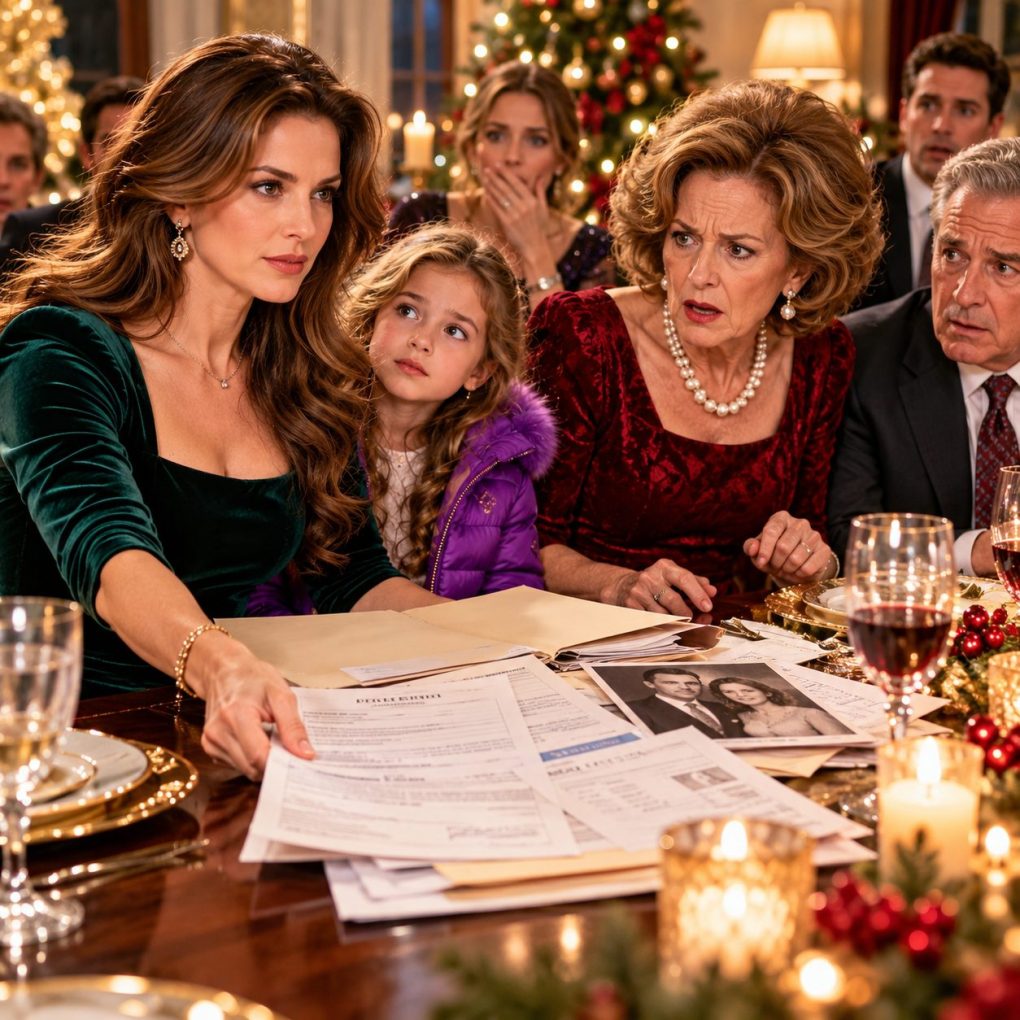
The room went silent so fast I could hear the ice settling in my water glass. My mother, Diane, was still standing behind my eleven-year-old daughter, Lily, holding the purple jacket she had just given her like it was some kind of trophy.
“This color means loyalty, sweetheart,” she had said, smiling for the whole table. “Don’t grow up to be like your mom.”
Everyone laughed. Not because it was funny. Because in my family, laughing when my mother cut someone down had become a reflex.
I set my fork beside my plate. “Say that again.”
Mom’s smile sharpened. She loved an audience, especially when she thought I wouldn’t fight back. “I said loyalty matters,” she replied. “And Lily should learn that early.”
My sister Melissa stared at her wine. My stepfather, Frank, suddenly became fascinated with the candles. Two cousins exchanged the look people give each other when they know something ugly is happening but don’t want to get involved.
Then Lily put down her spoon. She looked straight at my mother and asked, “Grandma, then why did you marry twice?”
No one moved.
Mom’s face changed first. Not much. Just enough.
I smiled. “My turn.”
I reached into my purse and pulled out a cream-colored envelope. Three days earlier, I hadn’t known that envelope existed.
A trust attorney in Dayton named Paul Mercer had called me at work and asked why I had authorized three distributions from my grandmother’s education trust.
I told him I hadn’t.
He went quiet. Then he asked if I could come to his office.
My grandmother Eleanor had died six years earlier. In her will, she created a trust for her great-grandchildren’s education. My mother was named trustee. Lily was one of four beneficiaries.
I had never questioned it. Why would I? Mom sent us annual statements. The numbers looked boring and official.
But Paul showed me copies of three “parental consent” forms bearing my signature.
The signatures were good. Very good.
They just weren’t mine.
One payment had gone to a family-law firm in Columbus. Another had gone to a private investigator. The third, for $18,400, had gone to an account controlled by my mother.
When I asked what any of that had to do with Lily’s education, Paul slid another folder across his desk.
Inside was a draft petition.
Petitioner: Diane Holloway.
Minor child: Lily Carter.
Requested relief: temporary guardianship.
I had read the first page three times before the words made sense.
My own mother had been using money intended for my daughter’s education to prepare a legal case to take my daughter away from me.
And she had forged my name to do it.
Back at the dinner table, Mom stared at the envelope in my hand.
“What is that?” she asked.
I pulled out the first document. “Something you should recognize.”
Frank’s face went gray.
Mom didn’t look at the paper. She looked at him.
That told me more than I expected.
I unfolded the document and laid it beside her plate. It wasn’t the trust statement.
It was a sworn deposition from my parents’ divorce in 1998.
And across the top, in my father’s handwriting, were six words I had never seen before:
Diane admitted the affair with Frank.
I thought the forged signatures were the worst thing I would uncover. I was wrong. The look between my mother and Frank told me the old affair and the new guardianship scheme were connected in a way I still didn’t understand.
Mom finally picked up the deposition, but her hands were trembling.
“This is ancient history,” she said.
“No,” I replied. “The affair is ancient history. The lying isn’t.”
Melissa looked at me. “What lying?”
For thirty years, Mom had told us that my father, Thomas, walked out because he wanted another life. She said he abandoned her, abandoned us, and left her to rebuild everything alone. I believed it until the day he died.
The deposition said something very different.
Dad had discovered Mom and Frank together eight months before the divorce. Frank had been Dad’s accountant. Mom admitted the relationship under oath.
Frank pushed back from the table. “Rachel, this has nothing to do with Lily.”
“That’s what I thought too.”
I removed the second document. It was the invoice from the family-law firm.
The room became painfully quiet as I read the description aloud: preparation of emergency guardianship pleadings, review of witness affidavits, consultation regarding parental instability.
Melissa’s head snapped toward Mom.
Mom stood. “You have no idea what you’re talking about.”
“I know you paid that firm from Lily’s trust.”
Her eyes flashed. “Because somebody had to protect her.”
There it was.
Not a misunderstanding. Not bad bookkeeping.
A plan.
I asked who Lily needed protection from.
Mom pointed at me. “You.”





