PART 2
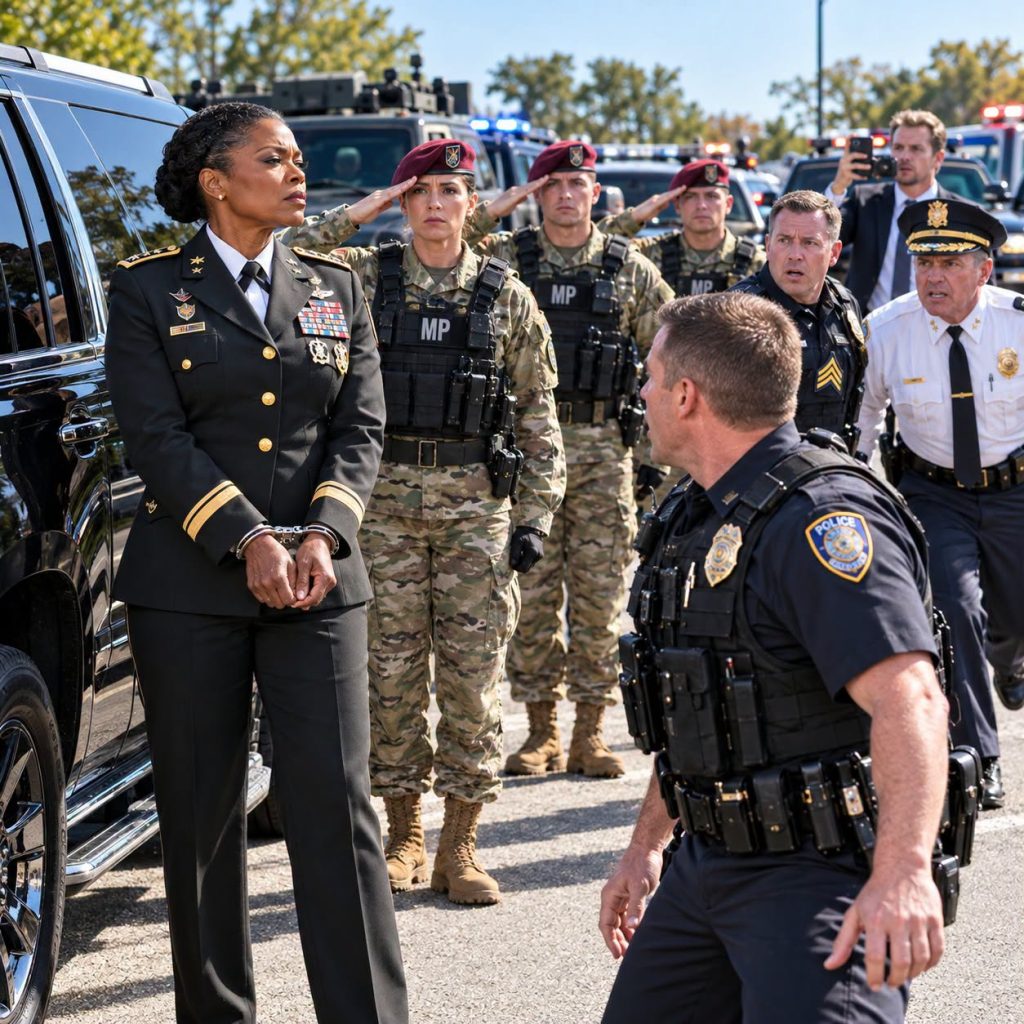
“Nobody takes those cuffs off,” Chief Nolan Briggs said. Major Tessa Bryant stared at him. “Excuse me?” Briggs walked between the patrol cars. “This is a civilian police investigation. Your people stay back.” Mercer’s confidence returned the instant his chief arrived. Bryant pointed at my swollen wrists. “Your officer is restraining a verified active-duty general beside an Army vehicle. Verify her identity and end this.” Briggs looked at me. “We’ll verify what we need.” “You already know who I am,” I said. His eyes flickered. Mercer tightened his grip on my arm. “Take your hand off me.” He jerked me backward. Pain ripped through my shoulders.
Bryant stepped forward. Two military police soldiers moved with her. Mercer reached toward his Taser. Wallace caught his wrist. “Don’t,” Wallace said. Mercer spun. “Get off me!” Wallace forced his arm down. “You are not tasing military police because you’re embarrassed.” For one second, everyone froze. Then Briggs shouted, “Wallace! Back away!” Across the highway, the mechanic was still filming. Briggs pointed at him. “Bring me that phone.” The man shook his head. “No.” “Then you’re interfering.” “Chief,” I said, “touch that witness or his recording and this becomes much bigger.” Briggs came close enough to lower his voice. “You want this to go away, General? Let us finish here, and I’ll make sure you get a private apology.” “A private apology for a public detention?” His jaw hardened.
Behind him, Bryant picked up my military ID and called Fort Harlan command operations on speaker. After she gave my identification number, the reply came in seconds. “Confirmed. General Renee Carter, commanding general, Strategic Sustainment Command.” Nobody moved. Wallace unlocked my cuffs. Mercer lunged toward him. “I didn’t tell you to do that!” Wallace blocked him. “Enough, Cole.” Mercer shoved him. Wallace shoved back. Then the mechanic crossed the road, phone still raised. “My name’s Mason Reed,” he said. “And I got all of it.” Briggs snapped, “Stay back.” Mason looked at me. “General, this isn’t the first time.” The chief’s face changed.
“What do you mean?” I asked. Mason pulled a folded photocopy from his coveralls. “I used to work dispatch here. I got fired after I questioned stolen-vehicle entries that appeared after officers had already made stops.” Mercer went pale. Briggs said, “He’s lying.” Mason handed the page to Bryant. She read it, then looked at me. “Ma’am, this Tahoe was entered as suspected stolen at 2:18 p.m.” I looked through the windshield at the dashboard clock. Mercer had arrived at 2:11. “You flagged it after you stopped me,” I said. “That’s not what happened,” Mercer snapped.
Wallace looked at Briggs. “I heard the chief on Mercer’s phone before dispatch returned anything,” he said. “He told him, ‘Build the theft report. I’ll handle the cameras.’” Briggs lunged for Mason’s phone. Mason jumped back. Bryant stepped between them. A military police captain caught Briggs by the shoulder. Briggs tore free and shouted, “Nobody leaves this road!” Then every Bell Creek body camera beeped at the same time. Wallace looked down. The recording light had gone dark.
PART 3
The lights died, but the evidence didn’t. “Everyone stay where you are,” I said. Briggs laughed. “You don’t command this road.” “No. But I know what evidence tampering looks like.” Bryant was already on the phone with Fort Harlan legal. Wallace called the county sheriff. Mason kept filming. Briggs moved toward him. “Give me the phone.” “Not a chance.” Briggs grabbed for it. Wallace caught his arm. “Stop.” Briggs drove an elbow into Wallace’s chest. Wallace staggered, recovered, and pinned him against the patrol car. Mercer rushed forward, but two sheriff’s cruisers appeared around the curve before he reached them. Wallace released Briggs and raised both hands.
Within minutes, county deputies separated everyone and secured the scene. The military police arrested nobody; they didn’t need to. Mason’s video was intact, my credential was verified, and the dispatch log showed the impossible timeline. Briggs claimed the cameras had suffered a “technical failure.” That lie lasted four hours. A Bell Creek evidence technician told investigators the body-camera system kept a protected local buffer even after remote recording was disabled. The shutdown command had come from an administrator account assigned to Briggs. Recovered footage showed Mercer examining my valid ID, hearing Wallace tell him to verify it, and cuffing me anyway.
Then investigators recovered Mercer’s call. “I’ve got another one,” he had said. Briggs answered, “Mark the vehicle first. We’ll clean the rest up.” That sentence cracked the department open. The Georgia Bureau of Investigation found eleven earlier stops with the same pattern: a driver detained first, a suspicious-vehicle entry created afterward, then reports rewritten to reverse the timeline. Most of the drivers were Black. Complaints against Mercer had repeatedly disappeared under Briggs’s administrator credentials. Mason had been fired because he noticed. Wallace had been threatened with demotion because he questioned it. I had simply been the first target whose complaint could not quietly disappear.





