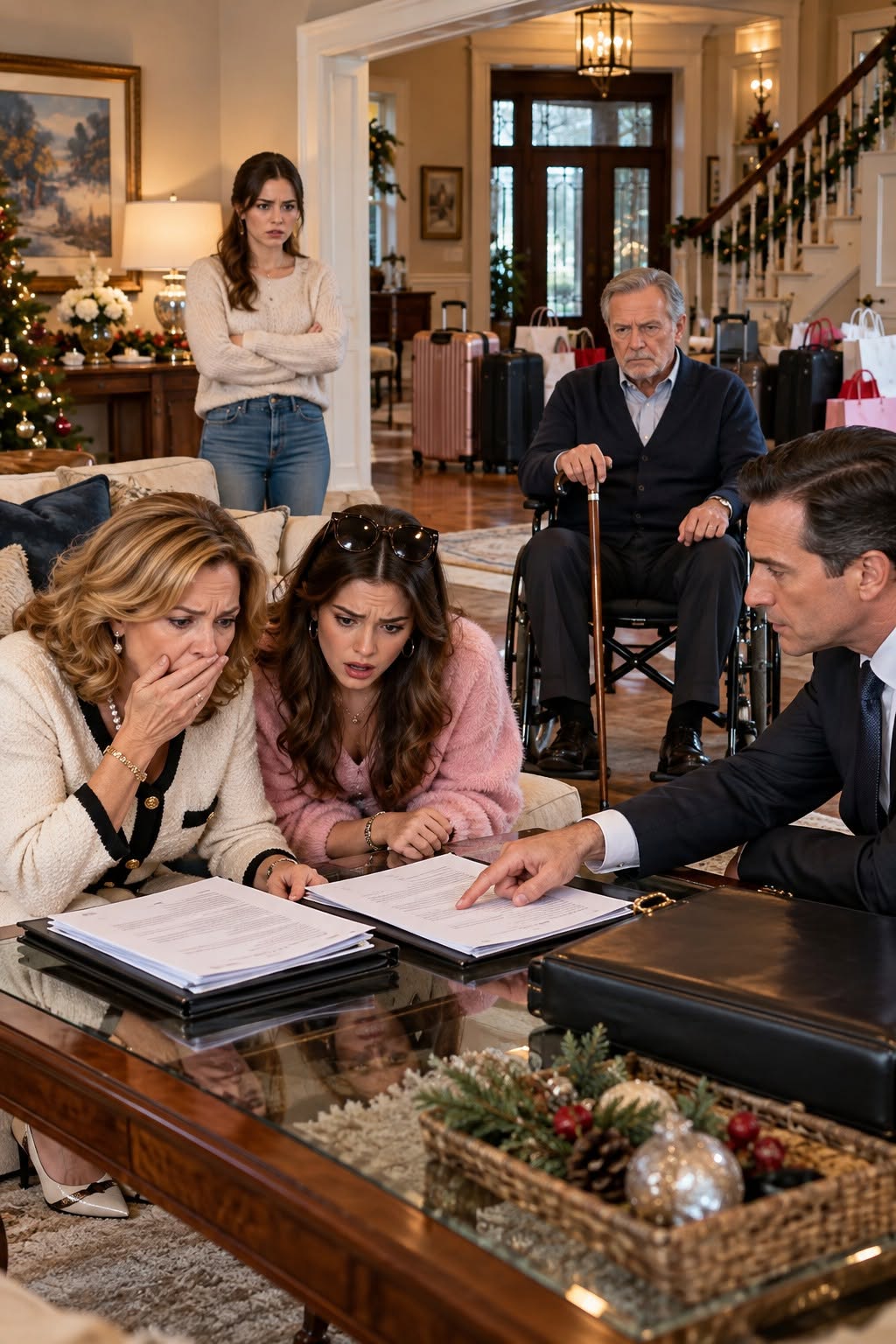
 “Robert… you can’t do this.”
My mother’s voice barely rose above a whisper.
For the first time in my life, Diane Whitmore looked genuinely afraid.
I stood beside my father’s wheelchair, watching her clutch the legal documents as though the pages themselves might bite her. Sabrina had stopped laughing. Her expensive sunglasses rested on top of her head, and one of her shopping bags had tipped over, spilling a designer purse onto the hardwood floor.
Dad looked at my mother for a long moment.
“Yes, Diane,” he replied calmly. “I can.”
Mr. Vance adjusted his glasses.
“Perhaps everyone should read the documents before making assumptions.”
Mom ignored him.
“You can’t simply take away everything we’ve built together!”
Dad’s expression barely changed.
“Everything we’ve built together?”
He repeated the words so quietly that I almost missed them.
“Tell me, Diane, what exactly did you build while I was lying in an intensive care unit wondering whether I would ever see my daughters again?”
Mom’s face tightened.
“That isn’t fair. We didn’t know you were going to have a heart attack.”
“No,” Dad said. “You didn’t know because you didn’t bother to check.”
Sabrina threw the papers onto the coffee table.
“This is ridiculous! You’re punishing us for taking a vacation?”
Dad turned toward her.
“No, Sabrina. I’m responding to years of decisions you made when you believed there would never be consequences.”
She stared at him as though he had suddenly started speaking another language.
I couldn’t blame her.
My father had spent decades protecting them from the consequences of their own behavior.
He paid Sabrina’s credit cards whenever she overspent. He covered Mom’s shopping sprees, repaired their mistakes, and apologized to other people on their behalf.
Whenever I questioned it, he told me that family meant forgiveness.
I had believed him.
Now, watching him sit in that wheelchair with a blanket over his knees, I wondered how much of his kindness had quietly become permission for them to hurt him.
Mr. Vance tapped the second packet.
“Mrs. Whitmore, this document concerns the immediate suspension of your authorized access to certain financial accounts owned exclusively by your husband. It also confirms the revocation of several powers of attorney previously granted to you.”
Mom stared at him.
“You can’t revoke my authority!”
“Actually, your husband can,” the attorney replied. “The documents have been properly executed, witnessed, and reviewed. Your husband has also received medical clearance confirming that he understands the nature and consequences of these decisions.”
Mom turned toward Dad.
“You did all this while you were in the hospital?”
“Yes.”
“Without telling me?”
Dad gave a small, humorless smile.
“When I needed you most, you were drinking champagne in Hawaii.”
Sabrina stood abruptly.
“We’re not discussing this. Mom, let’s go.”
“Sit down,” Dad ordered.
She froze.
“I said sit down.”
Slowly, Sabrina lowered herself onto the sofa.
Mr. Vance opened another folder.
“There is one additional matter. The estate of Theodore Whitmore, your husband’s late father, has now completed probate. The principal inheritance belongs to Robert under the terms of the estate documents.”
I had heard about my grandfather’s estate, but I had never understood its full significance.
Grandfather Theodore had owned several commercial properties, investment accounts, and a small portfolio of businesses that had grown considerably over the years.
Apparently, his estate was worth far more than anyone in our household had realized.
Mom’s eyes widened.
“Robert, you promised we would discuss the inheritance together.”
“I promised nothing of the sort,” Dad answered. “I told you the estate was still being settled.”
“And you deliberately kept me in the dark?”
“I kept the details private until the legal process was complete.”
Mr. Vance turned to a page marked with a yellow tab.
“Theodore Whitmore’s will is quite explicit. The inheritance passes to Robert as his separate property. The estate’s distributions are not automatically marital property merely because Robert is married.”
He paused.
“Any questions about marital rights or the enforceability of these provisions would need to be addressed under the applicable state law. However, the estate documents themselves do not give either of you an automatic right to control the inheritance.”
Mom stared at the page.
Then she looked at me.
And suddenly, I understood something terrible.
She wasn’t primarily upset because Dad had nearly died.
She was upset because he had made a decision without asking her permission.
“What about the house?” Sabrina demanded.
Dad looked at her.
“What about it?”
“Our home! You’re not going to throw us out, are you?”
“This house is legally mine,” he replied. “And no one is being thrown out tonight.”
Mom exhaled sharply, seemingly relieved.
Then Dad continued.
“But the financial arrangements that allowed this household to function are changing.”
Her relief vanished.
Mr. Vance placed a separate document on the table.





