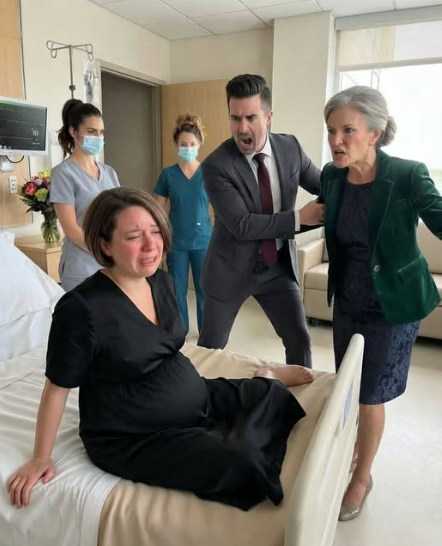
The nurses did not allow Linda back onto the surgical floor.
One security officer remained outside my door while another escorted her toward the hospital’s main entrance. Her voice traveled down the hallway long after she disappeared from view.
“This is a family disagreement!”
“My son invited me here!”
“She is manipulating everyone!”
The words became fainter until the elevator doors closed.
Inside my room, the alarms gradually stopped.
A nurse named Carla adjusted the leads on my chest and asked me to breathe slowly. Another nurse checked the dressing over my surgical incision without removing it completely. The sudden movement had not torn anything, but the muscles around the incision had tightened so violently that it caused a sharp increase in pain and heart rate.
Daniel stood several feet from the bed.
His hands were shaking.
I had seen him angry before, though rarely at his mother. His anger had usually been quiet and temporary—a tense jaw during dinner, a frustrated sigh in the car, a muttered complaint followed by another excuse for Linda’s behavior.
That evening was different.
He looked frightened by what he had almost allowed to happen.
“Is she okay?” he asked Carla.
“She needs rest,” the nurse replied. “Her vital signs are stabilizing. The surgeon has been notified.”
“I should have stopped my mother at the door.”
“You did stop her,” I whispered.
My throat hurt so badly that the sentence barely carried across the room.
Daniel came closer.
“Not tonight. Years ago.”
Carla looked between us but did not comment.
She asked whether I wanted to make a formal report about Linda’s conduct. Hospital security had documented the incident, and two nurses had witnessed part of it. Because Linda had approached a vulnerable patient after being ordered to leave, the hospital could issue a permanent trespass notice.
Daniel answered before I could.
“Yes.”
Carla looked at me.
“The decision belongs to your wife.”
That correction mattered.
For years, people in Daniel’s family answered questions for one another. Linda spoke for Megan. Linda spoke for Daniel. Daniel occasionally spoke for me because he believed it made uncomfortable situations easier.
I looked at him.
He understood.
“I want the report,” I said.
Carla nodded.
“I’ll contact security and the patient advocate.”
Daniel sat beside me while the paperwork was prepared.
My phone remained at the hotel, but his had not stopped vibrating since Linda entered the hospital. Family members called repeatedly. Some sent messages asking why Daniel had “thrown his mother out” after she spent the entire day managing Megan’s wedding.
Others asked whether I was really in surgery.
One uncle wrote:
Linda says it was a minor procedure and that you became hysterical.
Daniel read the message twice.
Then he turned his phone facedown.
“Do they know my appendix ruptured?” I asked.
“I told everyone.”
“Did they believe you?”
He did not answer immediately.
That was enough.
The surgeon, Dr. Leena Shah, entered shortly after eight. She explained that my appendix had ruptured before I reached the hospital. The infection had begun spreading through my abdominal cavity, and I would need intravenous antibiotics for several days.
“You were fortunate your husband brought you in when he did,” she said. “Another few hours could have produced sepsis.”
Daniel looked down.
“What if I had gone to the wedding?” he asked.
Dr. Shah’s expression remained professional.
“I cannot speculate about an exact outcome. But delaying treatment would have increased the risk significantly.”
The room became silent.
Linda had ordered him to leave me.
She had treated emergency surgery as a scheduling inconvenience.
And if Daniel had followed the pattern of our marriage—appease his mother first, repair the damage later—I might have been alone when complications began.
After Dr. Shah left, Daniel walked to the window.
The hospital overlooked part of downtown Charleston. Evening traffic moved beneath us, distant and ordinary.
“My mother said I was choosing you over my family,” he said.
“You are my husband.”
“I know.”
“Do you?”
The question came out more sharply than I intended.
Pain medication had weakened my ability to soften the truth.
Daniel turned.
I continued before fear could stop me.
“When she insulted me at Christmas, you asked me to ignore it. When she told everyone I had caused our fertility problems before we had even spoken to a doctor, you said she was stressed. When she entered our house with her own key after I asked her not to, you told me changing the locks would embarrass her.”
Daniel lowered his head.
“When she criticized my job, my clothes, the way I cooked, the way I talked, you kept saying she did not mean real harm.”
“I was wrong.”
“You were comfortable.”
The sentence hurt him.
I saw it.
But it was true.





