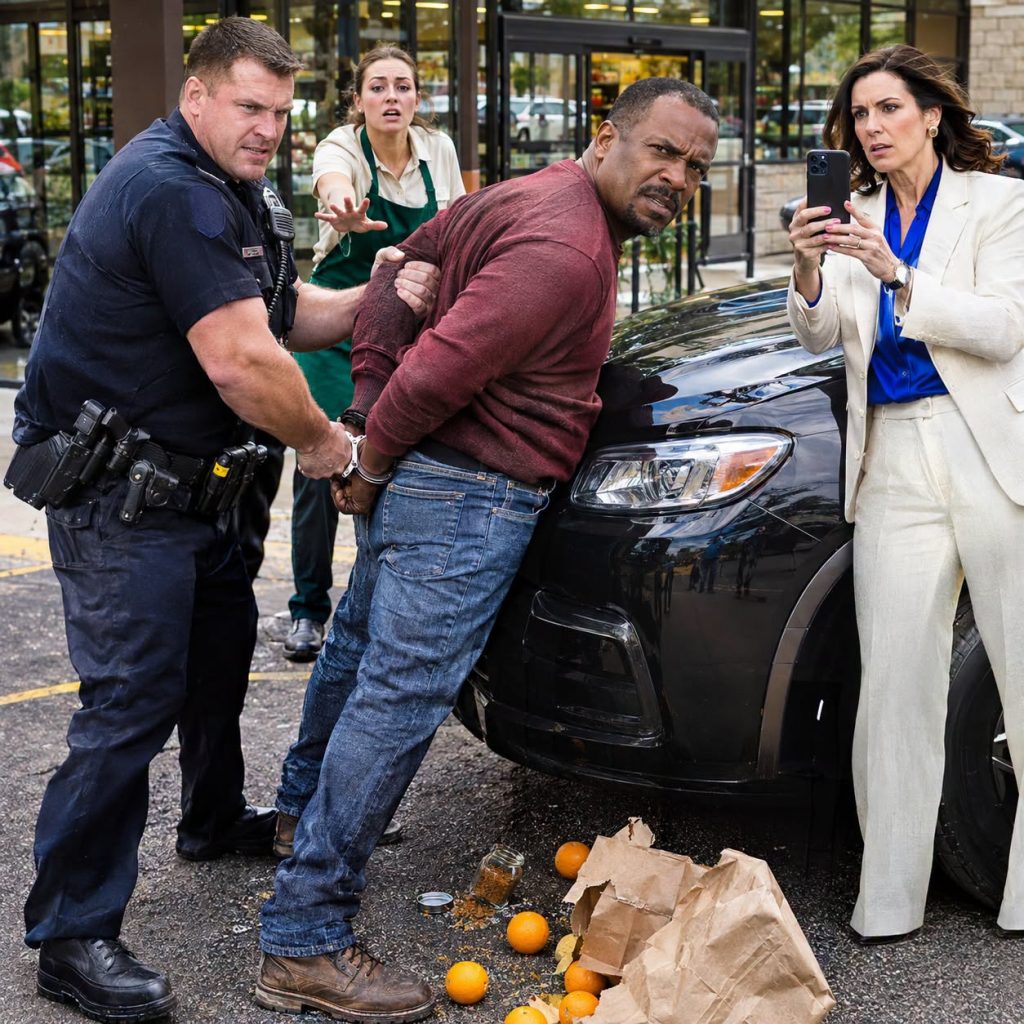
Part 2
Caldwell glanced toward the buzzer. I kept my eyes on the packet. “Leave it sealed,” I said. “Whatever you’re about to do, don’t make it worse.” He leaned close enough that I could smell coffee on his breath. “You threatened me in the parking lot. You reached inside your vehicle. Now we find this. Who do you think they’ll believe?” “The cashier. The woman filming. Your sergeant, if he decides to tell the truth.”
His hand closed around the back of my neck. He pushed my forehead toward the table. My injured wrist struck the edge, and I cried out before I could stop myself. “Get your hand off him.” Pike stood in the doorway. For the first time, he wasn’t looking at the floor. Caldwell released me slowly. “Take care of the front.” “No,” Pike said. “You need to come out here.”
Rachel’s voice carried down the corridor. “Nathan Brooks is a federal employee. We need to establish his condition and the basis for holding him. Now.” Caldwell grabbed the packet. I raised my voice. “Rachel! He brought suspected evidence into the interview room after I was searched. Preserve the hallway video.”
Footsteps accelerated. Rachel appeared beside Deputy U.S. Marshal Daniel Price and FBI Special Agent Lena Ortiz. None of them rushed Caldwell. Ortiz watched his hands. Price came straight to me. “Tell me where you’re hurt.” “Left wrist. Shoulder. Head.” Rachel looked at the cuff marks, then at Caldwell. “Who authorized continued detention after you obtained his identification?” “Active investigation.”
Ortiz held out a clean evidence bag. “Officer, put the packet on the table. We need to document what happened here.” “You don’t run this station.” Chief Martin Voss arrived behind them, adjusting his tie. “Everybody take a breath. There’s been an unfortunate misunderstanding.” Then he saw the packet. His expression flickered.
It was small, but I had spent twenty years watching people when they thought nobody was watching them. “Chief,” I said. “What’s in that bag?” “I have no idea.” Caldwell looked at him. Voss looked away.
Ortiz asked for the station’s evidence custodian and the arrest paperwork. Rachel requested preservation of dispatch recordings, surveillance, booking logs, and messages concerning my arrest. Price photographed my injuries with my permission. Pike unlocked my cuffs. The relief hurt almost as much as the pressure had.
A paramedic met us in the lobby. As she checked circulation in my hand, Rachel crouched beside me. “The witness is safe,” she said. “Her name is Melanie Grant. She uploaded her video before leaving the parking lot.” I closed my eyes. “There’s more,” Rachel added. “The market manager sent us the receipt and security footage. You paid. Nobody reported a theft.”
Across the lobby, Caldwell was still explaining himself to Ortiz when Pike spoke. “He told dispatch the store called.” Caldwell turned. “Owen.” Pike swallowed. “I checked. There wasn’t a call.” Voss stepped forward. “Sergeant, my office.” Pike stayed where he was. His hands shook as he took his own phone from his pocket.
“I need a lawyer,” he said to Ortiz. “And I need you to preserve the evidence-room camera before somebody overwrites it.” The lobby went silent. Caldwell moved toward him. Price stepped between them, palm open. “Stay there.” Pike looked at me. “That packet wasn’t in your property.” “Where did it come from?”
He couldn’t answer. Ortiz stopped the conversation and arranged to separate everyone for interviews. My release paperwork came minutes later, but walking out did not feel like freedom. It felt like leaving a room where somebody had almost buried me alive.
At the hospital, Rachel stayed while a doctor examined my wrist. Then Ortiz called. Rachel listened without speaking. When she hung up, she pulled a chair close. “They found the evidence-room footage,” she said. “Caldwell took the packet from an older case.” “And the chief?”
Her phone lit again. This time she turned the screen toward me. A preserved message from Voss to Caldwell read: Make the charge stick. We cannot afford another complaint. Below it was a photograph of a man I didn’t recognize. Rachel’s voice softened. “Nathan, you weren’t the first.”
Part 3
The man’s name was Isaiah Turner. He repaired heating systems, had two daughters, and had spent nineteen days in jail after Caldwell accused him of possessing stolen tools. “He lost his job,” Rachel said. “His complaint reached the chief. Nothing happened.” I stared at the photograph. Isaiah was wearing a work shirt with his name stitched above the pocket. Someone had circled his case number. “Did they frame him, too?” “We don’t know yet.” “Then find out.” “I intend to.”





