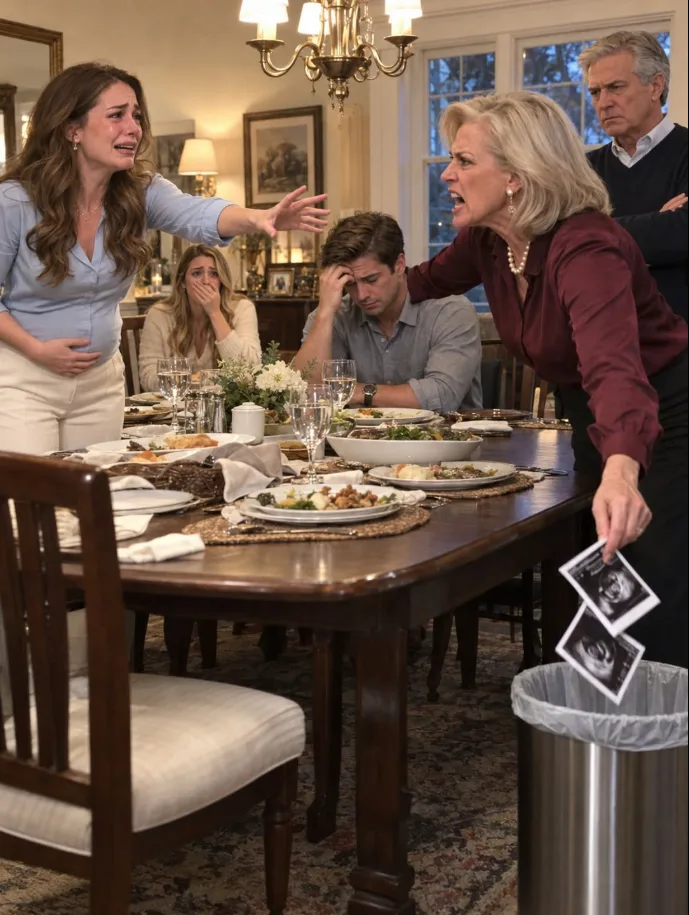
 “Those mean nothing until you prove that baby is normal,” Margaret Rossi said, casually dabbing her manicured fingers on a linen napkin as though the glossy black-and-white printouts had contaminated her skin.
I was twelve weeks pregnant. My husband, Thomas, and I had come to his parents’ sprawling suburban estate for Sunday dinner, planning to announce that we were expecting our first child. I had spent the entire morning rehearsing how we would share the news. I had pictured joyful tears, perhaps a celebratory toast with sparkling cider, and Margaret immediately debating whether the nursery should be painted sage or cream.
Instead, she had picked up the first tangible proof of my child’s existence, glanced at it with visible distaste, and asked whether I had scheduled an abortion.
“Of course not,” I stammered, my heart thumping against my ribs. “We’re having a baby. We’re starting our family.”
Margaret exchanged a cold, deliberate glance with her husband, Richard, before turning her sharp hazel eyes back to me. “Your family carries that Down syndrome problem. You should terminate before you bring a defective child into this family and ruin our name.”
For several seconds, the dining room felt airless. I genuinely thought I had misheard her. Across the table, Richard set down his wine glass with a sharp click against the mahogany wood and nodded solemnly.
“We have a reputation in this community, Nora,” Richard said. “We must be realistic.”
I spun toward Thomas, waiting for the righteous anger that any loving husband would display. But Thomas wasn’t looking at me. He was staring down at his plate, pushing a roasted fingerling potato through a smear of gravy with the tines of his silver fork.
“Thomas?” I whispered.
He cleared his throat, refusing to meet my gaze. “Mom is just thinking about the genetic risks, Nora. Maybe we need to consider comprehensive screening. Maybe she has a point.”
Testing had never been an issue for me; I had already scheduled the standard non-invasive prenatal panels with my obstetrician. What knocked the breath out of me was the venomous assumption that my child was worthless simply because of my beloved cousin, Roman. Roman had Down syndrome. He was thirty-two, worked at the local botanical conservatory, remembered every family member’s birthday without fail, and had held my mother’s trembling hand throughout my grandmother’s funeral without leaving her side for eight straight hours. Roman was the gentlest, kindest soul I knew.
To Margaret, he was a stain on a pedigree.
“Having a cousin with Down syndrome doesn’t mean our baby will have chromosomal anomalies,” I said, my voice shaking with fury. “Most cases are entirely random.”
Margaret gave a dry, mocking laugh. “Don’t lecture me on genetics, Nora. I’ve looked into your family tree. Your aunt suffered from clinical depression, and Roman is what he is. Your bloodline is tainted. Thomas deserves an unblemished heir.”
“Roman is a human being!” I snapped, rising from the table. “And our baby is going to be loved no matter what!”
“Love doesn’t pay for around-the-clock care,” Richard remarked coldly.
Margaret stepped closer, pointing a sharp acrylic nail at my chest. “You will not embarrass this family. Control your wife, Thomas!”
I looked at my husband, waiting for him to stand. He stayed seated, murmuring, “Let’s just consider every option, Nora. If something is wrong… Mom is right. We have to think practically.”
I retrieved the crumpled ultrasound strip from beneath Margaret’s discarded paper napkins, tucked it safely into my purse, and walked out into the chilly evening air.
Over the next month, the silence in our townhouse became deafening. Thomas slipped out of our bed at odd hours to take whispered phone calls from his mother. Whenever I tried to talk about baby names, cribs, or maternity clothes, his eyes glazed over.
Then came week sixteen.
Margaret arrived at our front door on a Tuesday afternoon unannounced, tossing a glossy packet onto my coffee table. They were pamphlets for a private termination clinic two counties over.
“I’ve booked the consultation,” she declared without blinking. “The staff is discreet.”
I ordered her out of my house. When Thomas returned from his corporate firm that night, I broke down in tears, expecting him to finally stand as my protector. Instead, he collapsed onto the sofa, rubbed his temples, and looked at my rounded stomach with something akin to dread.
“Maybe this isn’t the right time for us, Nora,” he muttered, staring at the floor. “Mom knows a doctor. If the child has special needs, we’ll be stuck dealing with it forever.”
*Stuck.*
That single word shattered every illusion I had clung to during three years of marriage.
“I’m leaving,” I told him quietly.





