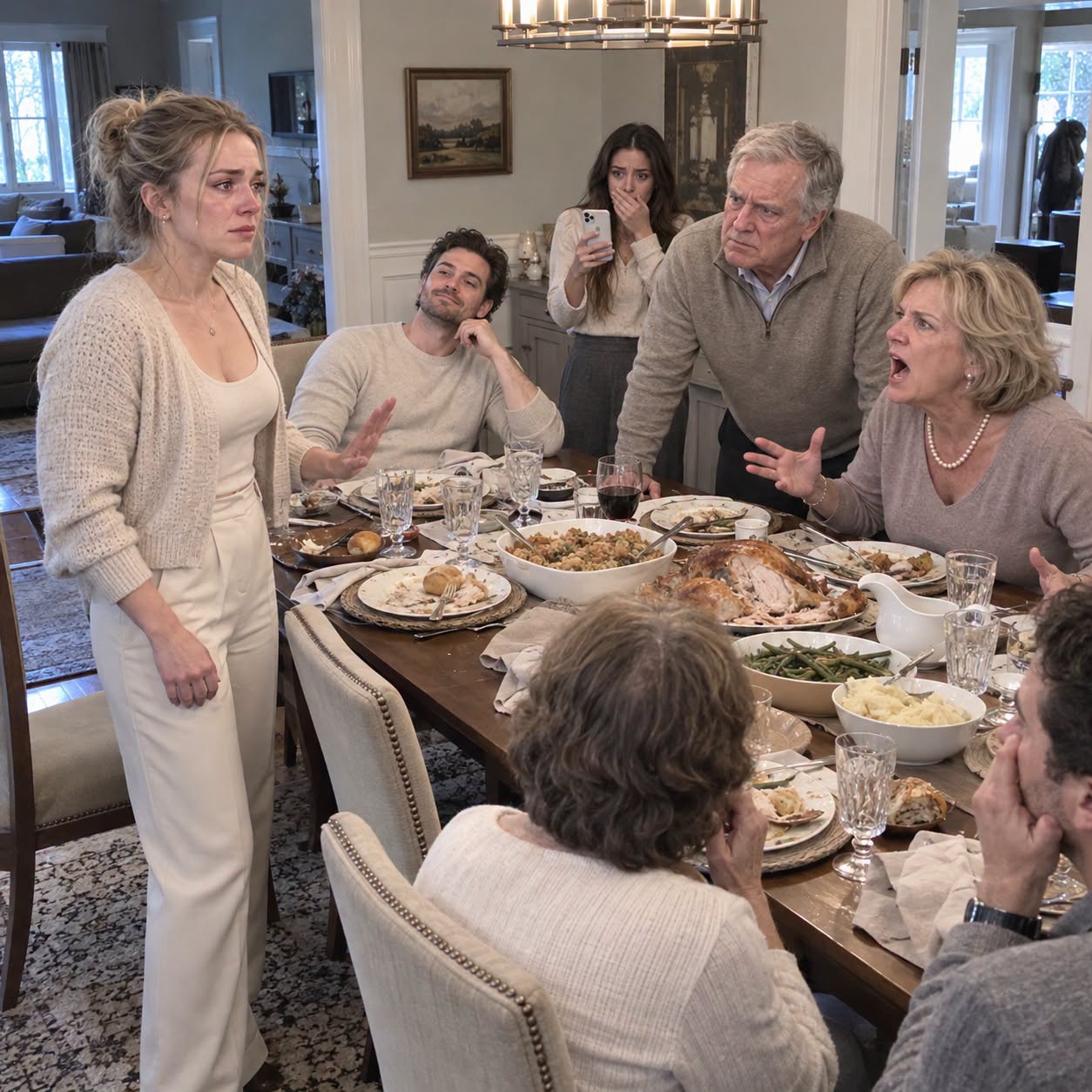
 The dining room of the house on Sycamore Crest Lane smelled of roasted sage, burnt butter, and three decades of accumulated compromises. It was three o’clock on Thanksgiving afternoon, and the light slanting through the blinds was the color of a bruised peach. Across the oak table, my thirty-five-year-old brother, Ryan, sat slouched in his chair, wearing a cashmere sweater I had purchased for his birthday the previous year. He was slowly, deliberately separating the skin from his turkey breast, his smirk humming with the quiet vibration of someone who had won a bet nobody else knew had been placed.
“You’re thirty-two,” my father, Arthur Blake, announced between heavy chews. He didn’t drop his fork. He didn’t look at my mother. He looked directly at the space three inches above my forehead. “It’s time to move out, Samantha. A woman your age shouldn’t still be living under her father’s roof.”
The room went so still I could hear the refrigerator compressor shuddering in the kitchen.
I held my glass of water halfway to my mouth, then lowered it slowly until the crystal touched the linen. “Excuse me?”
“You heard your father,” my mother, Eleanor, murmured softly, her fingers fluttering nervously around the salt cellar. She wouldn’t meet my eyes. She had perfected that look over thirty years: the tragic matriarch bearing the burdens of an uncaring world. “It’s about independence, Sammy. You’ve become too comfortable. You work your shifts at the hospital, you come home, you sleep. You’re letting life pass you by. You need your own space to build an adult life.”
I stared at her, waiting for the punchline, but her chin merely tightened into that fragile, stubborn set that meant she had rehearsed this. Beside her, Ryan took a sip of cider, his eyes gleaming with malicious satisfaction.
“Independence,” I said, the word tasting of lead. “That’s what this is about?”
“It’s about family balance,” Dad said, wiping his mustache with a paper napkin. “Ryan’s music production business is expanding. He’s taking on serious clients. He needs a professional footprint. Your bedroom at the end of the hall has the soundproofing from when we converted the nursery, plus the separate exterior entrance through the terrace. It belongs to him now. We want you out before New Year’s.”
I looked across at Ryan. “Your business. You mean the podcast you record on your cracked iPhone that has seventy-four followers?”
“It’s a creative incubator, Samantha,” Ryan snapped, leaning forward, his voice suddenly sharp. “Not all of us want to be glorified oxygen mechanics changing phlegm filters for ten hours a day. Some of us actually have a vision for our lives.”
“I am a licensed respiratory therapist,” I said evenly. “I kept six people alive on ventilators last night while you were asleep.”
“Enough!” Dad roared, his fist hitting the table hard enough to make the gravy boat rattle. “This is my house. I decide who lives here and who doesn’t. You’ve had a free ride long enough, Samantha. Pack your things. January first.”
I sat very still. The grandfather clock in the corner ticked five times. A bizarre, cold calmness settled over my ribcage, slowing my pulse. For three years, I had believed I was holding this family together with my bare hands. I had picked up ninety-hour pay periods during the peak of winter hospital surges. I had worn N95 masks until my nose bled and my cheeks were permanently raw, rushing home to drop my scrubs in the wash and write checks so my parents wouldn’t lose the only home I’d ever known.
“All right,” I said quietly.
Dad blinked, clearly thrown off by the lack of tears or screaming. “All right?”
“All right,” I repeated. “I’ll be out by next weekend. Not January first. Next weekend.”
I began folding my napkin, preparing to rise, when Mom suddenly reached across the table, her hand clamping over my wrist like an iron band. Her eyes, pale and watery, widened with genuine panic.
“Wait,” she breathed. “Sammy, wait. You’re moving, yes, but… we still have an understanding, don’t we? You’ll still take care of the $1,845 mortgage each month, right?”
I stopped moving. I looked at her hand on my wrist, then up at her face. “What did you just ask me?”
“The mortgage,” Mom repeated, her voice dropping into a desperate, cajoling whine. “Arthur’s back is still acting up, and Ryan’s business needs another year to become cash-flow positive. You know the bank doesn’t care about our hardships. You’ll keep paying the $1,845 directly from your Huntington account, won’t you? It’s only fair. We raised you. You’re family.”





