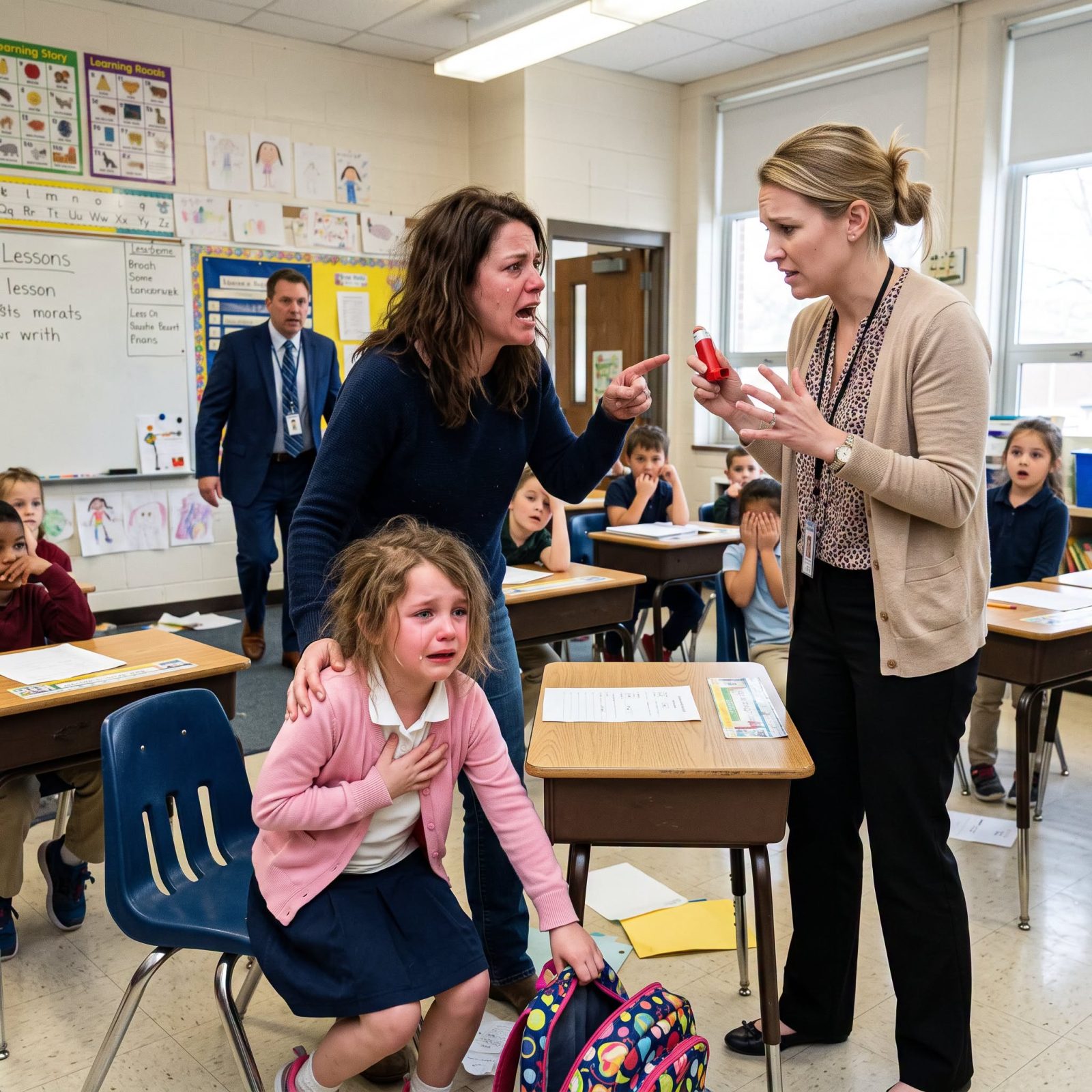
The linoleum floor of Oakridge Elementary felt cold beneath my boots, but inside, my blood was boiling. Principal Vance stood before me, his smartphone still trembling slightly in his grip. The hallway was unnervingly silent now, save for the muffled, rhythmic sob of a child two doors down and the distant hum of the industrial air vents.
“What do you mean, Maya wasn’t the only one?” My voice was barely more than a jagged whisper, yet it cut through Vance’s defensive posture like a blade.
Vance swallowed hard, his Adam’s apple bobbing above his stiff collar. He was a career administrator—a man polished by decades of school board meetings, PR spin, and liability mitigation. But the sheen had completely peeled away. His skin had taken on the ashen hue of wet cement.
“Mrs. Carter, let’s step into my office,” he murmured, his eyes darting toward the classroom door where Mrs. Collins still remained, sequestered behind the narrow reinforced glass. “This isn’t an appropriate place to discuss student health records or personnel matters.”
“My daughter almost stopped breathing on that floor five minutes ago!” I snapped, my composure fraying. “You do not get to dictate propriety to me. Who was on that phone?”
Before Vance could answer, the classroom door creaked open.
Mrs. Collins stepped out.
She wasn’t panicked. She wasn’t rushing to apologize. She carried herself with the terrifying, rigid posture of someone entirely convinced of her own righteousness. She smoothed the front of her navy knit cardigan with deliberate, unhurried strokes. Her silver-streaked hair was pinned back in a severe twist, and behind her wire-rimmed glasses, her pale eyes were completely cold.
“Sarah,” Mrs. Collins said, addressing me with an infuriating, condescending intimacy. “I understand you are distressed. Any parent would be. But you are overreacting to what was simply a behavioral tantrum that manifested somatic symptoms.”
I took one stride toward her. Vance immediately threw an arm out, interposing his broad frame between us.
“Don’t,” Vance warned, though whether he was protecting me from a misdemeanor or protecting the school from a lawsuit, I couldn’t tell.
“A tantrum?” I felt the room tilt. “Maya has moderate persistent asthma. We filed three separate physician authorizations with your office in August. Her rescue inhaler is prescribed by a pediatric pulmonologist! She wasn’t having a tantrum, Evelyn. Her bronchioles were spasming shut!”
“Children today are conditioned to rely on chemical crutches the moment they feel slight discomfort,” Mrs. Collins replied without flinching. Her voice possessed the flat, rhythmic cadence of a zealot. “Self-regulation is a cornerstone of my classroom. If Maya learns to hyperventilate every time she struggles with a math worksheet, she will never develop resilience. I merely instructed her to focus on deep diaphragmatic breathing. Her theatrical collapse was entirely performative.”
“Performative?” The word choked in my throat. “The nurse had to administer two consecutive doses to bring her oxygen saturation back above ninety! If Nurse Daniels hadn’t run in—”
“Nurse Daniels undermined my authority in front of twenty-two impressionable children,” Mrs. Collins countered, her lip curling slightly. “Discipline in this institution is crumbling precisely because parents indulge weakness.”
“That is enough, Evelyn,” Vance snapped, his voice suddenly thick with genuine fear. He turned to me, his hands raised in surrender. “Mrs. Carter, please. Your priority must be Maya. The paramedics have been dispatched just as a precaution. Go to the nurse’s station. Be with your daughter. I give you my word, we will conduct an immediate, exhaustive administrative review.”
I stared at Vance, then at Collins. Collins didn’t look away. There was no remorse in her eyes—only the cold, stubborn defiance of an untouchable veteran educator who had spent thirty years ruling her classroom like a feudal fiefdom.
“An administrative review won’t save you,” I said softly, looking directly into Collins’ eyes. “Neither of you.”
I turned and sprinted down the hall toward the clinic.
Maya was sitting on the examination cot, wrapped in a faded yellow fleece blanket. Her small, seven-year-old frame looked impossibly fragile. The nebulizer mask lay on the stainless-steel tray beside her, droplets of condensed albuterol mist clinging to the clear plastic. Nurse Daniels—a woman whose kind, exhausted eyes had seen every skinned knee and viral bug in the county—was sitting beside her, holding a cup of apple juice.
“Mommy,” Maya whimpered.
Her lips still carried a faint, terrifying lilac tint around the edges, and her chest heaved with shallow, exhausted breaths. Seeing her alive, conscious, and breathing broke whatever dam was holding me together. I fell to my knees beside the cot, wrapping my arms around her shoulders and burying my face into her soft, strawberry-scented hair.
“I’m here, baby,” I wept, kissing her forehead. Her skin was clammy and cold. “I’ve got you. You’re safe.”





