PART 2 — THE GENERAL’S SECRET
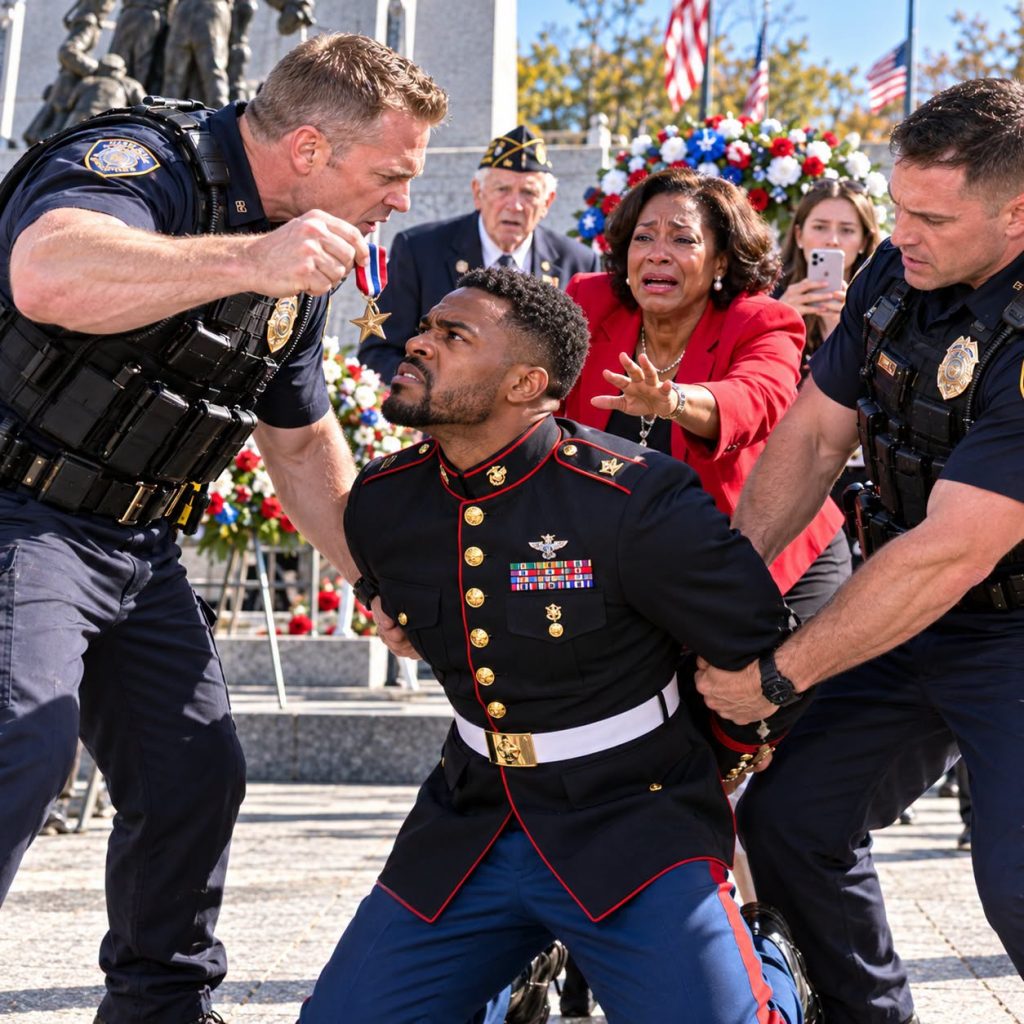
“WHO PUT HANDCUFFS ON MY MARINE?” General Nathaniel Beckett repeated. His voice silenced the memorial. Officer Dawson straightened, still gripping my shoulder. “Sir, we’re conducting a lawful investigation.” Beckett stopped inches from him. “Then explain why Captain Fletcher Vance is kneeling beside a decoration awarded for combat valor.” Dawson blinked. “Captain?” “Yes,” Beckett replied. “Captain. I personally reviewed the citation for his Bronze Star.” Brennan looked toward his partner. Dawson’s grip loosened, but he refused to release me. “With respect, General, military rank doesn’t override civilian law.” Beckett’s expression remained cold. “Correct. Neither does a police badge.”
My mother rushed toward him. “Nathaniel, they pushed me. They wouldn’t check his identification.” Beckett steadied her with one hand, then turned toward Brennan. “Remove those handcuffs.” Brennan hesitated. “Our supervisor has to authorize—” “Then call your supervisor,” Beckett interrupted. “And while you’re doing that, explain your legal basis for continuing this detention.” I lifted my head. “General, please check on my mother first.” His eyes softened briefly. “I’ve got her, Fletcher.” Dawson reached for his radio, but Brennan suddenly grabbed his wrist. “Craig,” he whispered, “we need to talk.” Beckett noticed. “Something you gentlemen would like to share with everyone?”
A woman pushed through the crowd holding her phone. “I recorded the whole thing!” she shouted. “Including what that officer did to his medal.” Dawson lunged toward her device. I rose instinctively, but Brennan forced me downward again. “Stay put!” Beckett stepped between Dawson and the woman. “Do not touch that phone.” Dawson froze. The general turned to his aide. “Colonel Hayes, contact the Stafford County Sheriff’s Office. Ask for Sheriff Alan Morrison directly.” Dawson’s face drained of color. “That won’t be necessary.” “I disagree,” Beckett answered. “And request an independent investigator. Every witness here deserves to be heard.”
Then my mother said something that changed everything. “Nathaniel, look at the man by the memorial wall.” I followed her gaze. The stranger in the gray overcoat was slipping toward the parking lot. Beckett’s jaw tightened. “Martin Keene.” Dawson spun around. “You know him?” Beckett didn’t answer immediately. Instead, he looked directly at me. “Fletcher, do you remember the contractor complaint you submitted three months ago?” My stomach tightened. I had reported irregularities in a defense contractor’s veteran-support program—payments supposedly made to injured Marines who had never received them. Martin Keene had been the program’s regional director. “You told me the investigation was confidential,” I said. “It was,” Beckett replied. “Until someone tried to find out who filed it.”
Dawson took a step backward. Brennan stared at him. “Craig, you said this was an anonymous complaint.” The general turned sharply. “What complaint?” Brennan swallowed. “A man contacted Dawson this morning. Said a Black guy wearing fake medals would be at the ceremony. He gave us a description.” “And a photograph?” Beckett asked. Brennan nodded. “Yes.” I felt cold despite the crowd pressing around us. Keene hadn’t merely recognized me. Someone had arranged this encounter.
A siren sounded near the entrance. Sheriff Morrison’s vehicle pulled alongside the memorial, followed by two deputies. Dawson moved quickly toward his patrol car. “I need to retrieve the original complaint.” Brennan caught his sleeve. “Don’t touch anything, Craig.” Dawson shoved him away. “Get off me!” Beckett raised his voice. “Sheriff! Secure the officers’ records and preserve their communications.” Morrison hurried toward us. “What happened?” Before anyone could answer, the woman filming shouted, “That man is getting away!”
Across the parking lot, Keene had climbed into a dark sedan. A deputy moved to record the license plate. Dawson suddenly shouted into his radio, “Disregard that vehicle! He’s not involved!” Everyone turned toward him. Morrison’s expression changed instantly. “How do you know that, Dawson?” Silence. Then Brennan whispered, “Because Craig knows him.”
Dawson’s hand moved toward his belt. Morrison shouted, “Craig, hands where I can see them!” And I realized the man who had accused me of pretending to be a Marine might have been protecting someone with far more to hide.
PART 3 — THE FOUR STARS THAT CHANGED EVERYTHING
“GET YOUR HAND AWAY FROM YOUR BELT!” Sheriff Morrison commanded. Dawson froze. His hand hovered near his duty radio, inches from his holstered weapon. Two deputies moved to either side of him. Brennan stepped backward, both palms raised. “Sheriff, I didn’t know about Keene,” he said. “Craig told me the complaint came through dispatch.” Morrison looked at Dawson. “Is that true?” Dawson said nothing. Beckett stood beside my mother, his face unreadable. “Sheriff,” he said, “Captain Vance’s detention needs to end immediately.” Morrison nodded to a deputy. Seconds later, the handcuffs clicked open. My arms fell forward, aching. My mother rushed into me, wrapping both arms around my chest. “Baby, are you hurt?” I held her tightly. “I’m okay, Mom.” But when I looked down at the torn ribbon hanging from my uniform, I knew something inside me had changed.





