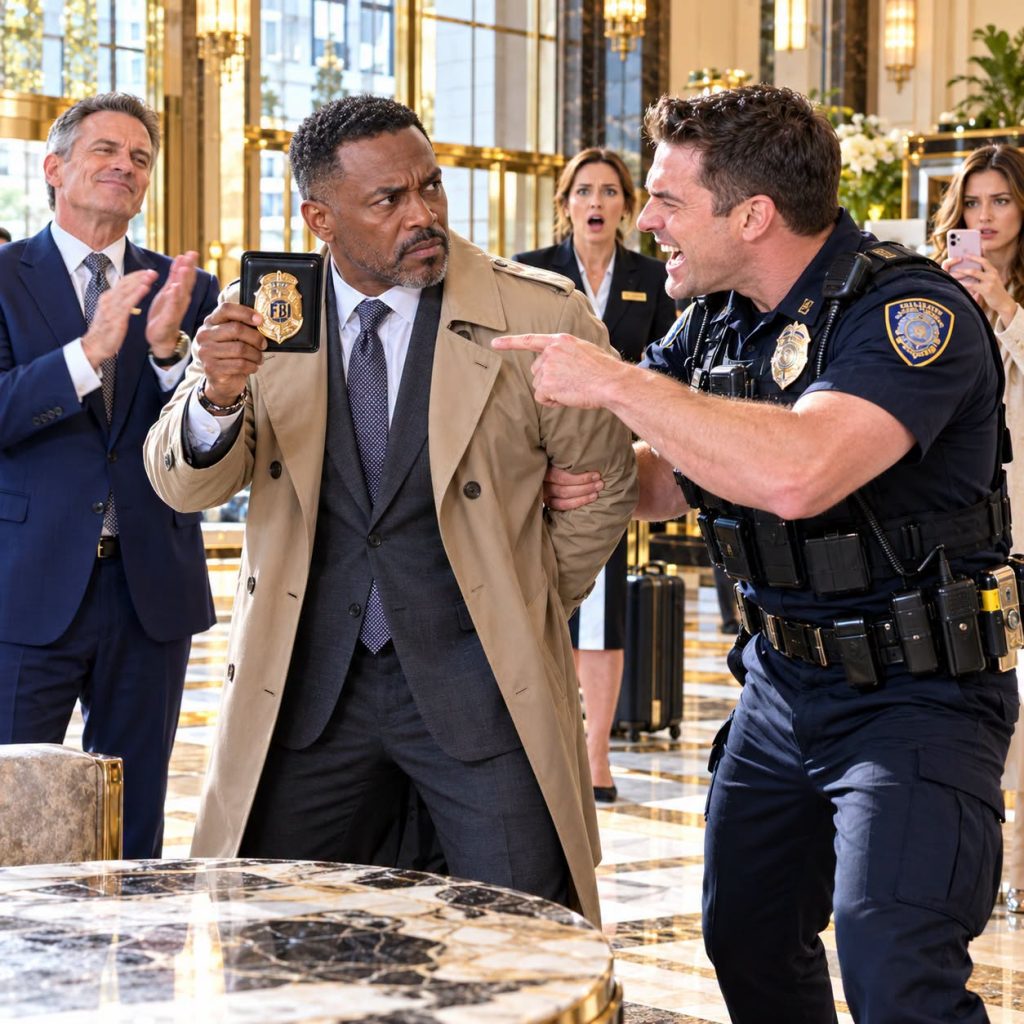
PART 2 — THE HOTEL WAS NEVER JUST A HOTEL
“Proceed!” I shouted. “Execute the warrants. Secure the exits and protect the civilians!” The revolving doors burst open as federal agents entered wearing clearly marked tactical vests. Special Agent Sarah Jenkins led the first team, her eyes sweeping the lobby. “FBI! Everyone remain calm and move away from the elevators!” Channing’s grip loosened, but he still held my wrist. “What is this?” he stammered. Sarah stopped directly in front of us. “Director Pendleton, are you injured?” The officer stared at her. “Director?” She turned toward him. “Release him. Now.” For the first time that morning, Derek Channing had nothing to say.
His fingers shook as he searched for his handcuff key. “Sir, I didn’t realize—” “You had my identification,” I interrupted. “You had every opportunity to verify it.” Sarah stepped between us while another agent secured Channing’s weapon and escorted him away from the operation. But I wasn’t interested in humiliating him. Vincent Moretti was moving toward the service corridor, and Caldwell had disappeared behind the reception desk. “Sarah, where’s the courier?” I demanded. “East hallway. Two agents following.” “And Caldwell?” She glanced toward the desk. “We lost visual contact.” My stomach tightened. “Then we’re not dealing with an ordinary hotel manager.”
A sharp crash came from the service corridor. One of our agents stumbled backward through a doorway as Moretti slammed a luggage cart into his path. I ran toward the noise. “Vincent! Federal agents! Stop!” Moretti turned, recognized me, and bolted toward a stairwell. Sarah intercepted him at the corner. He shoved her shoulder, but she caught his jacket and drove him against the wall. Two agents helped restrain him. The briefcase struck the floor and burst open, scattering documents, electronic storage devices, and bundles of cash. Moretti laughed bitterly. “You’re too late, Pendleton. Caldwell already sent the message.”
“What message?” I demanded. Moretti looked past me toward the elevators. “Ask your friend in the police uniform.” I stopped. “What did you say?” He smiled. “You think he came here because some manager complained about a man drinking coffee?” Sarah’s expression changed. “Director, we need to talk.” She handed me a tablet displaying communications recovered during the fourth-floor search. Several messages referenced my surveillance position. One included my physical description. Another instructed someone to create a disturbance in the lobby before the courier’s departure.
Then I saw the final entry. A payment had been routed through a consulting company connected to a Chicago police officer. Derek Channing.
“Bring him to the conference room,” I ordered. Minutes later, Channing stood across from me, his face drained of color. “I never knew you were FBI,” he insisted. “Caldwell told me you were harassing guests.” I placed the tablet on the table. “Then explain the money.” He stared at the transaction. “That’s not mine.” Sarah leaned forward. “The account belongs to a company registered in your wife’s name.” Channing swallowed. “She doesn’t know anything about this.” “Then tell us who paid you.”
He looked toward the door, trembling. “Caldwell said it was private security consulting. He wanted certain people removed from the lobby. That’s all.” I studied him. His fear looked genuine, but fear didn’t make him innocent. “Who else was involved?” He shook his head. “I never met anybody else.”
My earpiece suddenly crackled. “Director, we found a hidden communications room behind Caldwell’s office. There’s an active remote connection.” Sarah grabbed her radio. “Shut it down!” A second voice interrupted. “Negative. Someone is uploading the operation files. The connection is routed through an FBI administrative credential.” I felt the room tilt. Caldwell wasn’t merely helping criminals. Someone inside our own agency had given him access. Then the lights went out, the emergency alarms sounded, and Sarah whispered, “Arthur, the compromised credential belongs to your deputy director.”
PART 3 — THE NAME BEHIND THE BETRAYAL
“Deputy Director Michael Reeves?” I repeated. “That’s impossible.” Sarah held her flashlight steady. “His credential authenticated the connection twelve minutes ago.” I knew Reeves. We had worked together for eleven years. He had approved personnel assignments, attended operational briefings, and personally congratulated me when we obtained the warrants. He also knew every detail of our surveillance plan. I grabbed my radio. “All teams, assume operational information has been compromised. Preserve every digital record. Nobody accesses the communications room without authorization.”
The emergency lighting came on as Sarah and I reached Caldwell’s office. Behind a concealed door, two agents were securing a small room filled with networking equipment. A laptop displayed an active file-transfer window. “Connection terminated,” one agent reported. “But a portion of the data was transmitted.” Sarah examined the screen. “Where did it go?” The agent pointed to a destination associated with a private server leased under an offshore company’s name. I recognized the company immediately. It had appeared in our money-laundering investigation three months earlier. Reeves had dismissed it as irrelevant.





