PART 2
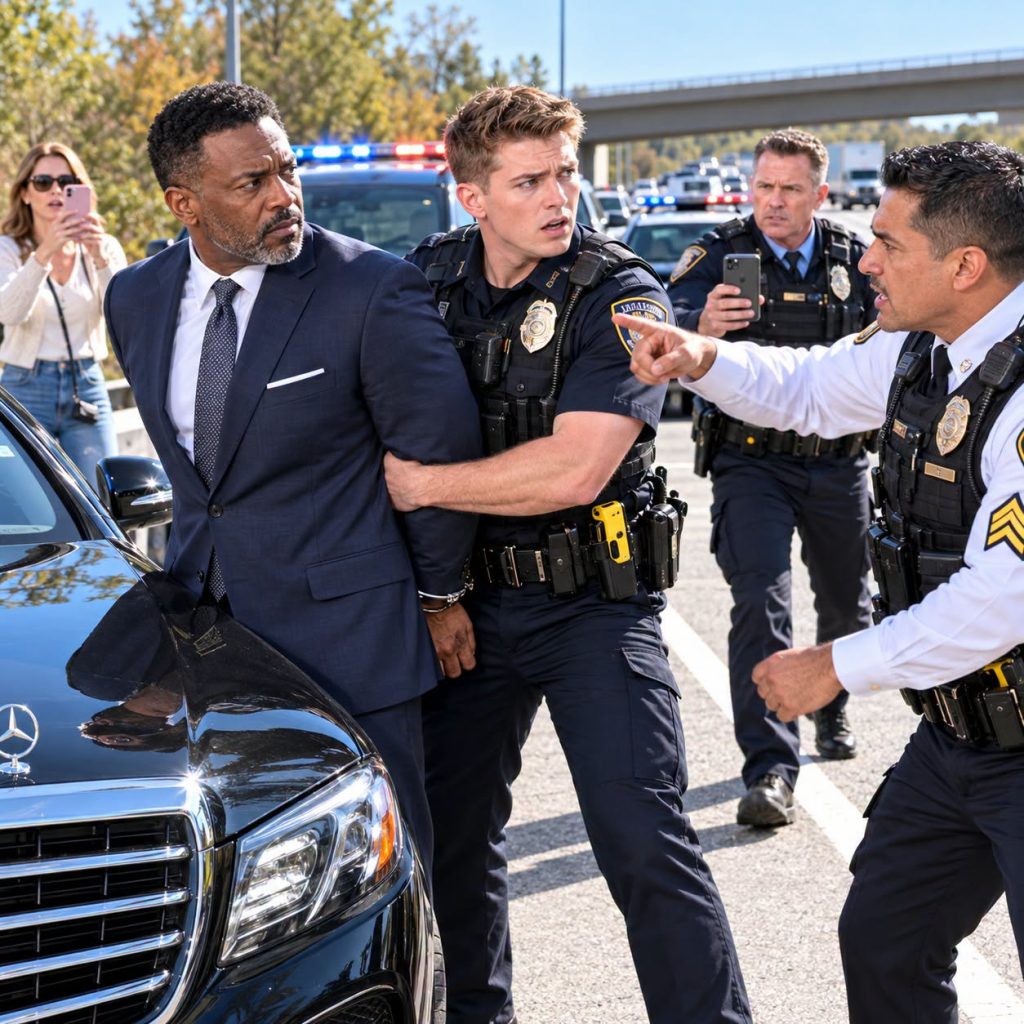
Sergeant Cole lunged for my wrist. Lieutenant Rodriguez knocked his hand aside. “Back up.” Cole squared his shoulders. “You interfering with an active detention now, Lieutenant?” “I’m stopping an unlawful one.” “Orders came from upstairs.” “Whose orders?” Rodriguez demanded. Cole hesitated. That hesitation told me more than an answer would have. Williams stood beside my Mercedes, pale and silent, staring at the alert on Cole’s phone. I stepped forward. “Sergeant, twelve minutes before I was stopped, someone entered my name and plate into your internal system. This morning I’m scheduled to rule on a motion involving missing body-camera files and altered evidence logs from your department. Is that a coincidence?” Cole’s eyes flicked toward me. There it was. Recognition. “Judge, you should stop talking.” “That sounded remarkably like a threat.” “It was professional advice.” “I’ve heard that phrase already today.”
Cole suddenly reached past Rodriguez and grabbed my briefcase from the passenger seat. “Hey!” I seized the handle. He pulled hard. The leather case swung between us. “Release police evidence!” Cole shouted. “That is court property!” Williams moved instinctively between us. “Sergeant, wait. We don’t have a warrant.” Cole shoved him backward. Williams crashed into the Mercedes door. Rodriguez caught Cole by the vest and dragged him away. “Enough!” For three seconds, four grown men stood on the shoulder breathing hard while passing drivers stared. Cole pointed at Williams. “You’re going to throw away your career for him?” Williams touched his shoulder where he’d been shoved. “No, Sergeant. I’m trying not to throw it away for you.” Cole’s expression darkened.
I opened my briefcase myself. Inside were ordinary case files, my tablet, and one sealed brown envelope delivered to chambers the previous evening. I had not opened it because the clerk had marked it for review during that morning’s hearing. Cole stared at the envelope. Too intensely. Rodriguez noticed. So did Williams. “That’s what this is about,” I said. Cole took a step toward me. “Hand it over.” “Why?” “Potentially stolen law-enforcement material.” “How would you know what’s inside?” He froze. Williams whispered, “Sergeant, nobody said what was in the briefcase.” Cole’s gaze snapped toward him.
Rodriguez took out his phone. “I’m calling Internal Affairs.” Cole slapped the phone from his hand. It skidded beneath the cruiser. Then everything moved at once. Rodriguez grabbed Cole’s forearm. Cole twisted free and shoved him against the hood. Williams caught Cole around the shoulders, and I stepped backward with the envelope pressed against my chest. Cole drove an elbow into Williams’s ribs, broke loose, and rushed me. I moved sideways. His hand caught my jacket, tearing the seam, but Rodriguez tackled him around the waist before he could take the envelope. They hit the grass. Williams dropped beside them and secured Cole’s wrists while Rodriguez shouted, “Daniel Cole, you are detained pending investigation!”
Cole started laughing.
Not nervous laughter. Confident laughter.
“You idiots,” he said into the grass. “You think this was my operation?”
A second radio call broke over Williams’s shoulder microphone. “All units, be advised, command directs Sergeant Cole released immediately. Judge Chen is to be transported to headquarters for protective custody.”
Rodriguez slowly looked at me. “Command?”
Williams grabbed his radio. “Identify commanding officer.”
The dispatcher hesitated. “Deputy Chief Nathan Harland.”
I knew the name immediately. Harland was the senior official whose department was at the center of the evidence-tampering hearing scheduled for that morning.
Cole rolled onto his side and smiled. “Now you understand.”
My phone rang. It was my courtroom clerk, Emily Parker. I answered on speaker. She sounded terrified. “Judge, someone broke into chambers. Your computer is gone, and the evidence server is offline. The hearing file has been wiped.”
I looked down at the unopened envelope.
Cole stopped smiling.
That told me whatever was inside had survived their cleanup.
I tore the seal.
Inside was a flash drive and a handwritten note from a police evidence technician named Aaron Bell: JUDGE CHEN — IF THIS REACHES YOU, THE ALTERED BODY-CAM FILES GO HIGHER THAN COLE. HARLAND ORDERED THE CHANGES. ORIGINAL COPIES ARE ON THIS DRIVE.
Williams stared at the message. “My God.”
Then Rodriguez’s police computer chimed.
A department-wide message filled the screen: OFFICER KYLE WILLIAMS AND LT. RAFAEL RODRIGUEZ — SUSPENDED. POSSIBLY ARMED. DO NOT ALLOW THEM TO LEAVE SCENE.
In the distance, sirens began approaching from both directions.
PART 3
“Those units don’t know what’s happening,” Rodriguez said. “If they see that bulletin, they’ll treat us as threats.” Williams looked at me, then at Cole on the ground. Thirty minutes earlier he had doubted my identification. Now his own department had labeled him dangerous with the same keystrokes. “Judge,” he said quietly, “I understand more than I did thirty minutes ago.” I nodded toward his body camera. “Then make sure everyone else understands too. Is it recording?” His hand touched his chest. “Yes.” “Good. Rodriguez?” “Mine too.” I held up the flash drive. “Then nobody runs. Nobody reaches. We stand in the open and force this into daylight.”





