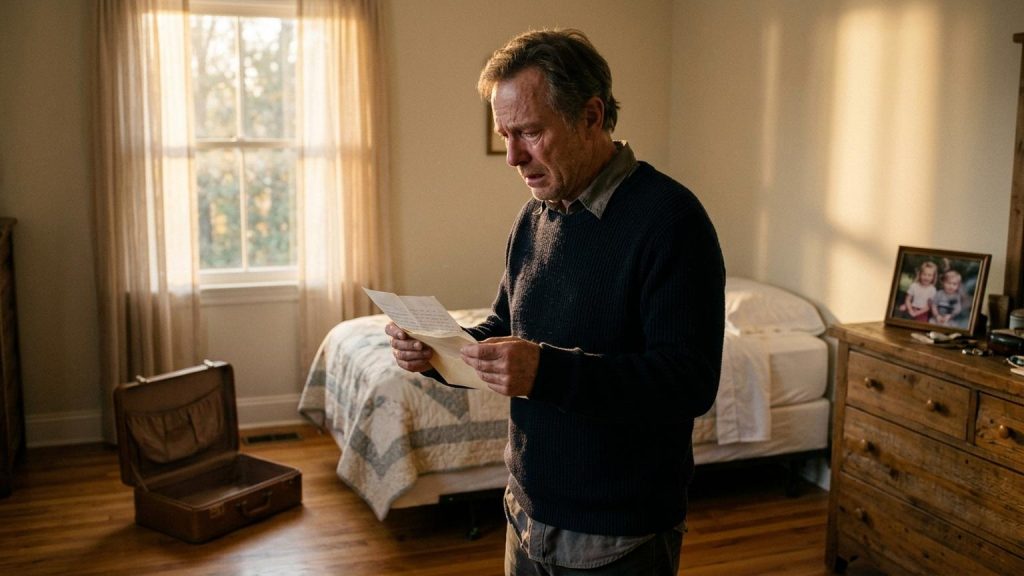
On the eve of my seventy-fifth birthday, I carried a homemade cake into the dining room and heard my son whisper to his in-laws, “I’m done living with Dad. The nursing home is his present.” I set down the cake. By sunrise, my room was empty…
“A nursing home will be his last birthday gift,” my son whispered. “I can’t do another year with Dad living here.”
I was standing outside the dining room with a homemade cake in both hands. Seventy-five was written across the frosting in crooked blue icing. My daughter-in-law, Laura, had said the bakery was too expensive this year, so I’d made it myself.
Her parents were seated at the table. I heard her mother ask whether they’d already reserved a room.
“There’s a tour on Monday,” Laura said. “Once he’s gone, we can turn his bedroom into an office.”
My son Michael sighed. “I feel trapped in my own house.”
I set the cake on the kitchen counter. The candles made a soft clicking noise against the plate.
Eleven years earlier, after my wife Ruth died, Michael had begged me to move closer. He and Laura were buying a house outside Columbus, Ohio. I sold the little place Ruth and I had spent thirty years fixing up. At the closing table, I put $126,000 of that sale toward the down payment.
“It’s our home now, Dad,” Michael told me.
I believed him. For eleven years, I paid part of the mortgage from my retirement check, picked up my granddaughter Emma from school, and cooked supper whenever Laura worked late. When Michael injured his back, I slept in the recliner so he could use my ground-floor room.
I wasn’t easy company every day. My knees complained on stairs, and I sometimes asked Emma to repeat herself. But I still drove, handled my accounts, took my own medications, and volunteered twice a week at the community garden.
Michael knew all that. He also knew the exact amount I paid toward the mortgage. He’d never missed a transfer.
I carried the cake back into the dining room. Laura’s mother smiled and asked whether I’d remembered to turn off the oven.
“It’s off,” I said.
Michael looked at the cake. “We can do that tomorrow, Dad. We’re discussing something.”
I nodded and returned to my room. Ruth’s photograph stood beside a small blue folder in the dresser drawer. On the back she’d written, in the shaky pencil strokes of her last winter, “Don’t forget there’s still a life for you.”
That night I folded my shirts into the suitcase Michael had given me as an early birthday present. I called my old friend Raymond and asked if his guest room was free.
By sunrise I was gone.
On my neatly made bed, I left Michael an envelope containing a photocopy of a paper he’d asked me, eleven years earlier, never to show Laura.
Michael called nine times before breakfast. I finally answered from Raymond’s kitchen while he was making toast.
“Dad, where are you? You scared Emma.”
“I’m safe. I’ll call her after school.”
“You can’t disappear like this. We already made plans.”
“I heard.”
He was quiet long enough that I could hear Laura asking him whether I’d taken my checkbook.
The next day Michael arrived at Raymond’s house carrying a folder labeled SENIOR LIVING. He hadn’t brought my birthday card. He hadn’t asked whether I’d slept.
“This place has nurses and meals,” he said. “You’d be more comfortable.”
“Did you ask me?”
“You don’t understand how much work it is, Dad.”
I looked at the hands I’d used to repair his fence last spring. One knuckle was swollen, the skin split beside the nail. “I know living together hasn’t always been easy. But you could have talked to me.”
His face tightened. “Sign the forms so we can move forward.”
I asked to keep them overnight. He agreed, then reminded me the automatic mortgage contribution was due Friday.
That was when I called an attorney, Priya Shah, whose office Raymond had used after his wife died. She pulled the county property records while I sat across from her with the papers balanced on my knees.
At the purchase eleven years earlier, Michael and I had taken title as tenants in common: sixty percent his, forty percent mine. He’d insisted we keep the arrangement private. “Laura will feel like she’s living in your house,” he’d said, though I’d paid most of the down payment.
The mortgage was in Michael’s name, but I’d been sending him $1,250 every month toward it. I had bank records for every transfer. I didn’t own everything; I didn’t have the right to throw them out. But I was not simply a guest he could send away.





