She had that casual, self-righteous tilt to her chin she always wore whenever she had successfully made someone else feel small.
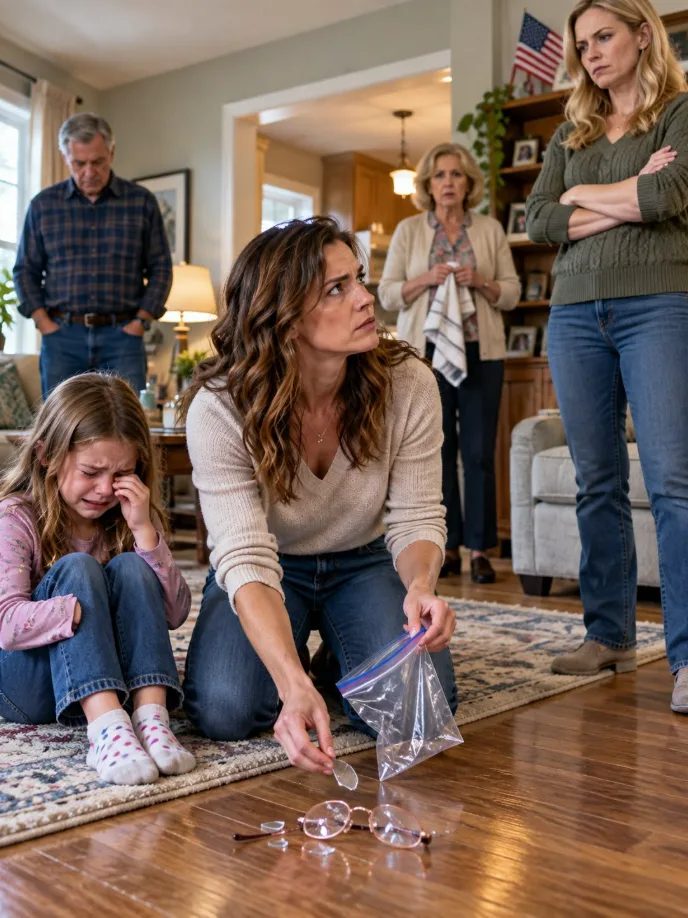
Three feet away from her, my seven-year-old daughter was curled into a tight ball on the braided living room rug. Grace was sobbing so hard her little shoulders hitched, each breath catching in her throat like a dry hiccup.
On the dark oak floorboards beside her lay the pieces of her world.
Her glasses were shattered. The left frame had snapped clean through the reinforced bridge, and both thick lenses were webbed with spider-veined fractures. One lens had popped out entirely, resting near the edge of the coffee table like a dropped ice cube.
Those were not standard, drugstore reading glasses.
Grace was born with microphthalmia in her left eye, rendering her legally blind on that side. Her right eye did the heavy lifting for her entire life, but it required an ultra-precise, high-index corrective lens manufactured by a specialty lab in Cincinnati. Without them, her visual acuity plummeted to near-darkness. Shadows bled into each other. Edges vanished. The world became a dizzying, terrifying smear of colored fog that triggered severe vertigo and nausea within minutes.
Lauren knew that.
My mother knew that.
Every single person under that roof knew that.
I let go of the grocery bags I was carrying. Two gallons of whole milk and a carton of eggs hit the hardwood with a dull thud. My blood turned into liquid nitrogen, freezing every instinct except the urge to wrap my child in my arms.
“You broke her glasses?” My voice didn’t sound like mine. It was dangerously flat, pitched low and vibrating with a tremor I couldn’t control.
“She snatched my phone,” Lauren replied, rolling her eyes toward the ceiling as if she were explaining basic fractions to a stubborn toddler. “She was snooping. Reading my personal notifications right off the lock screen. In this family, Aaron, we teach our children to respect basic privacy. Or at least, some of us do.”
Grace didn’t snoop. She was seven years old, painfully shy, and walked through rooms with her hands tucked close to her chest so she wouldn’t bump into furniture. The phone had simply lit up on the cushions next to where she had been coloring. A bright light in a dim room. She had glanced at it.
That was Grace’s crime. She had looked toward a sudden beam of light.
Before I could speak, my mother emerged from the kitchen, wiping her hands on a gingham tea towel. Her face was set in that cold, dismissive mask she wore whenever she decided a problem wasn’t worth her empathy.
“Grace needs boundaries, Aaron,” my mother said, her tone dripping with manufactured exhaustion. “You baby her far too much because of her eye. She has to live in the real world. We had her scrub down the kitchen baseboards and wash the lunch plates so she’d actually remember not to touch things that don’t belong to her.”
I walked past them without a word and dropped to my knees in front of my daughter.
I gently took her small hands in mine. Her fingers were bright red, pruned, and cold from standing in front of a sink filled with lukewarm dishwater she had barely been able to see. A legally blind child, forced to clean pots while her vision swam in darkness, punished by the very people whose blood ran in her veins.
My father stood in the kitchen archway. He didn’t look up. He kept his eyes locked on his own leather work boots, silent as a tombstone. He had spent forty years playing dead whenever my mother and sister went hunting.
“Come here, sweet girl,” I whispered.
I didn’t argue with them. I didn’t scream. When you work in corporate fraud and insurance claims, you learn very quickly that screaming gives the guilty party a script to work with. Silence unnerves them far more.
I pulled a clean Ziploc sandwich bag from my jacket pocket, knelt on the floor, and methodically picked up every shard of high-index polycarbonate, the snapped tortoiseshell arms, and the tiny gold hinge screws. I zipped the bag shut and slid it into my breast pocket, right over my heart.
Then I lifted Grace into my arms. She buried her wet face into the crook of my neck, her small fingers clutching the fabric of my denim jacket as if she were hanging off the edge of a cliff.
“We’re leaving,” I said simply.
“Aaron, don’t be dramatic!” my mother called after us as I pushed open the front door. “Sunday dinner is in forty minutes! You’re ruining the afternoon over a pair of cheap plastic frames!”
I didn’t look back.





