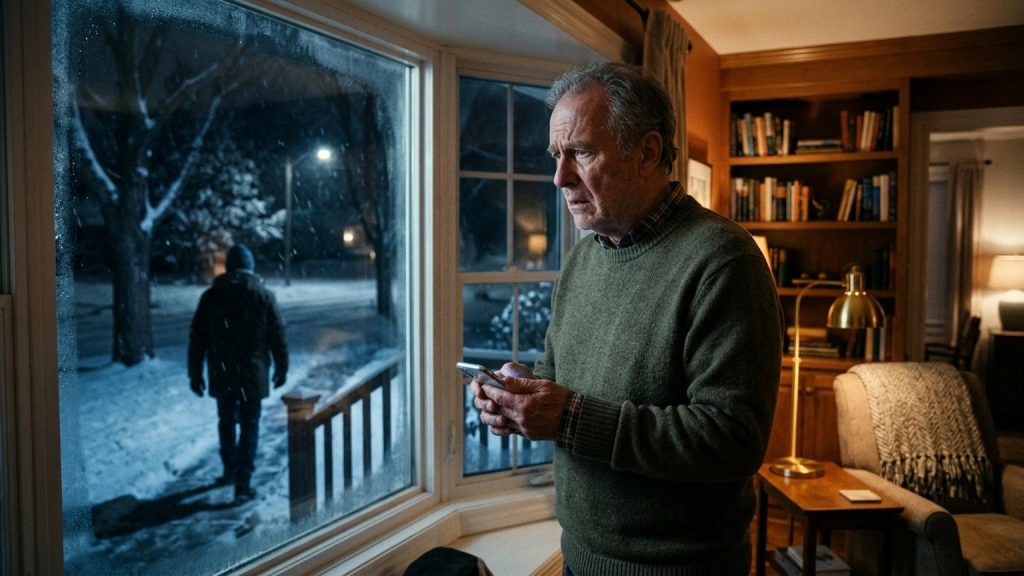
“Don’t come tonight. Your sister’s new family doesn’t know you exist.”
My mother’s text arrived while I was standing on her porch with a pecan pie balanced against my hip. Through the front window, I could see the dining table I’d helped Dad carry upstairs years earlier. There were eight place settings. One had a folded gold napkin where my chair used to be.
It was Christmas Eve in Dayton, Ohio. At eleven that morning, Mom had reminded me to bring dessert. Now she wanted me gone before my sister’s fiancé and his parents arrived.
I read the message twice. The aluminum pie pan was still warm through the towel. I had made it the way Mom taught me when I was eight, pressing each little ridge of the crust with the back of a fork.
Six months earlier, my parents had been three days from losing that house. Their home-equity line had gone into default, and the lender demanded just over $100,000 to settle it. I’d spent twelve years saving for a down payment on a place of my own. I emptied that account and paid the bank directly. The lender released its lien.
Dad cried at the kitchen table when the confirmation arrived. He insisted we sign a no-interest repayment agreement: $850 a month starting in January, with the balance due if they sold the house. “I won’t let you lose your future over us,” he told me.
I believed him.
Mom never told my younger sister, Natalie, what I’d sacrificed. At least, that’s what she said. Natalie was marrying Ben Dawson, whose family owned several local construction businesses. They were coming to dinner for the first time. Mom wanted everything to look successful, spotless, uncomplicated.
I caught movement behind the curtain. Natalie, dressed in green satin, looked out at me. She didn’t wave. She reached over and pulled the curtain closed.
My phone vibrated again. This time it was Dad: “Please don’t make a scene. We’ll explain after Christmas.”
I set the pie beside the wreath and typed seven words: “Then explain the loan agreement you signed.”
I attached the first page, both their signatures visible.
Ten minutes later, Dad called. His voice shook so badly I heard him swallow between words.
“Leah, please. You can’t let Ben’s parents see that.”
“Why?”
He went quiet. Then he said, “Because Natalie told them she was the one who saved our house.”
I sat in my car with the engine off. The windshield was beginning to fog, and in the side mirror I could see my pie sitting beneath the wreath like a gift nobody wanted to open.
“You let her say that?” I asked.
Dad cleared his throat. “She wanted to make a good impression.”
“With my hundred thousand dollars?”
“Don’t say it like that. We are going to pay you back.”
I looked at the empty passenger seat, where I’d kept a folder of house listings until June. I’d stopped checking them after the bank transfer.
“I’m not asking for applause,” I said. “I’m asking why you erased me.”
Mom took the phone from him. “Ben’s parents are traditional. Natalie told them she’s an only child, and it’s too late to correct it tonight. Can’t you give your sister one evening?”
“I’ve already emptied my savings for this family.”
“You gave it to us,” Mom snapped. “And we signed your little paper, didn’t we?”
The call ended. A moment later, Natalie came onto the porch. She picked up the pie, checked the street, and walked down to my car without a coat.
“Just go home, Leah,” she said through the lowered window. “They’re nice people. I don’t want the whole night to become about your problems.”
“My problems?”
She shifted the pie from one arm to the other. “You don’t understand what it’s like to finally be respected.”
I remembered watching her cut the ribbon at her first boutique, Mom holding the scissors and Dad taking photographs. When my promotion came that same month, they’d said we could celebrate another time. We never did.
“Did you tell Ben you paid the bank?” I asked.
She stared at the crust. “It was our family’s debt.”
“That’s not an answer.”
Her jaw tightened. “Fine. I told him I helped. So what? Do you want me to introduce you as the woman who paid for everything?”
Before I could answer, the front door opened. A man in a navy sweater stepped outside, followed by a woman holding a stack of dessert plates.
“Natalie?” the man called. “Who’s this?”
She smiled too quickly. “Just someone dropping something off.”
I could have driven away. I had done that after birthdays, graduations, and Sunday dinners, always telling myself there would be a kinder time to speak. Instead, I turned off the headlights.





