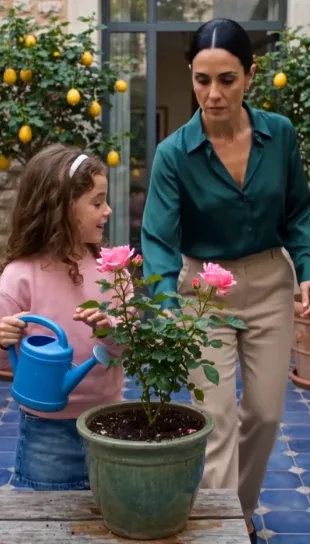
 The golden afternoon light fell upon the terrace of the mansion in La Moraleja, and Alma Salazar watered the white hydrangea with the gentleness of someone who believes flowers can hear. She was seven years old, with two half-undone pigtails and a patience beyond her years. The green watering can was almost bigger than her wrists, but she tilted it slowly, proud not to spill a single drop outside the red pot. That hydrangea wasn’t just any plant. It was the last thing she kept alive of her mother’s, the same one she had planted with her one spring ago, and which had since become a small, intimate ritual: every afternoon, Alma spoke to the flowers as if a familiar voice still awaited her beyond the perfume. The sliding door to the living room opened with a sharp click.
Verónica Salazar appeared without a greeting, dressed in black, impeccable and cold as a well-groomed shadow. She stared for a moment at the pot, then at the girl, and then back at the plant. She didn’t ask what Alma was doing or why she was smiling. She took two quick steps, bent over the pot, and grabbed the base of the hydrangea with brutal decisiveness. She ripped it out whole, roots and soil and all, in one swift motion. The root ball hung for a moment in the air before crashing against the cream-colored stone of the terrace. Alma stepped back, the watering can pressed against her chest. She didn’t manage to utter a word before she saw Verónica crush the flowers with her shoe. One stomp. Another. Another. The branches bent,
the white petals mingled with damp earth, and the small daily ritual was reduced to a dark mess. Alma felt something break inside her chest in the same rhythm as the flowers under the sandal. Her eyes welled up, and her throat closed. Verónica said nothing. Not an explanation, not a reproach, not a hint of shame. She simply took a step back and surveyed her handiwork with a hard expression, as if she had disposed of a domestic nuisance. The little girl huddled beside the wicker chair, unable to understand why this woman had chosen precisely the one thing that still connected her to her mother. She cried silently at first, then with real sobs, her shoulders trembling. It was then that she saw a small glimmer in the disturbed earth of the empty pot.
It wasn’t glass or a stone. It was the transparent rim of a plastic bag buried at the bottom. Alma put the watering can down and, still crying, knelt beside the pot. She covered her hands in mud as she pushed aside damp clods until she pulled out a sealed zip-top bag. Inside, protected from the water, lay a small cream-colored paper envelope. The little girl’s heart began to pound with a strange mixture of fear and curiosity. The envelope was intact, slightly folded at one corner, but clearly hidden there for a long time. Alma turned it over between her muddy fingers. No writing was visible from the outside.He tried to open the plastic zipper, but his hands kept slipping. To the right, through the door visible from the terrace,
Daniel Salazar appeared. He came from inside the house with his shirt sleeves rolled up and his brow furrowed, alerted by the crying. First, he looked at the crushed flowers on the stone. Then he saw his daughter’s dirty hands, the clear plastic bag, and Verónica’s motionless face in the background. He hurried over, not to his wife, but to the little girl. “Alma,” he murmured, but she was already holding the bag up to him as if she were carrying a frightened animal. “Daddy, there was something hidden in Mommy’s flowerpot,” she said breathlessly. Daniel took the package, still not understanding. He looked at the mud under Alma’s fingernails, the disturbed flowerpot, and the envelope protected inside the plastic, as if the order of the world had just shifted before his eyes. With tense fingers, he opened the zip closure. He took out the cream-colored envelope, noticed a folded piece of paper inside, and lifted the flap. Alma watched his every move, holding her breath. Verónica remained silent, a step back, too still. Daniel took out the sheet of paper and unfolded it. The afternoon light, the scent of damp earth, and his daughter’s sobs were suspended in a single instant. His eyes scanned only a few lines. Initial curiosity transformed into bewilderment, then into a pale, definitive shock. The muscles in his face stiffened. He lowered the sheet only slightly, without uttering a single word aloud. Alma knew that whatever was inside was important because her father, who rarely lost his temper, seemed to have run out of breath. And,





