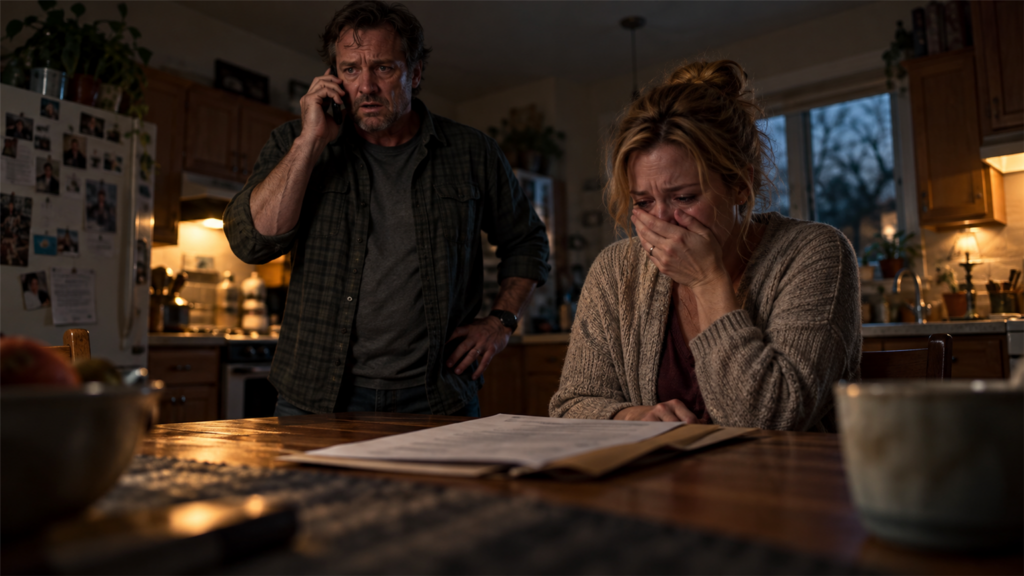
My parents kicked me out at eighteen because I was one dollar short on rent.
Not fifty dollars. Not even ten.
One.
Dad counted the bills twice at the kitchen table, flattening each one with his thumb. “Six hundred forty-nine.”
“My paycheck clears Friday,” I said. “I can give you the last dollar then.”
He looked at me like I’d asked him to forgive a thousand-dollar debt. Mom stood at the sink with her arms folded, watching the reflection of all three of us in the dark window.
“You live here, you pay rent,” Dad said. “That’s how adults survive.”
“I know.”
“Apparently you don’t.”
I could hear my little brother, Caleb, stop his video game in the next room.
Dad pushed the envelope back toward me. “Pack a bag.”
I thought he was trying to scare me. Then Mom walked to the front door, opened it, and said quietly, “The real world won’t tolerate excuses, Emily.”
That hurt more than Dad shouting.
I went upstairs and filled one suitcase and a gray duffel bag. Jeans. Pharmacy uniform. Community-college textbooks. Toothbrush. The framed photo of Grandma Evelyn that had sat on my dresser since her funeral.
At the bottom of my desk drawer was a manila envelope stamped FRANKLIN COUNTY TREASURER. I slid it between two textbooks before Dad came upstairs.
“You have ten minutes.”
I nodded.
No screaming. No begging.
People tell you who they are when they think you have nowhere else to go.
At the door, Caleb hugged me so hard his glasses pressed into my shoulder. Dad looked away. Mom stared at the floor.
Then she closed the door.
The deadbolt clicked while I was still standing on the porch.
That night, I slept on my coworker Hannah’s couch with my suitcase beside me. At 2:14 a.m., I opened the county website on my phone, stared at a payment confirmation, and turned the screen facedown.
For the next four weeks, I worked every shift I could get. I went to class. I found a room to rent from Hannah’s aunt. I never called my parents, and they never called me.
Until a Tuesday morning at 6:17.
My phone lit up with MOM.
I almost let it ring out.
When I answered, all I heard at first was breathing.
Then Mom whispered, “Please don’t hang up.”
Behind her, Dad was saying something fast and angry.
“What happened?” I asked.
Mom started crying.
“The county sent another notice.”
I sat up.
Then Dad took the phone.
His voice was different now.
“Emily,” he said, “the treasurer’s office says the person who’s been making payments on this house… was you.”
I was back in their kitchen forty minutes later.
Nothing had changed. Same chipped fruit bowl. Same humming refrigerator. Same hook by the door where my keys used to hang.
Except now a red certified-mail envelope sat in the middle of the table.
Dad didn’t offer me a chair.
“How long?” he asked.
“Since May.”
Mom looked at the envelope. “Since May what?”
I looked at Dad.
He knew.
Three months earlier, I had found the first delinquent-property-tax notice under a pile of junk mail. The house was more than eleven thousand dollars behind. A tax-lien sale had been scheduled if the balance stayed unpaid.
When I asked Dad about it, he ripped the notice in half.
“I’ve got it handled.”
He hadn’t.
Grandma Evelyn had left me fourteen thousand dollars when she died. Not a fortune. She called it my “start-your-life money.” I had planned to use it for tuition and a used car.
Instead, I went to the county office.
I paid enough to stop the sale and set up a temporary payment arrangement while Dad was between steady jobs.
Mom stared at me. “You used Grandma’s money?”
“Most of it.”
Her hand went to her mouth.
Dad’s jaw tightened. “Why would you do something that stupid without telling us?”
The room went quiet.
“You were losing the house.”
“That was my problem.”
“It was Caleb’s house too.”
Dad slapped his palm against the table. “And now you left, missed the next payment, and put us right back in trouble.”
There it was.
Not thank you.
Not I’m sorry.
Blame.
I pulled three folded receipts from my backpack and laid them beside the red notice.
“Those payments came from my account. The last one cleared the night you threw me out.”
Mom looked at the dates.
Then at me.
“The night…?”
“I had thirty-seven cents left after that payment. That’s why your rent envelope had six hundred forty-nine dollars instead of six-fifty.”
Her face changed.
Dad picked up one receipt. “Then use whatever’s left.”
“There isn’t anything left.”
“You spent fourteen thousand dollars?”
“On your house.”
He pushed the paper away.
Mom sat down slowly.





