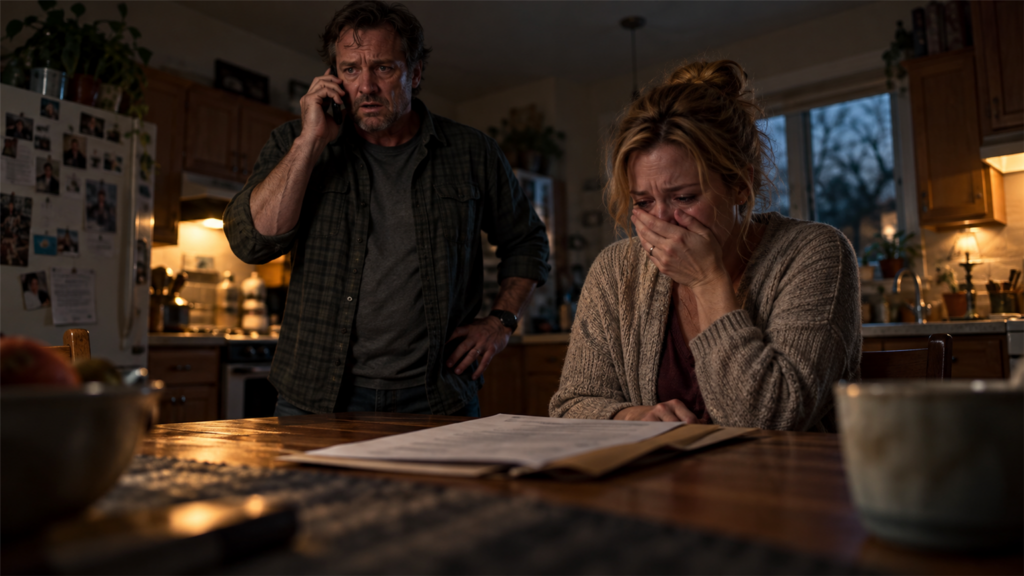
A knock came at the front door.
Dad frowned. “Who’s that?”
“I asked someone to meet us.”
On the porch stood Marisol Alvarez, the county housing counselor I had been working with since May. She carried a thin blue folder.
Dad lowered his voice. “You brought a stranger into this?”
Ms. Alvarez looked straight at him.
“I’m the reason your property hasn’t gone to sale yet, Mr. Parker.”
Then she opened the folder.
“But before we discuss what you owe now, you need to understand exactly what your daughter has already paid to keep this address yours.”
Ms. Alvarez turned the folder toward my parents.
The payment history filled almost an entire page.
“Emily has paid fourteen thousand four hundred thirty dollars toward your delinquent taxes, penalties, and current installment,” she said. “Her last payment kept the account out of the next enforcement step.”
Mom’s lips parted.
Dad stared at the numbers.
“She lived here,” he said. “She was supposed to contribute.”
Ms. Alvarez didn’t raise her voice.
“Your daughter is not legally responsible for your property taxes, Mr. Parker.”
Dad sat down.
The amount needed to keep the new payment plan alive was $2,640. Due Friday. I could tell by Dad’s face they didn’t have it.
Mom reached across the table. “Emily… could you borrow it? We’d pay you back.”
I moved my hand before she could touch it.
“No.”
Dad looked up sharply.
“I’ll help with the hardship paperwork,” I said. “I’ll give Ms. Alvarez every receipt. But I’m not paying another dollar.”
“So you’ll let us lose the house?”
“No. I’m refusing to be responsible for saving it.”
Caleb was standing in the hallway. He had heard everything.
That was when Dad stopped arguing.
Ms. Alvarez explained the options. Dad could request a revised plan if they made a smaller good-faith payment and documented the loss of his overtime. Mom could add her income. They could cut expenses and sell assets.
Dad’s motorcycle was worth more than enough.
The same motorcycle he polished every Sunday while I took the city bus to work.
He looked toward the garage.
Nobody said anything.
Three days later, Dad sold it.
They made the payment, submitted the hardship packet, and the county approved a twelve-month arrangement. The house stayed theirs, but the payments were theirs too.
I stayed with Hannah’s aunt.
Mom called twice the first week asking me to come home. Both times I said no.
The third time, she didn’t ask.
She said, “I keep hearing that lock.”
I knew what she meant.
“I shouldn’t have closed that door on you,” she whispered. “Not over a dollar.”
I stared at the wall.
“Thank you for saying that.”
Dad took longer.
Nearly two months later, after chemistry class, I found an envelope under the windshield wiper of the used Honda I had finally bought with wages and a small school grant.
Inside was a single one-dollar bill.
There was a note in Dad’s handwriting.
*You were never one dollar short. I was one apology late.*
I sat in the parking lot with that bill between my fingers until the paper went soft.
I didn’t move back home. Forgiveness did not mean returning to the arrangement that had hurt me. I kept my room, kept working at the pharmacy, and kept going to community college.
My parents kept the house.
More importantly, they started paying for it themselves.
At Thanksgiving, I went over for dinner. Caleb saved me the chair beside him.
Before I left, Dad stood by the front door.
For one second, I looked at the deadbolt.
He noticed.
Then he opened the door for me and said quietly, “Drive safe, Em.”
That first night, I thought being locked out meant I had lost my home.
It took one missing dollar to teach me the difference between a house and a place where you are treated like you belong.





