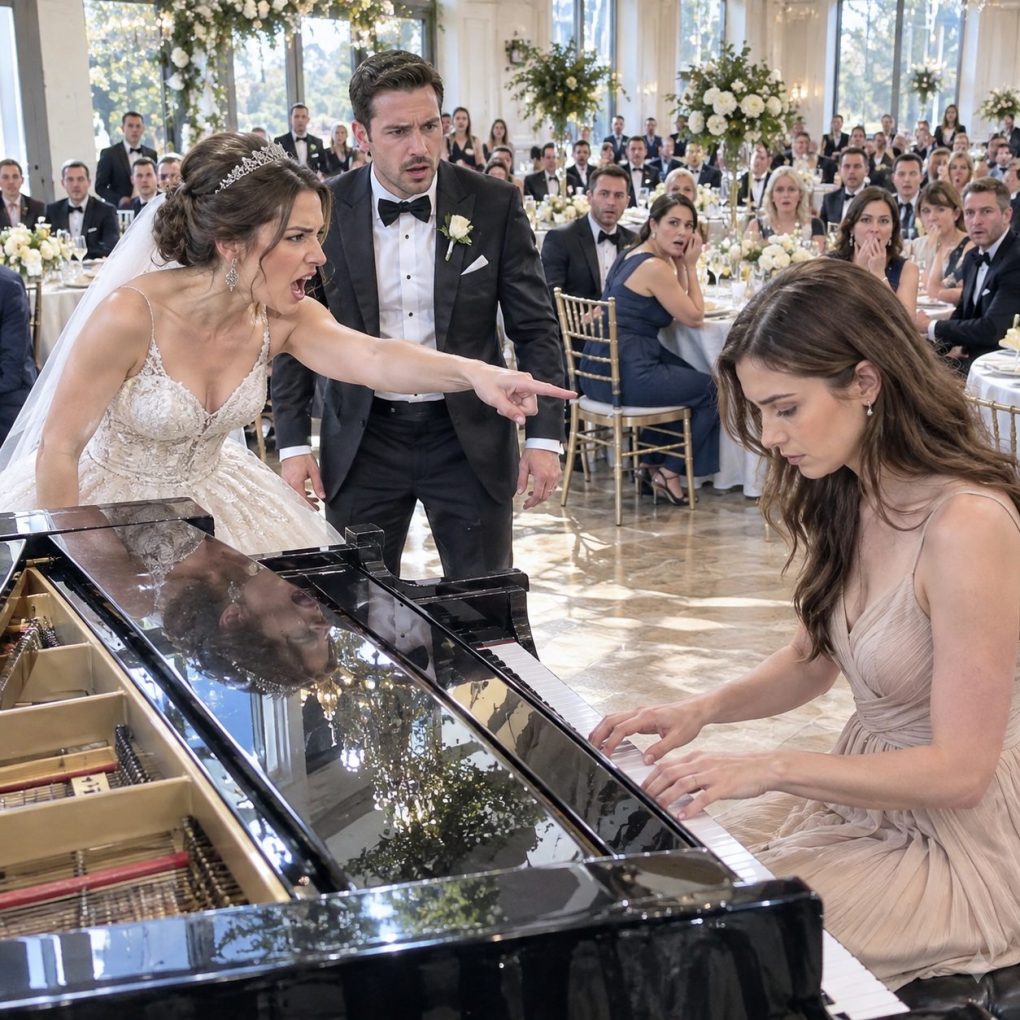
“You call yourself a musician? Prove it!” my sister-in-law shouted, pointing toward the piano in front of eighty wedding guests. She had just graduated from a prestigious music school. I smiled and touched the keys. But when my brother recognized the melody, he suddenly stood up and whispered, “Oh, no…”
“Show me some respect as your brother’s wife,” Sophie snapped, pointing toward the grand piano. “You said you teach music. Play something useful.”
Eighty wedding guests turned in their chairs. My brother Ben stood beside his new bride, still holding the champagne glass from his toast. A few people laughed, waiting to see whether I would make a scene.
I set down my untouched slice of cake.
“Sophie, this is your reception,” I said. “The pianist you hired is coming back from his break.”
“Oh, come on, Mara.” She gave me a tight smile. “You teach children after school. Surely you can manage three minutes.”
I could feel the folded paper inside my purse pressing against my hip. Six weeks earlier, a former student had sent me a video of Sophie’s graduation recital. She was seated at a black grand piano, introducing an original composition called “The Last Porch Light.”
Only it wasn’t hers.
I had written that music four years earlier, when our mother was dying. The opening notes followed a little tune Mom used to hum while putting dishes away, always stopping before the last phrase because she could never remember how it ended. I wrote the ending after she was gone, sitting at her kitchen table with her sweater over my knees.
Ben had helped me record it on Mom’s old upright. I still had the yellow manuscript pages and the recording, including the squeak of the piano bench whenever he shifted his weight.
Last winter, Ben asked whether he could share the recording with Sophie. He thought she might arrange it for their wedding ceremony. I said yes. I wanted Mom to be there somehow.
When I saw the recital video, I called him. He promised to talk to Sophie. Then weeks passed without an answer.
Now she was telling eighty people I was barely a musician.
I walked to the piano. The keys were cool beneath my fingertips, and one of the pedals gave a faint click when I tested it. I had played for funerals, school recitals, and once for a room with only three people. None of them had frightened me as much as the sight of my brother staring at the floor.
I began with the four notes Mom used to hum.
Ben’s glass struck the table.
“Mara, stop.”
Sophie stepped forward. “That’s my graduation piece. How does she know it?”
Ben looked at his bride.
“Do you even know who my sister is?”
And the room went silent.
Sophie folded her arms. “She heard it at my recital. I’m not surprised she memorized it.”
I stopped playing. The last note faded into the clink of somebody setting down a fork.
“You told your professors you composed it,” I said.
“Because I did.”
Ben moved between us. “Sophie, Mara wrote that piece for Mom. I was there when she recorded it.”
Sophie turned toward the guests. “You’re really going to humiliate me on my wedding day over a piano song?”
Her father rose from his seat. “This can wait. You’re upsetting everyone.”
I almost apologized. That was what I had done when Mom needed medicine and Ben needed help with rent: make my needs small enough to fit around theirs. Instead, I closed the piano lid gently.
“I can leave,” I said. “But I won’t say the music is yours.”
The wedding coordinator approached, asking whether the scheduled first dance should begin. Sophie told her to take away the piano microphone. Then she faced me again.
“People paid to hear me play that piece at my recital. You can’t just come here and claim it.”
“I didn’t come here to claim anything. You asked me to play.”
Ben took his phone out. He found the recording from four years earlier: the camera pointed at our mother’s upright, the bench squeaking as I played, his voice asking whether I wanted another take. The file had been saved in the family cloud folder long before Sophie joined our lives.
He showed it to her, then the two bridesmaids nearest us.
Sophie barely looked.
“A recording proves you played it, not that you wrote it.”
She had a point, at least technically. So I took the creased pages from my purse: handwritten drafts, crossed-out measures, a dated email from the small publisher that had licensed the piece for a community-theater production two years earlier.
Sophie’s expression changed when she saw the publisher’s name.
Ben touched the edge of a page. “I sent her the recording, Mara. I never sent your manuscript.”





