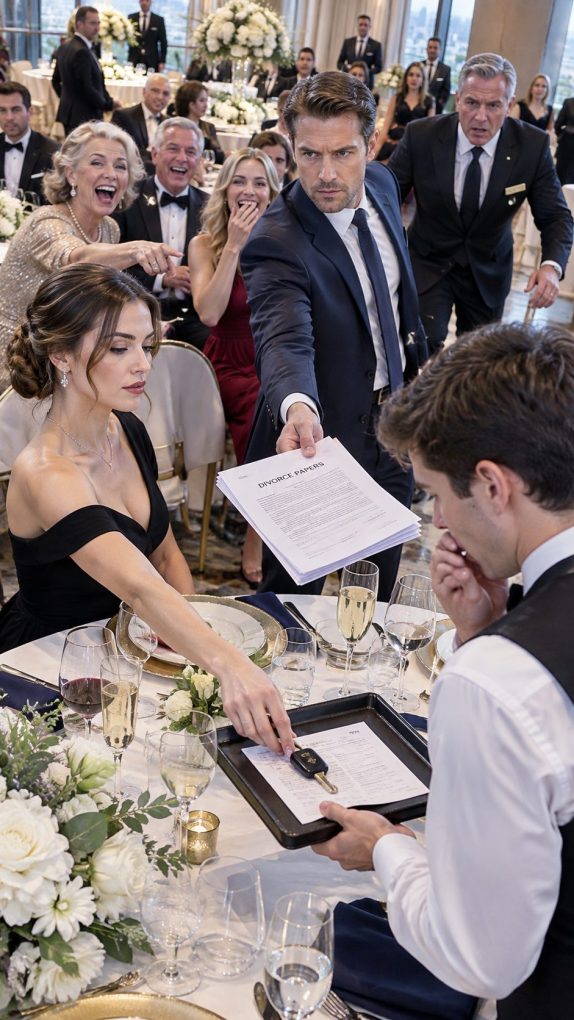
“You can sign these tonight, or you can leave with nothing.”
My husband, Andrew, slid a thick envelope across the white tablecloth.
Inside were divorce papers.
His mother, Patricia, smiled into her champagne glass.
His younger brother, Nathan, actually laughed.
“Guess the free ride is over, Claire.”
We were halfway through the twenty-fifth-anniversary founders’ dinner for Whitmore Hospitality, my husband’s family restaurant business, at The Marlowe in downtown Chicago.
Thirty guests surrounded us.
Investors. Family friends. Senior employees.
Andrew had chosen this exact moment to announce he was divorcing me.
I looked down at the papers.
“You brought these here?”
He straightened his jacket.
“I wanted witnesses. You’ve spent nine years living off my family. It’s time you learned to support yourself.”
Patricia leaned toward me.
“Don’t make a scene, dear. You were never really one of us.”
I folded the first page and placed it back inside the envelope.
Nobody at that table knew I’d spent seven years quietly helping Andrew’s struggling company with its payroll systems and vendor contracts.
I’d stopped working full-time two years earlier to care for his father after a stroke.
When his father died, Andrew began calling me unemployed.
Apparently, that was easier than remembering why I’d left my job.
A waiter approached with the dessert menu.
Andrew waved him away.
“Separate checks. My wife can pay for herself.”
Nathan grinned.
“Hope she brought enough cash.”
I reached into my handbag.
Not for a credit card.
For a small black onyx key.
Its silver handle was worn smooth, with a tiny number seventeen engraved beneath the stone.
My grandmother, Evelyn Bell, had given it to me shortly before she died.
She’d been one of the original investors in The Marlowe. When I was young, she used to bring me here on Sunday afternoons.
She always told me the same thing.
Never confuse being welcomed into a room with being allowed to own your place in it.
I placed the key beside my untouched dessert plate.
“Could you ask Mr. Bennett to come over?” I asked the waiter.
The young man’s expression changed.
He looked at the key.
Then at me.
“Ma’am… where did you get that?”
“It belongs to me.”
His hand trembled as he picked up the leather bill folder.
He excused himself.
Two minutes later, the restaurant’s general manager hurried toward our table.
“Ms. Bell?”
I nodded.
His eyes moved to the key.
“Would you like your dinner charged against your grandmother’s founder account? There’s still a prepaid balance.”
“Yes, please. Just my dinner.”
Andrew frowned.
“What founder account?”
Mr. Bennett hesitated.
Then he said something that wiped the smile from Patricia’s face.
“Mrs. Whitmore, your wife is the managing member of the company that owns this restaurant and the building we’re sitting in.”
Andrew stared at me.
But Mr. Bennett wasn’t finished.
“And I believe your family has been trying to buy that building for the last six months.”
For several seconds, nobody spoke.
Then Andrew laughed.
“That’s impossible.”
Mr. Bennett remained beside my chair.
“Ms. Bell oversees Marlowe Property Holdings. Her grandmother established the founder account years ago.”
Patricia set down her glass.
“Claire, what exactly have you been hiding?”
I looked at her.
“Nothing you ever cared enough to ask about.”
When Grandma died three years earlier, she left me her controlling ownership interest in Marlowe Property Holdings, the small company that owned the restaurant building and two adjoining commercial properties.
Andrew knew I’d inherited part of her business.
He’d called it “that old restaurant investment.”
He never asked what it included.
I didn’t correct him.
Grandma had left clear instructions about protecting the properties, the tenants, and the employees who depended on them.
With help from her longtime attorney, I’d continued overseeing the company while keeping my involvement private.
Now Andrew stared at me as though I’d become a stranger.
Nathan leaned forward.
“Wait. You own the Marlowe property?”
“Through the holding company, yes.”
His expression changed.
Whitmore Hospitality had been trying to acquire the building for a new flagship restaurant.
Six weeks earlier, they’d announced to investors that the property acquisition was nearly finalized.
I knew because our property manager had received their offer.
We’d declined it.
Their financing proposal required us to accept a price below an independent appraisal and terminate several existing commercial leases early.
Andrew had never mentioned the offer to me.
Patricia recovered first.
“This doesn’t change anything about the divorce. Andrew’s attorney will handle that.”
“I know,” I said.
Andrew suddenly leaned across the table.
“You’d better not interfere with our expansion.”
“I haven’t interfered with anything.”
“We’ve already committed to the purchase!”
I looked at him.
“Then you’ve committed to buying a property its owner hasn’t agreed to sell.”
Nathan glanced toward his mother.
“Andrew, didn’t you say the seller had approved the terms?”





