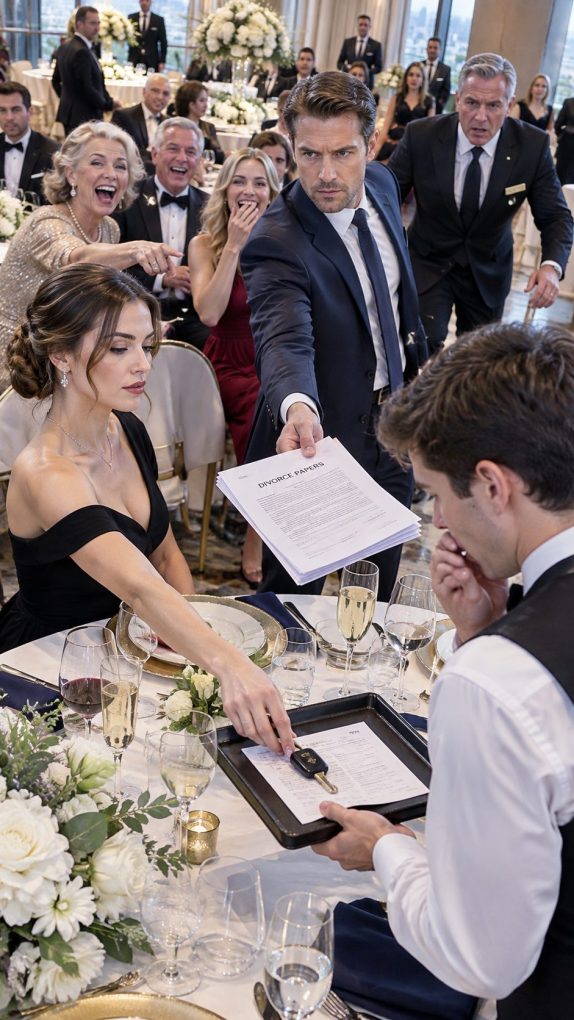
“He did,” Patricia said quickly.
I turned toward her.
“Who approved them?”
She didn’t answer.
Mr. Bennett quietly asked whether I wanted him to call the property’s attorney.
I nodded.
Andrew stood.
“Don’t involve lawyers. This is a family discussion.”
I looked at the divorce papers.
“You made it a legal discussion when you served me those.”
His face reddened.
Patricia opened her handbag and removed a folder.
“Fine. We have written consent.”
She placed a photocopied letter on the table.
At the bottom was a signature.
Claire Bell, Managing Member.
I stared at it.
The signature had been copied from a routine tenant-renewal letter I’d signed eight months earlier.
Even the unusual loop in the letter B was identical.
I looked at Patricia.
“Where did you get this?”
Her lips pressed together.
Andrew glanced at Nathan.
“Mom?”
I turned the page.
The letter claimed Marlowe Property Holdings had agreed to sell the building for $3.8 million, subject to final documentation.
I’d never agreed to that sale.
Then Nathan made the mistake of opening his mouth.
“But the bank has already approved our expansion loan based on that letter.”
I looked at him.
“What loan?”
His face went pale.
Patricia reached for the document.
I held it still.
And asked one question.
“Did you submit my signature to a lender without my permission?”
Andrew stared at his mother.
“Tell me you didn’t do that.”
Patricia’s expression hardened.
“I was trying to protect this company.”
“With my signature?” I asked.
She looked at me.
“We intended to buy the building. You were supposed to cooperate.”
I sat back.
“Then why didn’t anyone ask me?”
Nobody answered.
The restaurant had gone quiet around us. A few guests were pretending not to listen, but Nathan’s voice had carried across the room.
Mr. Bennett returned with the dinner receipt.
He placed it beside my plate.
“Your meal has been charged to the founder account, Ms. Bell.”
I thanked him.
Then I picked up the onyx key.
It wasn’t magical.
It didn’t unlock a secret vault or give me power over every person in the room.
It opened Grandma’s private wine cabinet, which she’d maintained at The Marlowe for decades. The restaurant’s records also identified its holder with the founder account she’d prepaid for special occasions.
The key was a reminder of where I’d come from.
The legal documents were what mattered.
And those documents told a very different story from the one Andrew’s family had been selling.
The following morning, I met with our property attorney, Rebecca Sloan.
We reviewed the purported consent letter and notified the lender that Marlowe Property Holdings had never authorized the proposed sale.
The lender suspended further processing of Whitmore Hospitality’s expansion financing while it investigated the representations made in the application.
No property had changed hands.
No money had been advanced against our building.
But Andrew’s family had represented an unsigned, unfinished transaction as though it were practically guaranteed.
Their investors wanted answers.
So did their attorneys.
Within two weeks, Whitmore Hospitality’s outside directors commissioned a review of the loan application and acquisition records.
The review found that Patricia had instructed a company employee to prepare the purported consent letter using a signature taken from an earlier document.
The employee had raised concerns.
Patricia had told him to proceed.
He’d kept the emails.
That evidence became important when my attorneys disputed the document and referred it to the appropriate authorities for review.
Andrew insisted he hadn’t known the signature was copied.
I couldn’t establish what he’d known when the letter was submitted.
But he’d repeatedly told investors the acquisition was secured without confirming it with the seller.
That was his responsibility.
The company’s financing plans collapsed.
Its board removed Patricia from her management role and required Andrew to step away from negotiations while the matter was investigated.
Several expansion commitments had to be renegotiated.
Their employees continued working at the existing restaurants. I had no interest in punishing people who had nothing to do with the deception.
Meanwhile, I hired a divorce attorney.
Andrew asked me to reconsider.
“Claire, we’ve been married nine years.”
I looked at him across the conference table.
“Then you had nine years to learn who I was.”
He lowered his eyes.
“I thought you needed me.”
“I needed a husband who respected me.”
Our divorce didn’t end overnight.
There were financial disclosures, legal fees, and difficult discussions about marital property.
The inheritance I’d received from Grandma had been kept separately titled and managed, although my attorney still reviewed all potential marital claims under Illinois law.
I didn’t walk out with a magical victory.
I walked out with my dignity and the records needed to protect my interests.
Months later, The Marlowe celebrated its fiftieth anniversary.
Mr. Bennett invited me to attend.





