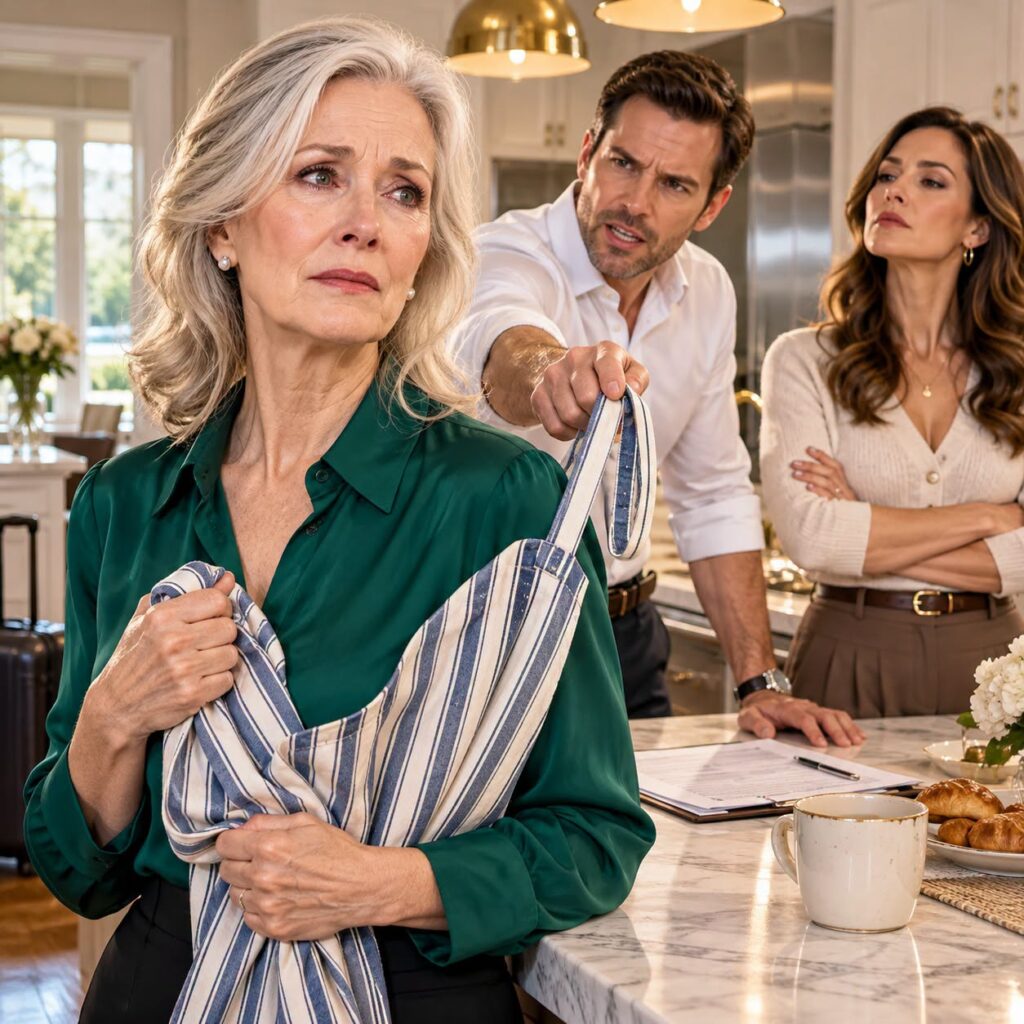
“Breakfast at six,” my son-in-law said, dropping a striped apron into my lap.
I had been inside my daughter’s house for eleven hours. Already, I was being handed a uniform.
“Coffee ready by five forty-five,” Trent added. “And clean the kitchen before we leave for work.”
My daughter, Megan, leaned against the marble counter without looking up from her phone.
“If you live off us,” she said, “know your place.”
I stared at the apron. I was sixty-four years old. For thirty-one years, I had owned Sunday & Rye, a chain of six bakeries around Columbus, Ohio. I had worked through snowstorms, sleepless nights, and the morning my husband died. I had paid Megan’s college tuition with flour on my sleeves.
Now she watched her husband assign me breakfast duty.
Two weeks earlier, I had closed my stores. Rising rents and delivery costs had finally made the storefronts impossible to keep open. I sold the equipment, paid my employees, and surrendered the leases. The headlines called it a collapse.
They didn’t mention that I still owned the name, the recipes, and every trademark.
Or that someone wanted them badly.
“Did you hear me, Mom?” Megan asked.
“I heard you.”
“Then say thank you. We gave you somewhere to sleep.”
Three days before, she’d begged me to stay instead of renting a room. “You shouldn’t be alone right now,” she had said. I had believed she meant it.
I set the apron on the table. “I can contribute to groceries. I told you that yesterday.”
Trent laughed. “Groceries? You have any idea what this house costs?”
He wore a watch that cost more than my first bakery oven. He also worked as a commercial leasing broker, which meant he understood exactly how valuable a business could be even after its doors closed.
“Then tell me what you want,” I said.
He slid a document across the counter. The first page read TEMPORARY RESIDENCY AGREEMENT. Halfway down, a paragraph assigned an eight-hundred-dollar weekly value to my room and meals.
At the bottom, in small print, was the real demand.
If I failed to pay, all rights to Sunday & Rye’s name, recipes, and branding would transfer to a company called T&M Ventures LLC.
I read it twice.
“Why would you want a closed bakery’s trademarks?” I asked.
Trent’s smile faltered. “Security. Standard business practice.”
“Who owns T&M Ventures?”
“Sign first,” he snapped.
Megan finally lifted her eyes. There was fear in them, but not enough to make her speak.
I took out my phone and photographed every page.
“Delete those,” Trent ordered.
“No.”
“You’re not leaving this house with our agreement!”
“Watch me.”
I folded the apron, placed it beside the unsigned papers, and carried my suitcase to the door. Megan didn’t follow.
At a motel fifteen minutes away, I called my attorney, Karen Wu. Before I could explain, she interrupted.
“Eleanor, the grocery chain’s lawyers just received an assignment transferring Sunday & Rye to Trent’s company.”
My mouth went dry.
Karen lowered her voice.
“It has your signature on it.”
My signature. On a document I had never seen.
And the buyer was supposed to approve my seven-million-dollar deal the next morning.
The apron had never been about breakfast. Somewhere inside my daughter’s house, someone had already tried to sell my life’s work.
“Read me the date,” I told Karen.
“Yesterday.”
Yesterday, I’d signed final payroll checks at my accountant’s office. His cameras showed me spilling coffee on my sleeve at 2:17 p.m.
The alleged assignment had been signed across town at 2:15.
“Send it to me,” I said.
My name appeared at the bottom in the same slanted handwriting I’d used on company forms for years. Too perfect. Someone had lifted it from an old scan.
Karen called the grocery chain’s counsel while I drove to her office. The buyer, Hearthland Grocers, had offered seven million dollars for Sunday & Rye’s trademarks, formulas, and distribution rights. Most of the money would be paid at closing; the rest depended on future sales. Until the contracts were final, our negotiations were confidential.
Hearthland had now frozen its approval.
Karen spread the documents across her desk. “A forged assignment doesn’t transfer ownership. But we have to prove what’s happened before they’ll proceed.”
She requested the original file and its email trail. Then she asked my accountant to preserve his security footage and appointment records.
T&M Ventures had been created six weeks earlier. Trent was its manager. Megan was listed as a member.
My daughter hadn’t just stood beside him that morning. She had entered business with him before I ever packed a suitcase.
I felt sick, but Karen kept working.
The assignment had arrived from Trent’s personal email. Attached to it was a forwarded message that he apparently hadn’t bothered to remove.





