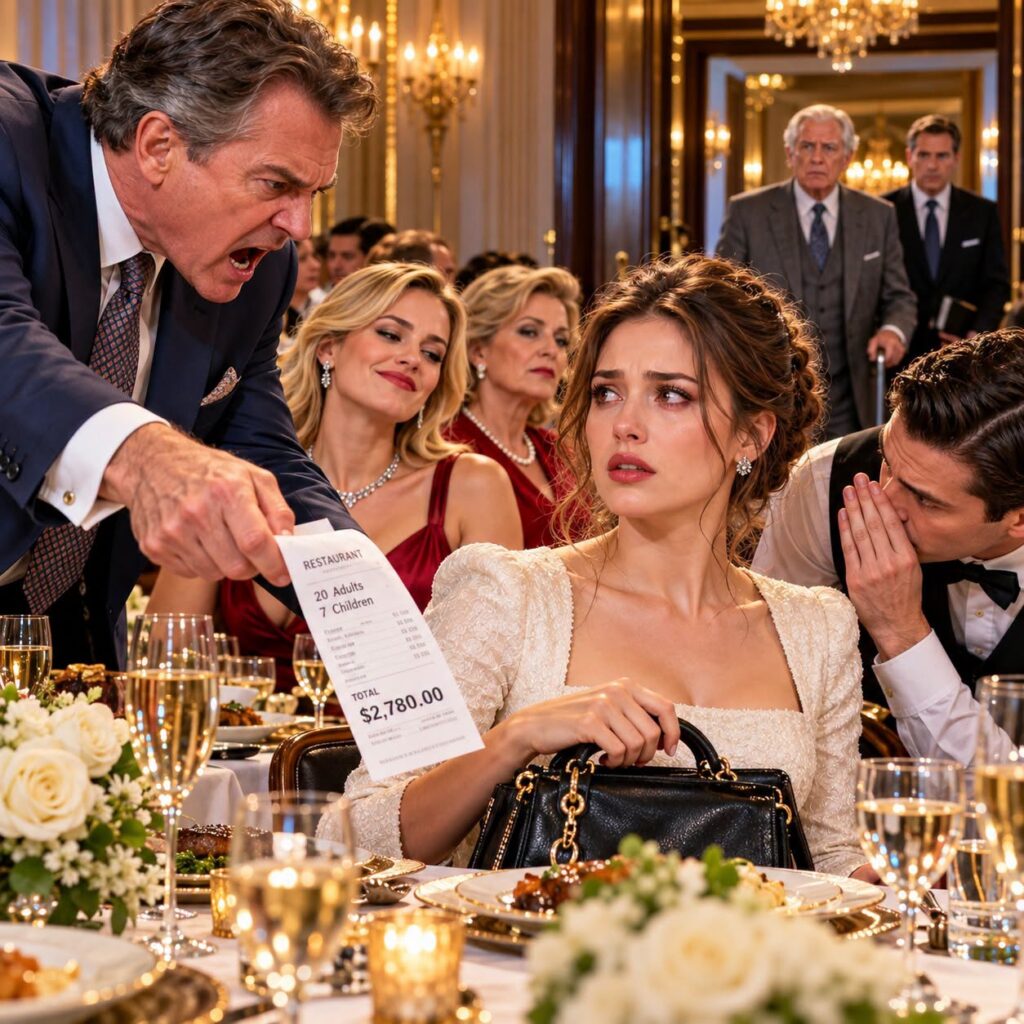
My father slapped a $2,780 restaurant bill against my chest and said, “Pay it. That’s the only reason we invited you.”
Twenty adults. Seven children. A private dining room in downtown Columbus. And apparently, I was the only person expected to reach for a wallet.
For three seconds, nobody moved. Then my sister Brooke laughed into her champagne.
“You should be grateful, Nora. We even let you sit here.”
My mother, Elaine, smoothed her silk napkin. “Don’t embarrass your father. This is his retirement dinner.”
I looked around the long table. Cousins I hadn’t seen in years were cutting into steaks. Their children were sharing desserts. My parents had invited everyone but somehow forgotten to mention that dinner was my treat.
“I didn’t agree to pay for this,” I said.
Dad leaned close enough for me to smell the bourbon on his breath. “You always were selfish.”
That word hit an old bruise. At nineteen, I’d worked nights to help cover their mortgage. At twenty-six, I’d paid Brooke’s overdue tuition. When Dad’s business failed, I’d quietly handled six months of utility bills.
Then I stopped. And suddenly I was the family disappointment.
Brooke slid the check presenter closer. “You run a bookkeeping business. Don’t pretend you can’t afford it.”
“I can afford my own dinner.”
Her smile sharpened. “Grandpa Walter would be ashamed of you.”
The mention of my grandfather sent a cold current through me.
He’d been in a rehabilitation facility since a fall last winter. Dad told everyone his memory was gone, that visits upset him, that he barely recognized family anymore.
But three weeks earlier, I’d driven there myself.
Grandpa had recognized me before I reached his doorway. And what he told me had changed everything.
Dad grabbed my wrist. “Stop staring into space and get your card.”
I pulled free. Chairs scraped. My aunt Linda whispered my name, but nobody challenged him.
“I already told the manager something important,” I said.
Dad scoffed. “That you’re finally paying?”
“No. That I never authorized this charge.”
Brooke’s expression flickered. She glanced at the leather folder beside my purse, then quickly looked away.
I’d carried that folder for nine days. Inside were copies of state business filings, bank transfers, and two letters bearing a signature I knew too well.
Mom noticed it too. “Nora, sweetheart. Let’s not make a scene.”
I almost laughed. She’d watched him humiliate me in front of twenty-seven people, and now she wanted privacy.
Dad raised his voice. “Everyone deserves to know what kind of daughter she is. She took advantage of an old man, and now she won’t even buy her family dinner.”
A spoon clattered against a plate.
I reached into my purse without answering. My fingers closed around my phone, already open to a message I’d been waiting to receive.
The waiter leaned down beside me.
“He’s here,” he whispered.
I turned toward the doorway.
Grandpa Walter stood there with his cane, his attorney at his side, looking straight at my father.
Dad looked up—and froze.
Then Grandpa spoke, clearly enough for every guest to hear.
“Richard,” he said, “why are you selling my house?”
Nobody touched another bite. My father’s hand was still gripping the bill, but his face had turned the color of the tablecloth. I knew the answer to Grandpa’s question. What I didn’t know was whether Dad would expose himself—or force me to do it.
Dad set down the bill as though it had burned him.
“Walter, you shouldn’t be out,” he said. “The doctors told us you were confused.”
Grandpa took one measured step forward. “My hip was broken, Richard. Not my mind.”
His attorney, Daniel Ellis, pulled out a chair. I had hired Daniel after an envelope from the Ohio Department of Taxation arrived at my office, demanding information about a home-care company I had never owned.
Dad reached for Grandpa’s arm. Grandpa moved away.
The waiter quietly guided the children toward the dessert station. My aunt Linda lowered her eyes, and nobody else spoke up for Dad this time.
“You’re upsetting him,” Mom snapped at me.
“No,” Grandpa said. “She’s the reason I finally know what happened.”
Daniel opened a thin binder. He explained that Grandpa had signed a financial power of attorney during rehabilitation so Dad could handle ordinary expenses. He had not authorized gifts to Brooke or payments to imaginary caregivers.
An independent physician had documented Grandpa’s ability to manage his affairs. On Monday, he had revoked Dad’s authority. Notices had already gone to his bank. Daniel had prepared an urgent notice for the title company handling his house.
Brooke pushed back her chair. “This is insane.”
I turned a statement toward her.
Over eleven months, $186,400 had left Grandpa’s accounts under payments labeled NORA HOME CARE LLC. The invoices carried a signature that resembled mine, except the N curled backward. I’d never signed them. I’d never even worked as a caregiver.





