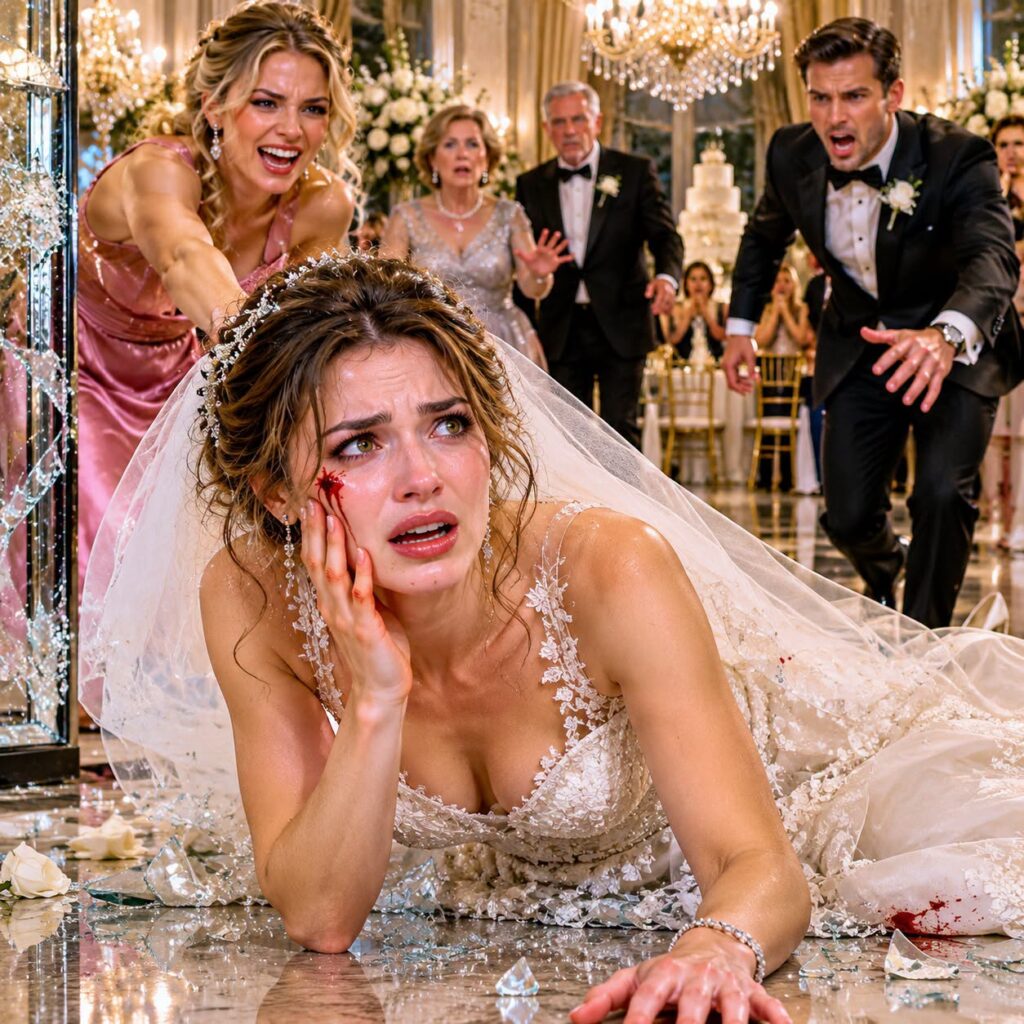
The glass door exploded against my face before our wedding cake had even been cut.
One moment I was stepping onto the terrace of the Hawthorne Conservatory in Columbus, Ohio. The next, my sister’s hands were between my shoulder blades, and I was falling through a rain of jagged glass.
“Ugly bride!” Vanessa screamed.
My knees hit the marble. Something warm ran along my cheek.
Behind her, seventy guests stood in a terrible silence.
Vanessa brushed glittering pieces off her pink bridesmaid dress. “Calm down. It was a joke.”
I touched my face. My fingers came back red.
My husband, Ethan, vaulted from the head table. We had been married for forty-three minutes. He yanked a linen napkin from a server’s tray and pressed it gently against my cheek.
“Call 911,” he shouted.
But my mother grabbed his arm. “Don’t make a scene. Vanessa didn’t mean it.”
“She pushed her through a door,” Ethan said.
Dad stepped beside Mom, blocking our wedding planner from taking pictures.
“Your sister gets carried away when she’s nervous, Claire. Stop embarrassing her.”
I couldn’t feel my upper lip. My veil was trapped beneath broken glass, and one of my shoes lay on the other side of the doorway.
Vanessa crouched near me. For a second I thought she might apologize.
Instead, she whispered, “You should’ve signed the paper.”
Then she stood and started crying loudly enough for everyone to hear.
For years, she’d been the daughter my parents rescued and I’d been the daughter they borrowed from. I covered her missed rent, replaced the money she took from Dad’s bakery register, and once spent my entire Christmas bonus paying off her car.
Whenever I said no, I was called selfish.
That morning, she’d slid a document beneath my makeup case and said it was a routine wedding expense acknowledgment.
I saw my grandmother’s property address halfway down the page and refused to put my name on it.
Vanessa’s smile had vanished.
I hadn’t told Ethan. I didn’t want another family fight before walking down the aisle.
Now he scooped me into his arms while the wedding coordinator called for an ambulance.
Mom followed, insisting I had “lost my balance.”
Dad told the coordinator to keep the incident private because it could “hurt the venue.”
“No one deletes a thing,” I managed, pointing at the security camera above the terrace door.
The coordinator met my eyes. “I understand.”
At the ER, a nurse carefully cut away my bloodstained veil.
A physician named Dr. Patel examined the gash under my left eye and ordered an X-ray before closing it.
“Some of this doesn’t look like a typical glass injury,” he said.
Ethan gripped my hand. I listened to metal instruments click against a tray.
Dr. Patel eased something tiny from the wound with forceps.
It flashed silver beneath the examination light.
He stopped moving.
“Claire,” he said quietly, “do you know what this is?”
“No.”
He looked at the nurse.
“Please preserve this. And ask her whether she’d like to speak to the police.”
The metal was smaller than a grain of rice, but it changed the way everyone in that room looked at my injuries. And while I sat under fluorescent lights, my mother was already making calls—just not the kind a frightened parent should make.
Dr. Patel set the fragment inside a specimen container.
“It’s the broken tip of a snap-off utility blade,” he said. “A glass door didn’t put that in your cheek by itself.”
He didn’t pretend to know who wielded it.
He didn’t have to.
I remembered Vanessa’s hand brushing my face a split second before the push.
I asked the nurse to call police.
When Officer Ramirez arrived, I told her what Vanessa had whispered. I also told her about the document.
The officer photographed my injuries, noted Dr. Patel’s finding, and arranged to collect the preserved fragment through the hospital’s evidence procedure.
Mom appeared at the door carrying my wedding purse and a manila folder.
“Your sister is hysterical,” she said. “She thinks you’ll ruin her life. Sign this statement saying nobody meant to hurt you. Then we can all go home.”
Ethan stepped between us.
“She needs stitches. You brought paperwork?”
Mom looked at the officer and froze.
I held out my hand. “Let me see it.”
The first page was an apology she had written for me.
Beneath it was a signature page authorizing the sale of my late grandmother’s two-story brick building on High Street.
The property wasn’t jointly owned.
Grandma had deeded it to me five years earlier. My parents rented the ground floor for their bakery.
“You hid this under a statement?” I asked.
Mom snatched the folder back.
“Your father needs help. We kept a roof over your head.”





