Two days later, Dad sent a message.
This family has sacrificed plenty for you. Stop being selfish and honor your commitment.
I replied:
I never signed a commitment. Please stop using my name.
Then I saved the conversation.
The following week, Madison called repeatedly.
I answered once.
“Our lender says the funds aren’t verified anymore,” she said. “We can’t qualify without them.”
“Then the house is beyond your current budget.”
“You have the money!”
“Yes.”
“You’d rather watch us lose the house?”
“I’d rather you buy one you can afford.”
She screamed that I was ruining her life.
I ended the call.
On October 28, exactly two weeks after my birthday, my family returned from Tahiti.
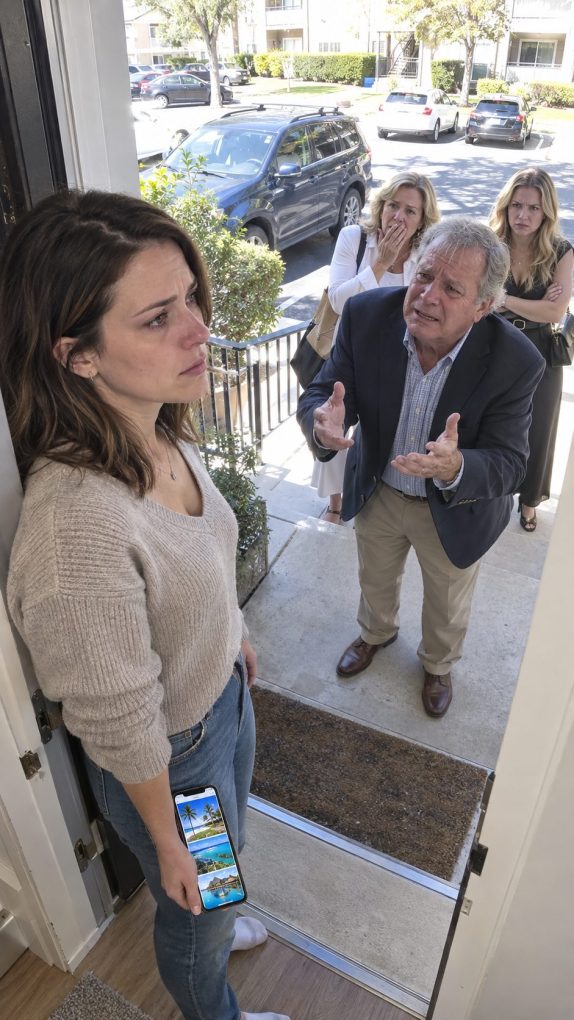
At 6:40 that evening, they appeared outside my apartment.
Dad knocked so hard the hallway light shook.
Mom was crying.
Madison was shouting into her phone.
When I opened the door, Dad stepped forward.
“Emily, we’re family. Please. Just sign the papers. They’re giving Madison until tomorrow to resolve the financing!”
I looked at the folder in his hand.
Then I noticed another document behind the mortgage paperwork.
It was a printed receipt from their Tahiti resort.
The total was $21,860.
And at the bottom, someone had handwritten:
“Reimburse from Emily’s next transfer.”
I looked at the receipt.
Twenty-one thousand, eight hundred and sixty dollars.
My parents had claimed they couldn’t afford dinner for my thirtieth birthday.
But they’d spent more than twenty thousand dollars celebrating in Tahiti.
I pointed to the handwritten note.
“What’s this?”
Dad quickly turned the paper over.
“That’s not important.”
“Then why does it say you’re reimbursing the trip from my next transfer?”
Mom started crying harder.
“We were going to explain.”
“Explain what?”
Madison stepped forward.
“Can we please deal with my house first?”
I looked at her.
“You knew?”
She crossed her arms.
“Dad said you’d help cover the trip because you’d been sending money anyway.”
I stared at my father.
For years, I’d believed the monthly transfers were helping my parents keep their home.
Instead, he’d begun treating them as money he could spend before I even sent it.
“You told me you had medical bills,” I said.
“We do,” Dad replied.
“Then why were you staying in an overwater bungalow?”
Mom wiped her cheeks.
“We thought we deserved one nice vacation.”
“You do. If you can afford it.”
Dad’s face reddened.
“After everything we’ve done for you, you think we don’t deserve a little help?”
I stepped aside so the neighbors could pass through the hallway.
Then I said quietly, “You can deserve a vacation without expecting me to pay for it.”
Madison shoved the mortgage folder toward me.
“Just sign. We can argue afterward.”
I didn’t take it.
“No.”
Her face crumpled.
“Emily, we’re going to lose the house!”
“You haven’t bought it yet.”
“We’ve already told everyone!”
That sentence explained more than she intended.
She was worried about the house.
But she was also worried about what people would think.
I looked at Dad.
“And you signed my name on her gift letter.”
He opened his mouth.
Mom interrupted.
“We didn’t think you’d mind.”
“I mind.”
I asked them to leave.
Dad refused at first.
Then I said I would call building security if they continued shouting in the hallway.
They finally walked away.
The next morning, I met with an attorney.
I brought the unsigned gift-letter correspondence, the document bearing the disputed signature, and screenshots of my family’s messages.
My attorney advised me to preserve everything and confirm directly with the lender that I hadn’t authorized the gift.
I’d already notified the broker.
We followed up formally.
The lender removed the proposed gift from Madison’s available funds and reviewed how the letter had been submitted.
Without the $48,000, Madison and Kyle couldn’t complete their planned financing.
Their purchase fell through.
Because their contract still contained a financing contingency, their real-estate attorney helped them address the earnest-money deposit according to its terms.
They didn’t lose everything.
They lost the house they had expected me to help buy.
That distinction mattered.
My parents faced different consequences.
Their vacation charges remained their responsibility.
They’d used their own credit cards and savings to pay for the trip, expecting my future support to replenish the money.
When I stopped the monthly transfers, they had to restructure their budget.
Dad took part-time consulting work.
Mom canceled several unnecessary subscriptions.
For the first time in years, they made financial decisions without assuming I would rescue them.
A month later, Dad called.
His voice sounded different.
“Emily, can we talk?”
I hesitated.
“About what?”
“Your birthday.”
I sat down.
He cleared his throat.
“I shouldn’t have called you that.”
“No, you shouldn’t have.”
“We thought you’d get upset for a few days and then everything would go back to normal.”





