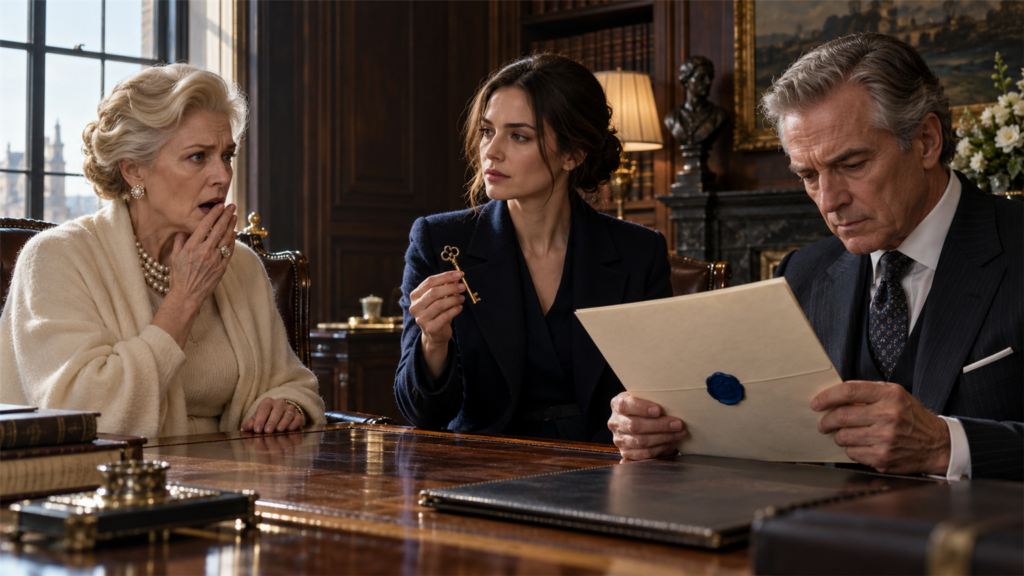
Mr. Harris carefully detached the brass key.
“There is one more item Evelyn instructed me to retrieve if Victoria attempted to gain financial control.”
Mom’s face drained of color.
The key, he explained, opened a records box kept in the firm’s private vault.
Inside were bank statements, handwritten notes, correspondence, and a recorded statement from Grandma.
“What correspondence?” Richard asked.
Mr. Harris looked directly at Mom.
“Records concerning the money Evelyn already gave Victoria.”
Mom whispered something so softly I almost missed it.
“Please don’t.”
Mr. Harris opened the inventory sheet.
His finger stopped beside the first total.
Then he read the number aloud.
And I finally understood why Grandma had needed twelve pages.
“Eighteen million, four hundred thousand dollars.”
Nobody moved.
Mr. Harris placed the inventory sheet between us.
Over fifteen years, Grandma had given Mom more than $18 million through real-estate purchases, debt payments, business investments, and direct transfers.
Richard had received a little over $11 million.
Every dollar was documented.
Mom stared at the pages.
“That was different.”
“How?” I asked.
Her lips parted.
Nothing came out.
Mr. Harris returned from the records vault carrying a gray archival box. He unlocked it with Grandma’s brass key and removed bank summaries, correspondence, and a black leather notebook.
Grandma’s handwriting filled the pages.
Dates.
Amounts.
Short observations.
Then I found one sentence.
Victoria called Claire’s nursing degree embarrassing. Paid Claire’s final tuition directly. Do not let Victoria make that girl ashamed of useful work.
My thumb stopped against the paper.
For a moment, I could hear Grandma at Thanksgiving.
She keeps people alive.
Mr. Harris explained that this had not been a sudden decision made by a sick old woman.
Grandma had begun giving substantial portions of her wealth to her children years earlier. She offered both Mom and Richard opportunities to participate in the family foundation.
Richard accepted.
Mom wanted control over the investments.
When Grandma refused, Mom repeatedly pushed her to change the trust and name her co-trustee.
Grandma kept saying no.
The recorded statement and medical evaluations existed because she expected someone might later claim she had been confused or manipulated.
Mom’s eyes snapped toward me.
“You knew.”
“No.”
“You were constantly at her house.”
“She was recovering from surgery.”
“As her nurse?”
I looked straight at her.
“As her granddaughter.”
The room went silent.
Mr. Harris then explained that Grandma’s trust documents contained provisions designed to discourage a baseless challenge. More importantly, the firm had independent medical assessments, witnesses, correspondence, and recordings documenting Grandma’s decisions over several years.
Richard slowly capped his pen.
“I’m not fighting this.”
Mom turned on him.
“You’re going to let her take everything?”
Richard’s expression hardened.
“Mom already gave us millions, Victoria. You spent yours.”
Mom stood.
Her chair struck the wall behind her.
Then she looked at me with the exact expression she had worn when I told her I had been accepted into nursing school—the mixture of disappointment and disbelief that I had chosen a life she did not respect.
“You’re going to destroy this family.”
I closed my fingers around Grandma’s brass key.
“No, Mom.”
My voice stayed quiet.
“I’m just not giving you control of mine.”
There was no dramatic courtroom battle afterward.
Mom hired her own estate attorney. Two weeks later, he apparently told her what Richard already understood: challenging years of documented estate planning would be expensive, public, and unlikely to produce the outcome she wanted.
She never filed.
I didn’t quit nursing the next morning either.
For four months, while accountants and attorneys worked through the estate, I continued three hospital shifts each week.
People thought that was strange.
I didn’t.
At three in the morning, a frightened patient didn’t care what my grandmother had owned. A ventilator alarm still needed answering. A family still needed someone to explain what the doctor had just said.
Money had changed what I could choose.
It had not changed what mattered to me.
Eventually, I reduced my hospital hours and joined Grandma’s charitable foundation.
My first major proposal funded nursing scholarships and emergency grants for hospital workers.
A year later, the estate transition was substantially complete.
Mom and I were civil, but distant.
She never gave me the apology I wanted.
She did, however, stop calling nursing “not a real career.”
At our first nursing scholarship ceremony, I wore my old pin on my dress.
Inside my pocket was Grandma’s brass key.
It no longer opened anything important.
I kept it anyway.
Because Grandma had been right all along.
Some people only recognize the value of something when they believe it should have belonged to them.





