I forwarded him the messages.
He read them while I waited.
When he finally spoke, his voice was barely audible.
“She told me you chose not to come because you didn’t want people seeing you sick.”
I pressed my fingers against my forehead.
“I wanted to come, Evan. I just couldn’t miss treatment.”
That evening, the hospital’s compliance officer contacted me to arrange an interview.
She had obtained the scheduling department’s documented account of the call and was reviewing the hospital’s telephone records.
“There’s something we need you to hear,” she explained.
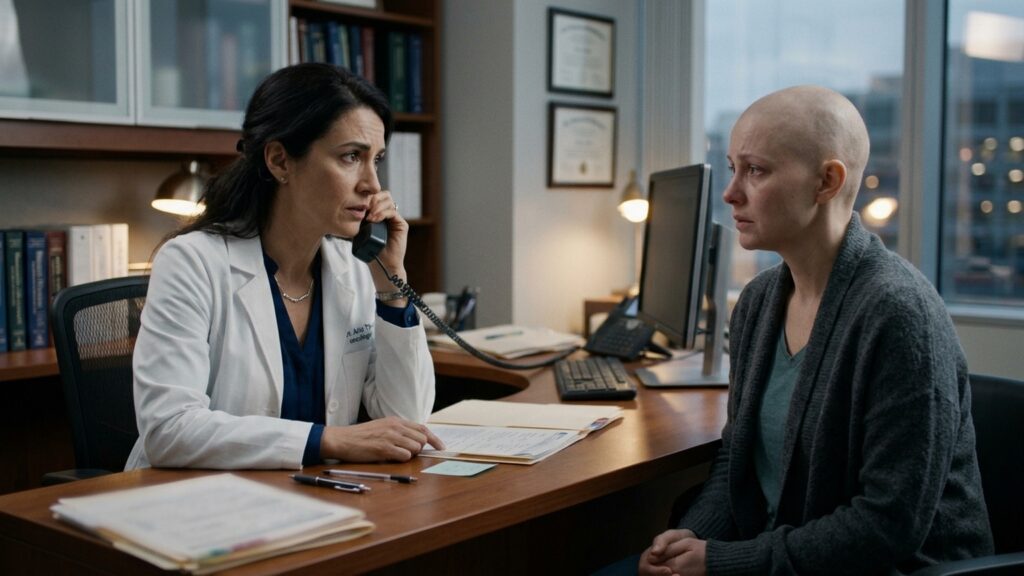
The following morning, before my infusion, I sat across from her in a small conference room.
She opened her laptop.
“Claire, the caller didn’t simply ask about changing your appointment. She claimed you had agreed to postpone treatment.”
Then she showed me the staff member’s written account of Brittany’s final instruction.
Don’t call Claire to confirm. She gets anxious about these things. I’m a nurse, and I’m handling it.
I stared at the words on the screen.
My sister had told a hospital employee not to contact me about my own chemotherapy.
Not because I was unconscious or unable to make decisions.
Because she wanted me available for photographs.
The compliance officer explained that the scheduling employee had refused to change the appointment without my authorization. The hospital was investigating whether Brittany had misrepresented her authority and violated professional expectations by trying to interfere with treatment.
The review wasn’t a criminal trial, and nobody promised she’d lose her license. But her employer took the allegations seriously.
With my consent, the hospital preserved the relevant records and referred its findings for review by the state nursing board.
I left the conference room and went straight upstairs for chemotherapy.
Hannah, my infusion nurse, brought me a warm blanket and a cup of ice water. She noticed my trembling hands as I tried to open the crackers I’d packed.
“Rough morning?” she asked.
I nodded.
She opened the packet for me without another question.
When the infusion started, I watched the clear tubing and thought about how much trust I’d placed in the people caring for me.
Brittany knew that trust. She’d taken the same professional oath to care for patients, protect their dignity, and respect their decisions.
Yet she’d treated my treatment schedule as an inconvenience.
By Friday afternoon, Evan had canceled the elaborate gender reveal. He told relatives they would share the baby’s sex privately and celebrate another time.
Brittany blamed me.
She called seventeen times before I finally blocked her number.
Mom came to my apartment that weekend with a box containing an expensive blonde wig.
“I thought this might make things easier between you,” she said.
I looked at the carefully curled hair beneath the plastic lid.
“Easier for whom?”
Mom began crying.
“Your sister could lose everything.”
I was sitting on the couch beneath a blanket, still nauseated from treatment. Beside me sat the bucket I’d used during the night.
I looked at my mother.
“Last Sunday, you told me not to make everything about my cancer. Today, you’re asking me to make my cancer treatment about Brittany’s career.”
She lowered her eyes.
For once, I didn’t comfort her.
“Mom, I need you to go.”
She left the wig on the coffee table. I donated it unopened several weeks later.
The hospital’s investigation continued. Brittany was placed on administrative leave while her employer reviewed the scheduling contact and her explanations. She eventually lost her position after the review concluded that she’d misused her professional status and attempted to influence care without authorization.
The nursing board conducted its own process over the following months. Brittany received a formal reprimand and was required to complete additional professional ethics education. She retained her license, but the disciplinary finding remained on her record.
None of that made chemotherapy easier.
I still woke some mornings unable to finish breakfast. Some days, even walking from my bedroom to the kitchen left me exhausted.
But I completed the treatment plan my oncology team recommended.
Six months later, my follow-up scans showed encouraging improvement. Dr. Martinez reminded me that continued monitoring was essential, and I listened carefully.
Brittany gave birth to a healthy little girl that autumn.
Evan sent me a photograph, asking whether he could share it. The baby was wrapped in a cream blanket, one tiny hand resting beneath her chin.
I studied her face for a long time.
She hadn’t caused any of this.
I sent a small gift with a note welcoming her into the world. I didn’t attend the family gathering, and I wasn’t ready to see Brittany.
A week later, an envelope arrived.
Inside was a letter from my sister.
She wrote about how frightened she’d been when her employer began investigating. She admitted she’d convinced herself that postponing one treatment couldn’t matter because she wanted the celebration to look perfect.





